Coming Out, Again and Again and Again

I am reposting this today though I wrote it four years ago. Much has changed since then. I was thinking this week how we still aren’t completely free to be ourselves in public. I was on the Oregon Coast and walking down the beach behind what I assumed was a lesbian couple. We were at least a mile from the main beach and far from the public eye on a remote part of the beach before they held hands. They seemed oblivious to my presence a dozen yards behind them, but I couldn’t help wonder what if I had not been me, but someone who didn’t support LGBTQ rights? What if I were a homophobe and emboldened to act out as so many are these days? 

Also, this piece was published in a slightly different version by Ooligan Press in their anthology Untangling the Knot:  Queer Voices on Marriage, Relationships, and Identity

It’s fitting that National Coming Out Day should fall during Mental Health Awareness Week. The two are inextricably linked.

We wore our cowgirl outfits to the wedding, after all the invitation had said country chic and it was being held outdoors in Jackson Hole, Wyoming with the reception to follow in a barn. Me: black cowgirl hat, pointy-toed boots, Western shirt with pearl snaps, bedazzled cowgirl jeans. The Little Woman: ruffled skirt, black cowgirl boots, black Western shirt with longhorns on the shoulders, pearl snaps. We had road-tripped down in our Jeep, all 1600 miles or so, through eastern Washington, eastern Oregon, Idaho, Wyoming. We were excited to see the family, to celebrate with my cousin Brad and his soon-to-be wife Megan.

TLW grabbed my hand when we got out of the Jeep and waited for my brother and his family and my father and his wife to debark from their vehicles and join us as we walked to the front of the (very upscale) barn. I let Nancy hold my hand then, but I could feel that familiar uneasiness creeping in the closer we got to the venue, and when I didn’t immediately see anyone we knew (i.e. members of the family) or anyone else so duded up, I pulled away and dropped her hand.

“So that’s how it’s going to be,” she said. “Really?”

At that moment, self-preservation trumped self awareness. I pretended not to hear and walked a little bit ahead, suddenly flooded with shame and hoping that either the ground would swallow me whole or that a whole posse of cowgirl lesbians might be waiting for us just around the corner. Of course neither happened. Around the corner waited only straight (as far as I could tell) normally attired wedding attendees—maybe a bit more casual than normal wedding attendees, but still, straight, suit jackets, dresses, the occasional cowboy boot. I wanted nothing more than to turn heel and run, to safety, to the familiar, to someone I’ve never been nor will ever be: a taller, thinner, more feminine, more socially acceptable me.It did not matter one whit in that moment that I was surrounded by people who loved and accepted me. It did not matter in that moment of panic that my brother was also wearing a cowboy shirt and cowboy boots and jeans and a cowboy hat. It didn’t matter that I had come out to my family years ago and that TLW and I were as accepted and loved and as much a family unit within the extended family as my straight cousins and aunts and uncles. All that mattered to me was my obvious otherness.

I did not flee. Even when I realized we were 45 minutes early and would have to mingle and make small talk or stand awkwardly with each other and sip the lavender water. I silently cursed the lack of pre-ceremony alcohol and our obsessive punctuality. I talked myself down from that internal ledge and tried to see us as others might. I tried to look at the individuals in the crowd and not at the crowd itself. I feigned interest in the barn and the surrounding grounds, and I eagerly greeted familiar faces as they trickled in. I reminded myself that I was 50 years old, goddammit and beyond (hahahaha) caring what other people thought of me and my life choices. I berated myself into behaving as if I actually believed that.

Eventually, I talked to enough people, had enough wine, ate enough dinner, spent enough time to re-inhabit my body. No one laughed at me. No one made fun of me for being a lesbian. In fact, just the opposite happened. I relaxed and opened up, and TLW and I danced. We danced together, alone, with strangers on the dance floor, and as we danced a funny thing happened: acceptance.

The wedding invitations had included RSVP cards to mail back. Each card asked for a song request, what song would we like them to play at the reception? TLW told me to put down “Same Love” by Macklemore. I seriously doubted that our song would get played—partly because it’s really not a dance song, partly because it’s gay. But wouldn’t you know it—about three quarters of the way through the evening, I heard those notes, grabbed TLW’s hand and pulled her onto the dance floor as I whooped and waved my hands in the air. We were the first ones out there, but not for long. My cousin wrapped us in a huge embrace and thanked us for coming. Strangers and relatives alike joined us on the dance floor in what felt like an enormous celebration of love. Period.

I wish I could bottle the feeling I had at the end of that night, wear it around my neck and sprinkle it over me before I walk into new situations, because coming out isn’t just a one time event. Coming out happens over and over and over again, every day, every week, every month.

Alzheimer’s Sucks

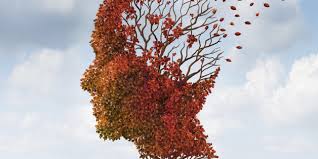
Alzheimer’s disease sucks. Gawd. It sucks on so many levels, I don’t know where to begin. I guess I’ll start with a story, the story of today. My today:

I wake up at 6:20. Before I do anything else, I listen. I strain my ears toward the kitchen and concentrate. Then, wishing I could rotate my ears, catlike, I swivel my head so my ears point toward Mom’s bathroom. Silence. I breathe. I get out of bed, softly walk to the bathroom, pee, do not flush.

I pad carefully to the kitchen to start the coffee maker. I tiptoe back to my bedroom and pluck my phone from the nightstand as I quietly, so very, very quietly, crawl back into bed, phone in hand so I can check Twitter to see a) if The Dumpster resigned b) if North Korea bombed us, and c) how many followers I have. While the coffee brews, I repeat a, b, and c for Facebook, my blog, Instagram, and finally, the more traditional news sources. I check my mail, my calendar, and my messages and then I tiptoe back out to the kitchen for coffee, which has now brewed, and either a smoothie (if I remembered to make it the night before) or a banana. I grab a napkin, and I creep stealth-like back to my room. I listen. So far. So good. I eat my banana, I sip my coffee.

I continue my foray on the Interwebs: I check the local paper, the local paper’s horoscope, the local obituaries, the NYT for the latest Modern Love or Couch column. If I am feeling particularly brave, I might even watch and listen to a video without putting on my ear buds. I sip coffee and eat banana, and while I read, I wait for the coffee to work its magic. When it does, when the banana and the coffee kick in, I head back to the bathroom. I no longer try to be quiet. The jig is up, because as soon as I flush that toilet (this time I have to flush, Febreeze alone is not enough), she’ll awaken and arise. The peace, my peace, short lived as it was, will shatter, and I will not be able to reassemble it, the sharp-edged shards of my peace, until mid-to-late evening. For the next thirteen hours, I am on duty. Double duty.

I go back to my bedroom swiftly, quietly, a thief in my own damn house. I listen, not breathing, craning my ears—is she making breakfast yet? She moves fast once awakened. My running stuff is hanging in the laundry area adjacent to the kitchen, which is adjacent to Mom’s wing, which is visible via a closed set of French doors, and I might be able to get my shorts, t-shirt, toe socks, and sports bra without her seeing me, but the odds are rarely in my favor.

My home is no longer my haven. I will seek peace all day, but not here. Away. I will seek peace on my morning run at Lake Padden. I will look for quiet in my kayak after my run. I will float and read and soak in the sun for as long as I can because inevitably I will need to go home and shower and get on with my day. I have clients to see and classes to attend and questions to answer. So many fucking questions. And Mom will be waiting for me at the front door. She will hear the beep when I lock my Jeep, and she will open the front door.

“How was your day?” she asks. “Have a good run? What are your plans for the day?”

I push past her. “Good. Fine. Read the note Ma. I left you a note on the counter.” I plop my running bag, a gift from my brother, onto the bench in the entryway, kick off my shoes.

“Okay, good,” she smiles. “Mommy was just wondering.” Her voice rises an octave. She talks to me the way one talks to an infant. She totters back to her wing, behind the French doors; she will putter there while I change. I used to strip naked in front of the washing machine and then wander carefree to the shower, but now when I strip off my running clothes, I do it in my room and throw on a t-shirt and a pair of boxers so I can take my sweaty nasty clothes to the washing machine without my mother seeing me naked. Ew.

I change in less than three minutes. Mom meets me at the washing machine. “How was your day?” she asks. “How was your run? What are your plans for the day?”

“The run was good,” I say, breathing deeply through my nose. “Not too many people.” I try to smile her direction. “The jury is still out on how my day will be, though, Ma. It’s only 10:30.” I nod toward the counter at the note I left her before I went running. “I left you a note.”

“Oh,” she hangs her head and scurries back to her side of the French doors.

“Ma,” I call. “Ma, it’s ok. Don’t leave. I just . . . “ My voice trails off as she shuts the door. I can see her sit on her couch and pick up the tv remote.

My heart sinks. I suck. I should be more cheerful, nicer. But every morning it’s exactly the same. Every (mostly). Fucking. Morning. Since. September. The same questions, repeated, ten, fifteen, twenty times an hour. Every hour. All day.

I shower and get dressed. I finished my internship hours a couple of weeks ago, but I still leave the house every day as if I am still going. Coffee shops. Friends’ houses. Breweries. Whole Foods has an amazing happy hour everyday from 4-7. Three dollar pints.

Mom meets me at the front door. “You’re in Seattle today? You have to drive? Is Diane coming to pick me up for group? Is it until 1 o’clock today?”

I sigh. “Did you see the note, Ma? I’m in town at my internship. Diane knows. Yes, it’s at one. I wrote it all down for you. Have a good day.” I muster a malnourished smile as I stand at the door and wait for her to move. She stands in the doorway, unaware that she is in my way.

“Goodness,” her voice goes up an octave, and the baby talk begins again. “Mommy wouldn’t know what to do without you, Pammy Sue.”

Just a note: Hmm. I guess this is the first in a series. Possibly it’s the second in a series. Caregiving for someone with Alzheimer’s or dementia is a very strange adventure. Per my usual MO, I did not come very prepared for the ride and am learning on the fly. I’ve connected with the local Alzheimer’s Society where Mom attends groups three times a week. I am well-connected with services. That’s the easy part. The hard parts are more complex, more nuanced, more opaque. I hope to be as honest as I can here. My intentions are good. I want what is right and good for my mom, but holy shit it is really difficult to figure out what might be best at any given moment. We have entered uncharted waters, Dear Reader. Flotation devices strongly recommended. Buckle up. 

A is for Alzheimer’s

Note: Since it is also National Poetry Writing Month (or NaPoWriMo) in addition to the 2017 A-to-Z Challenge, I will try to include a poem at the end of each blog entry. Today’s poem is a Haibun, a Japanese form in which a prose-poem precedes a haiku. 

My mother only eats off of salad plates, and she will only use a salad fork. When we run out of small plates (we only have six and she will not use the one that doesn’t match the rest, the blue one with stars, the sun, and the moon) and small forks, she tells me it is time to run the dishwasher even though it may contain only her six salad plates and her six salad forks. She does not remember that she can wash the plate and fork by hand. She eats off of small plates and she drinks only tea but her teacup goes in the dishwasher rarely. It is brown with discoloration and stains and sticky from the sugar she ladles into her tea.

Her habit of eating off of the small plates is not new. She has been in the habit of using the salad plates for a long, long time now. It comes, I believe, from years of being monitored by my father for overeating. For as long as I can remember, my father scrutinized my mother’s eating habits. When I was a kid, a teenager, I remember going out for ice cream and my dad making my mom get a diet coke while the rest of us had ice cream cones. Divorced for 16 years, she now eats ice cream right from the container. It’s as if not using a bowl means the ice cream doesn’t count, doesn’t really mean anything, will not invite supervision or scrutiny.

My mom moved in with me in September. My brother and I had been fielding reports from her friends and neighbors for several months in which they outlined her memory declines and odd behaviors. She reported seeing Sasquatch in her back yard a year ago in March. She forgot that she had ever played Farkle, a dice game that she played regularly over the past several years with friends and family. She got lost driving and forgot why she went places, her best friend told us.

I expected she would move in with me last June, but she called and refused. She didn’t want to leave her community or her friends. She had book clubs and garden club and Friends of the Library, she said. I had time last summer, time to orient her to Bellingham, time to sign her up for services, time to drive her to appointments. But she couldn’t quite marshal her resources, became overwhelmed at the monumental task of packing up her house, of sloughing off unnecessary items, of sorting through the detritus. My brother and I showed up last Mother’s Day weekend and hauled a ton of stuff to Goodwill and the dump. We divvied up her Waterford crystal and boxed up the china to be auctioned off on Ebay. I prepared her room in my house, but she didn’t come in June. She didn’t come in July or August either. And when I asked, she told me she was too tired to pack, too overwhelmed to organize the boxes.

Her friends kept calling. She shouldn’t be driving, they said. She tells the same stories over and over, they said. As if I hadn’t noticed that. Each phone call was the same as the last. Each conversation might as well have been a recording of the previous one. She couldn’t muster the energy or wherewithal to travel. She had missed Thanksgiving and Christmas the previous years. She told her friends she hadn’t been invited. She told her children she didn’t feel like traveling. I know now that she couldn’t get organized, couldn’t leave her dog, didn’t know what to do to get ready.

My mother eats off of small plates. She only will use a small fork. Her life is getting smaller. The walls are closing in. On both of us.

Haibun
My mother has become an old woman before my eyes, aging into forgetfulness and dementia, a victim now of ancient routines. She flutters toward the light, safe and trapped simultaneously, unable to escape the confines of what little remains, the walls of her cerebrum wiped smooth, scrubbed of the dust and fluff of daily nuances, the surfaces there papered only in history, teflon to what is new. She hunkers inward, shuttering her blinds, while painting on a brave façade.

Memory’s threads fray,
Ragged edges and patchwork
The mind’s makeshift quilt

Transracial Adoption, Research, and Me

So, I’m on the downhill side of this mental health counseling degree I started three years ago. I can see the light at the end of the tunnel—but before I can emerge victorious from the darkness, I must complete a handful of tasks:

  • First, I must accumulate three hundred hours of direct counseling experience. I am about a quarter of the way there.
  • Then, I must amass a dozen or so hours of direct observation of my counseling skills. I’ve got that covered—no sweat.
  • I must also acquire many hours of supervision, which I am working on and should have little trouble accomplishing.
  • Simultaneously, I need to add about 20 credits to my credit total, six of which will come from the two remaining required classes I must take, Intro to Research and Tests & Measures, eight of which will come from my remaining Case Consult classes, and the rest of which will have to come from a couple of electives.

I am taking Intro to Research now, right this very quarter, and it has me flummoxed. I should not have put it off this long. I should not have waited until I was in internship to take it. I should not have dropped it all those previous quarters when I registered for it. Nope. Bad decisions have come back to bite me in the ass, here Dear Reader. I have no room in my little pea brain for academic articles. I am up to my armpits in counseling clients who have many serious mental health needs, and I am having difficulty wrapping my head around how researching and writing a paper is going to help me be a more effective counselor. It seems an exercise for its own sake, a tuition-generating requirement, if nothing else.

So, while I could not give less of a fuck about this paper in general, I am quite interested in the specific topic I have chosen, which makes me reluctant to simply blow it off. I have decided to research Trauma and Transracial Adoption (TRA). It’s a topic that is near and dear to me, a topic that I neglected to address 27 years ago when I first adopted my oldest daughter, a topic that I am now ashamed to admit that I gave no serious consideration to until just recently.

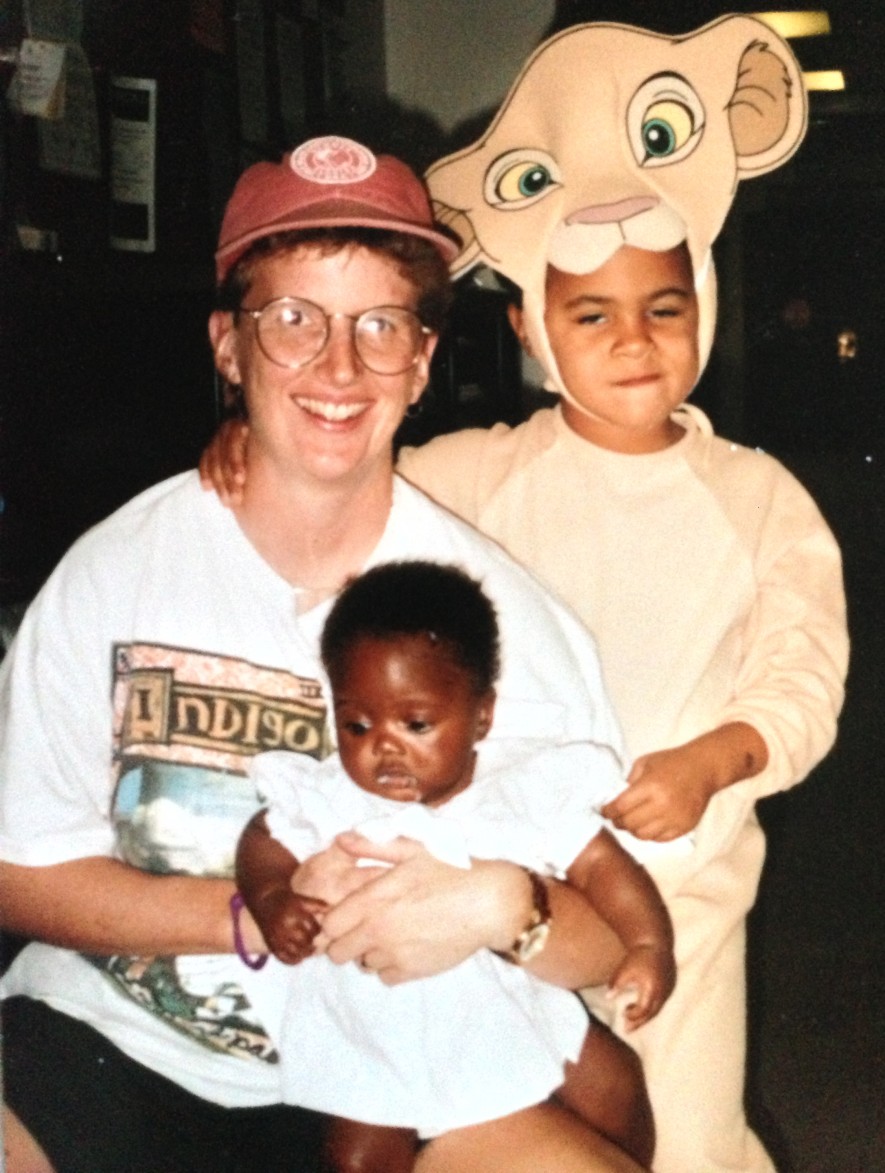
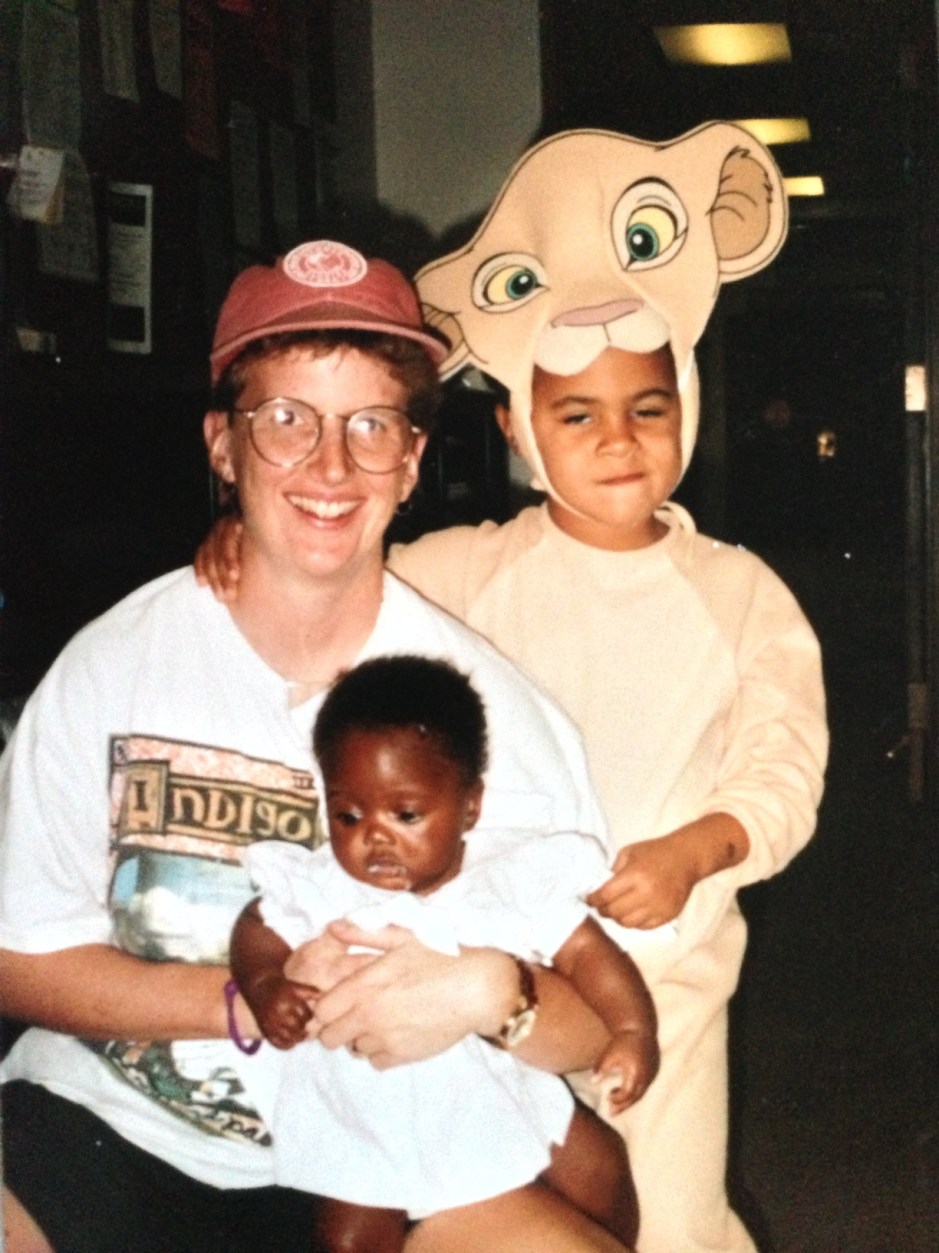
cropped-me_nala_t_halloween941.jpgIt makes sense to me that if adoption is a traumatic experience, that transracial adoption would be even more so. I mean, think about it. How in the world can white people adequately prepare children of color to navigate our racist culture? I know now that our optimism when we adopted our girls was misplaced and the result of white privilege. We didn’t have a clue how steeped in white privilege we were. Of course, when the social workers asked if I would be willing to make sure my kids received information about their cultural heritage, I promised to provide it. Of course, I said. Of course. I will read them books. I will tell them about Martin Luther King, Jr. I will hang pictures of Rosa Parks and celebrate Black History Month. But I had no idea how, 27 years later, my ignorance would affect my girls.

I had no idea. I was so naïve, my friends. So very naïve. I did not imagine all those years ago that race relations would be WORSE in 2017 than they were in 1990. Who among us would have predicted? I had no idea raising two black children in our lovely little liberal bubble Bellingham would not prepare my daughters to live in the greater world as women of color, would not adequately prepare them for future encounters with racists, with white supremacists, with law enforcement officers who would just as soon shoot them dead as ask questions.

I should have known. I should have tried harder. I should have. I should have. I should have. And so now, here I am, trying to figure out what I wish I had known then, what I wish someone had slapped me upside the head with all those years ago: how will being raised in a white family impact an African American child? What will they learn? Who will teach them how to navigate this racist world? How did I contribute, willingly or not, to their marginalization? This is perhaps the toughest question: what was my culpability? Did I collude? Can I admit it?

Admittedly, getting to the place where I can acknowledge my culpability has been tough. When my ex-partner and I adopted our kids, we just wanted children. We did not think beyond our desire to have a baby. She wanted kids, and I was along for the ride. Don’t get me wrong, I love my daughters. I would not trade them for anything. But that love doesn’t mean I don’t have regrets about the way in which we went about the adoption process. I should have steeped myself in Black culture. I should have moved to a city more inhabited by Black people. I should have made an effort to connect my kids to their heritage. I didn’t. I admit it. I took the easy path. I surrendered my responsibilities.

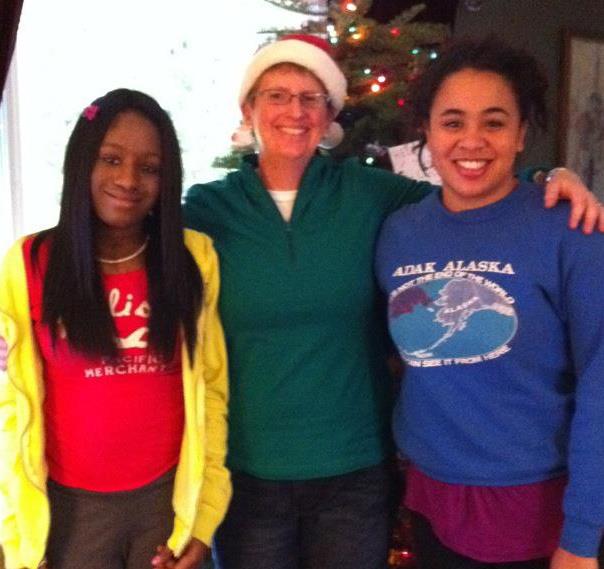
And now, as a sort of atonement, I am writing this research paper. It is not enough, but it is a start.anna and taylor xmas


Becoming a Warrior of the Light & Discovering the Sacred: A Spiritual Autobiography of Sorts

Last week I had to write my Spiritual Autobiography for the Spirituality and Counseling class I’m taking this quarter. This particular assignment scared me a bit. More than a bit. In fact, just thinking about this assignment made me itch. By its very nature, the assignment implied that not only am I in possession of some sort of spirituality, but that I have been for most of my life. I’ve discovered over the past 15 years or so that the word “spiritual” conjures up positive happy feelings for a lot of people, yet there was nothing positive about my early spiritual development. In fact, I did not have a positive spiritual experience until just two years ago at the tender age of 51. Everything spiritual in my life up to that point came from either my parents pushing their religion on me or me trying to accommodate their wishes, or me fleeing from any and everything that even hinted of religion, spirit, or the supernatural. That’s what I have to work with: my own fear and dread regarding spirituality. 

IMG_1478
My Spiritual Autobiography Art Project

Sometimes, we get stuck in our stories, so I decided it was time to change the story. Below is what I ended up turning in as well as an art project I created to go with my paper.

It is time to change the narrative that has been my spiritual autobiography. It is time to rewrite my history from a power stance, from a strength perspective, from the view of a survivor rather than a victim. While my parents filled my formative years (ages 5-22) with radical fundamentalist christianity, and while those tenets and precepts haunted and dogged me for most of my life, I somehow found the courage to follow my own inner voice and at the age of 22 began shedding what held me back. I started to develop an ethos to call my own. I used to say that I spent the years between 22 and 51 avoiding all things that had even the faintest whiff of religious/spiritual energy, but in my reframe, I must say that I spent those years searching for a spirituality that worked for me. And, truth be told, I am still searching. Only in the past two years have I discovered the merest thread of a spirituality that may work, but when I look back, I can now identify the many sacred elements of my life that have been there all along. I just didn’t know that I could shift my definition of sacred to fit my needs. What I once thought to be profane is actually sacred, and much of what I learned early on to be sacred is, in fact, profane.

The bible served as my early foundation, and I learned god was angry, vengeful, wrathful, and to be feared. Scripture seemed to mock my most deeply held personal beliefs—equality, justice, fairness, and the right to love who I wanted. I grew up with a sense that no matter what I did, I would probably end up in hell anyway: if I took communion without all of my sins being forgiven, if I had premarital sex, if I even thought about someone with lust in my heart. If I took the lord’s name in vain. If I read “secular humanism.” If I listened to non-christian music. The world became a place not to be embraced but to be feared, a land fraught with temptation and danger. I couldn’t even love to be in nature because if I loved anything more than I loved god, I was committing an act of idolatry.

Somehow, I managed to hang onto myself just enough so that the summer before I started graduate school (the first time, when I was 22), I began to seek out other perspectives. I started reading those dangerous books and making friends with non-believers, and listening to the still small voice inside that urged me to stand up for what I actually believed, not what I’d been told to believe. I stood at my kitchen sink one morning, washing the dishes and decided in that moment that I could no longer be both true to myself and remain a christian. Christianity had to go. Thus began the journey in which I started collecting my own sacred experiences.

pam_baby anna
Baby Anna and Mommy Pammie

I started dating women. Sacred. I met and had a commitment ceremony with my first long-term partner. Sacred (and a little profane, but that’s another story). We adopted Anna. So sacred. I started therapy and exploring my feelings, wants, needs, and desires. Sacred. I learned I was depressed and began taking a new wonder drug that lifted my fog and allowed me to enjoy the world. We adopted Taylor. Sacred. I learned to stand up for myself and my needs. Sacred. And painful. When my ex had our daughters baptized without my permission after our divorce, I returned to church (I opted for the Unitarians) for the first time in ten years in order to provide my children with an alternative to mainstream religion. Sacred, though I didn’t end up staying long.

I bought a house and set about making it a home for my girls and me, an act that I now see as a step on my path to a personal spirituality. I met and married another woman and we lived and laughed and loved for fifteen years. When same sex marriage became legal, we got married with my children as our witnesses. Our love had finally been recognized and validated as sacred. Much of what we shared was sacred—some of it was struggle, and when it ended, we left each other intact, emotionally, having developed a stronger sense of what was sacred in the other.

Announcing Taylor's adoption
Announcing Taylor’s adoption

During those fifteen years, I did not spend much time thinking about my spirituality or my soul or the sacred. From my vantage point now, I can see that I did continue to cultivate and sharpen my own sense of sacredness, however. I spent eight of those years working with for a Catholic elementary school, and I came to understand, perhaps for the first time, that not all who are religious are judgmental and/or narrow-minded. At Sacred Heart, I learned that the individuals in a religion could hold different values than the institution itself, and that community more than religion or dogma is what compelled most people to attend that church.

Also while working for the Catholics, I realized that I needed to start taking my body more seriously, that it was in fact sacred, and necessary to a healthy long life. I started working out, and found a connection with others, sacred bonds of friendship, which, for me, represented the spiritual connections with others I craved. Eventually, after I left the Catholics, I started running and found whole new worlds of spirituality open up. More connections and new friends, time in nature, the dawning awareness that my body really is a miracle in its own right. I started my runs (especially the more challenging runs) with a meditation: “I am thankful for my feet. I am thankful for my legs. I am thankful for my lungs and my heart. I am grateful for the time to run and for the money I have to buy shoes and running clothes. I am thankful I live here where I can run on trails instead of sidewalks.” By the time I got through my meditation, I forgot that running hurts.

Before I started running, I generally felt as if I were living two lives, and I often said in therapy that I needed to pull my circles into alignment. One circle represented the me I wanted others to see, and the other circle represented what I did that I wouldn’t want others to see, probably the real me. As running became paramount in my life, I began treating my running time as sacred, inviolate. Pargament (our text book author) writes that when we discover the sacred, our sense of fragmentation dissipates and the sacred becomes a passion and a priority.

As running began taking over my life, I began to wonder if it might not be time to stop taking the Wonder Drug, if it wasn’t maybe masking my (normal) responses to a difficult world. I found the new clarity to be sacred, and I redoubled my efforts in therapy to seek enlightenment, a search which led me to body work: massage, acupuncture, breath work. And on the massage table I had what can truly be described as my first encounter with The Divine. My massage therapist always finished our sessions with a blessing, her hands on my head, channeling love and oneness (that’s what she said, I just figured it was a nice way to signal the end of my session). This time, however, she stood at the head of the table, her hands hovering over my hair, and I could feel a new and different energy fill me up, a surge and a tingling from my scalp to my toes. She stood there for a good ten to fifteen minutes while something or some being left her and entered me.

Once I dressed and asked her what had happened, she just laughed and said, “You’ll have to ask Spirit.”

I wrote a haiku (that’s another sacred thing in my life: writing) to commemorate the event:

She laid hands on me
Channeled a Divine spirit–
Broke through to my Soul

That encounter with Spirit (or whatever/whomever) on the massage table served as a breakthrough of sorts, or at least it opened me up to the possibility of a spirituality absent of religion and a sense of The Divine unattached to the particular form of god on which I was raised. I felt pure love. And though my skepticism wasn’t completely eradicated, that experience gave me permission to explore my spirituality in ways I didn’t ever think I would want to. I now attend what I call Not Church, the local Bellingham Center for Spiritual Living, on a somewhat regular basis. They offer a 9:30 a.m. service in which there is no music and no singing, no “meet and greet your neighbor,” all things from traditional church services that tend to make me anxious. We end with a 10-15 minute meditation.

I’ve dabbled in meditation and mindfulness. Both sacred experience, and in the process, I’ve sort of fallen in love with Buddhism—the sacredness in not grasping, in letting go, in silence, in pausing. I feel as if these past two years have made up for a lifetime of ignoring my spiritual life, and if I were to describe myself spiritually, I would have to say that I am becoming a Warrior of the Light, as described by Paulo Coelho:Warrior of the Light

K is for Karma, or Newton’s Third Law of Physics, or Comeuppance if you’re not particularly Buddhist or Scienc-y

KKarma is the Buddhist notion of moral causation, the idea that we all get what we deserve in this lifetime based on what we’ve done in previous lifetimes. It’s an interesting thought—and one that explains the discrepancies in fortune along the human spectrum, i.e. why some of us suffer and others don’t.

Whenever I ponder karma, I think of Newton’s third law of physics: For every action, there is an equal and opposite reaction. I don’t know why—I’m not much of a scientist, but that’s what comes to mind. Also, the law of the conservation of mass—that mass is neither created nor destroyed but remains constant over time. If science can have these sorts of intractable laws, why not the human condition?karma_dominoes

Last summer I had an encounter with a spiritual advisor of sorts—a seer, a psychic, someone who purported to see into my past lifetimes. Her instructions before our meeting were that I should come with seven questions about my life. To be honest, the timing wasn’t very good. Immediately after our session I had an appointment at the lawyer’s office to sign my final divorce papers.

Anyway, I asked her about my writing and she waxed on for a bit, but didn’t really tell me anything I didn’t know, or anything I wanted to hear, as in nothing about my memoir writing itself and making the NYT bestseller list. So, I waved her off and asked my next question: What is up with the pain in my body?

I’d been experiencing a strange array of symptoms in my shoulder, liver, back, arms, and feet. But it was the weird sensation in my shoulder that caused me the most grief and discomfort. I expected an alien to pop out at any time. My physical therapist determined it was nerve pain, an assertion backed up by MRIs. Various massage therapists told me I needed to breathe more deeply or explained that I had steel cables running down my spine instead of the expected flat ribbons of muscle. The psychic consulted my Akashic records. Initially she reported that she couldn’t see anything—my records were blank, or, perhaps, closed.

Why would my records be closed, I asked, having absolutely no idea what an Akashic record even was, but imagining a very large filing cabinet in the sky. She replied that I might not be ready to see them, that whatever information they held might prove to be too much for me. Well, ask again, I admonished. I’ll be fine. So she asked again—and this time, after a few minutes with her eyes closed, told me a story.

“Do you have much experience with betrayal?” she asked.

I rolled my eyes. “Let me count the ways,” I said. “More than my fair share.”

karma_next tattooShe nodded. “The pain you feel in your back is the pain of betrayal, of your heart being broken. Of being stabbed in the back, metaphorically speaking.” And she went on to tell me a story.

Evidently, many, many, many lifetimes ago, I was a gay man with a devoted lover. We were very close, very respected in our community. We worked together as builders and architects. I thought we were happy and committed, but then I found out my lover was having an affair. My world crumbled then, and I never recovered. Three thousand years and many lifetimes later, she told me, I am still searching for that kind of love, trying to recreate that relationship.

Her words rang true. I’d never before heard of Akashic records. I’d never given much credence to past lives, though I tried to keep an open mind about such things. I felt the pain in my back more acutely at that moment and pushed away from the table, looking at my watch.

“I’ve gotta go,” I said. “Got an appointment.”

I thanked her and stumbled out into the sunshine and made my way to the lawyer’s office nearby. As I walked through the bright and warm summer day, I replayed in my mind every betrayal I had experienced in my 52 years. The ache behind my shoulder thrummed more intensely as each one sprung to mind. Had I really been trying to recreate this perfect relationship from millennia ago? Would I ever be rid of the pain? Did I even believe in Akashic records? Did it matter?

What I know is that her words rang true. What she said made sense to me on some deep, previously unexplored level. There’s so much we don’t know, so much we can’t see, so much happening beneath and beyond consciousness. Is karma real? I don’t know, but it feels like it might be.

C is for Counseling, or How I Got into this New Gig


CTurns out that April is Counseling Awareness Month. Isn’t this just a serendipitous turn of events? I’m writing a blog a day, A to Z about my adventures as a graduate student in Mental Health Counseling and the American Counseling Association is making it a special month. Pretty sure I can’t take credit, but still . . . (maybe tomorrow I’ll tackle Delusional and Diagnosis).

I have a long history with counseling. I started seeing a psychologist in 1992 and have been in therapy of some sort consistently since then. For a long time, I thought of myself as having a serious character defect. I was young. I didn’t really understand how counseling worked, or could work. I had only a vague notion of Freud and his couch and Woody Allen’s neuroses.

Prozac and SSRIs hit the market about the time I began therapy* and not long after my psychologist diagnosed me with depression, she and my general practitioner agreed I would do well to try the new wonder-drug, Prozac. And, honestly, I looked forward to some relief. At 29, in 1992, I was a fairly new mom of an adopted bi-racial daughter, in a relationship with a woman 13 years my senior. I had just sold the bookstore I started, owned, and operated for three years, and I had moved back home full-time after living 90 miles away for most of each week. To complicate things, my fundamentalist Christian parents were only just beginning to adjust to my, er, lifestyle (as we called it then) and its unconventionality.

There’s more, but that’s enough. You get the idea. I was a stress monster. The crinkling of a tissue set my teeth on edge. The noise of someone actually blowing their nose sent me over the edge. The first time I swallowed one of those little green and white pills, I felt like I was taking communion. I crossed myself and sent up a prayer.rumi

After four weeks of taking that precious little capsule every morning, I no longer cared who sneezed or how loud. Irritation rolled off my back. The grey veil that separated me from the rest of the world lifted, and I started seeing in color again. Cliché, I know, but accurate. Everything sparkled. I got a good job as the bookstore manager at the local technical college with a great boss as well as health and retirement benefits. Did the little pill have anything to do with my new job? I believe happier, less-stressed, less-depressed people tend to have more self-confidence and do better in job interviews, so yes. But I digress.

I felt good, and I loved talking to my therapist. I loved paying someone to listen to me. I loved the 50 minutes of uninterrupted attention. I could do this for a living, I thought. I’d love to listen to people’s stories, to help them make sense of their feelings, to help them gain the confidence to reach for their high dreams. I had no idea that someone who went to counseling could actually ever become a counselor. I thought my diagnosis and being on meds precluded me ever being in the field.

I had never heard of Jung’s Wounded Healer. I was an English major who, stupidly and stubbornly, avoided all social science classes. The books cost too much. The classes met on Fridays. What can I say?

I wanted to get off the meds, though, yet every time I quit taking them, things in my life would head south, and the psychologist would exhort me to stay on the meds. I got stuck in a loop and never really got to the issues that were causing me to become depressed. I’d just start popping the pills again, and things would improve. Etc.

franklquoteI spent about twenty years with the psychologist before I found a new therapist, and the woman I chose to see was an LMHC (Licensed Mental Health Counselor). I didn’t know what the difference was when I made the switch, I was just seeking someone a little more flexible and spiritual, a little less dogmatic and not so pharmacologically oriented. Turns out the switch worked very well for me then. I made several changes in my life at the same time: I got a new job, I relocated, I started taking writing classes and running, and found new community with both activities.

The psychologist got me up and out of the depression and quite literally saved my life on many occasions. And the LMHC has helped me move forward from there, developing self-confidence, practicing mindfulness, introducing me to non-Western philosophies. I have learned so much about myself, about why I am the way I am, and how I can move forward.

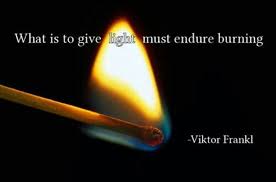
I’ll never be done working on myself, but it turns out, I can become a counselor anyway, not in spite of my past, but because of it. Jung believed that disease of the soul could be the best possible form of training for a healer. And as Victor Frankl wrote, “What is to give light must endure burning.” By these measures, I am perfect for this job.

*for a more in-depth—but still inadequate—explanation of the differences among therapy, counseling, psychotherapy, and psychology see this previous blog

A is for Ack! It’s April Already and I am Anxious

AI can’t believe I haven’t finished my first blog for the A to Z challenge yet. I’ve been thinking about it for weeks, planning, scheming, writing it in my head, but clearly I’ve not put any words down yet. Until now. These few, uninspired, last minute words that seem so unequal to the task, so small and worthless and hurried.
A is for Apology, apparently. Abject. Abysmal. But I’m at AWP this week, a conference all about writing, and so, apology or not, abysmal or not, tired or not, write I must.

I am going to write about Anxiety. My plan for this year’s A-to-Z Challenge is thus: I want to spend this month writing about my experiences as a student in the Clinical Mental Health Counselor Program at Antioch University. I want to weave together a narrative, exploring the concepts (from A to Z) that I study as a student of mental health counseling and how my studies intersect with my life. How my coursework shows up in my day-to-day world.

I haven’t studied Anxiety, per se. I have taken many relevant classes, delved into the DSM 5 and learned how I might diagnose a client who presented with symptoms that fit the criteria for, say,  Generalized Anxiety Disorder (GAD). I learned to write a treatment plan and theorized about which therapeutic modality I might employ to best help my client regain his or her equilibrium.

Most of what I’ve learned about Anxiety comes from first hand experience. I am not one who has been plagued with Anxiety for much of my life. No, my familiarity with this particular demon has only been recent and is one of the reasons I started running regularly a little over two years ago.

I started waking up in the mornings with a pit of dread churning in my stomach and found that if I went for a run, somewhere around mile two or three, the pit of dread loosened and eventually abated. I guess the endorphins kicked in, the oxytocin released, and the runner’s euphoria lifted the anxiety. Cured, if only temporarily, I could get on with my day. The next morning, the anxiety would return, and I’d start over. Run. Rinse. Repeat.

A nice side benefit to running off all my anxiety was that I started to lose weight. I felt healthier. My blood pressure dropped, as did my cholesterol, and my pants size. But, I digress. I still woke up most mornings feeling like something horrible was about to happen. I kept waiting for the other shoe to drop, for the axe to fall, for the bottom to drop out, for . . . well, you get the picture.

Anxiety chased me into my running clothes and out of the house each morning. But the thing about being a graduate student in a counseling program is that these sort of disruptions don’t slip by unanalyzed. While one part of me succumbed to the anxiety, another part of my tapped my forefinger thoughtfully against my chin  and asked, “How do you feel about this, Pam Sue?”

Some people have angels and demons sitting on their shoulders. I now have Sigmund Freud and Carl Jung, or their modern day equivalents, Jack Cornfield and Tara Brach. I can have a panic attack and simultaneously know for certain that while what I am experiencing might feel real, it isn’t true.

It’s weird, living with this meta awareness. I had all sorts of anxiety about traveling to AWP this week–logistical stuff that I know I’m capable of handling but for whatever reason just kept spinning on: how am I going to get to Sea-Tac from Bellingham? To the airbnb from LAX? I can’t check in until 4 p.m., but I arrive at 9 in the morning. What would I do? These questions dogged me for weeks. I envisioned myself in dire circumstances, dragging my carryon around LA for hours, sad and alone and dazed.  Yet, I simultaneously knew my fears were unfounded and not based in reality. I could make a shuttle reservation, find a friend to stay with in Seattle, even one who might take me to the airport. I just couldn’t see the logical steps in the midst of my anxiety.

Something similar happened when I realized how expensive it was going to be to eat and drink here in Los Angeles. The first day I spent way too much money on so-so food and paid $8 for a mediocre beer. So, I took myself to the grocery store, but instead of going shopping at the end of the day, when the conference was over, I went in the morning on my way to the conference and so had to schlep my groceries around the conference hall, from one panel discussion to another.

I was so anxious about not having drinking water back at the airbnb that night, I bought a six pack of bottled water and stuck it in my already heavy backpack. All the while I’m hearing Jack and Tara on my shoulders, telling me not to believe the anxiety, reassuring me that all will be well, that I will be fine, that there will be water at the conference. That the universe will provide.  But, do I listen? No. I buy the water. And I vow to do better tomorrow.


Writing Trouble: A Few Words on Distractions and Truth Telling

Every writer I know has trouble writing. —Joseph Heller

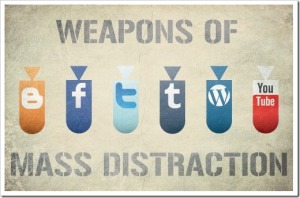
Nearly every night I sit down with my laptop and open it to a blank Word document, convinced that this is the night I will begin my masterpiece, my opus, my version of the Great American Novel. And then I get distracted: laundry, dinner, cats, a funny lump behind my earlobe, the stupid TwoDots game on my phone. Words with Friends. Something. Anything to keep me from putting my thoughts down. There are a million things I will do before I finally succumb to that little voice, that growing voice, that roaring voice, the one that pushes and pulses behind my eyeballs, that makes my heart pound faster. I have to, at some point, listen to that voice, give in to that voice or I will explode. Maya Angelou is credited with saying that there is no greater agony than bearing an untold story inside. I agree.homework

Another trouble with writing, with being a writer, particularly if one is a writer of nonfiction, memoir, creative nonfiction, is that telling the truth, or our version of the truth, is bound to offend someone. Probably we will offend someone close to us, a family member, a good friend. And we may throw lots of other folks under the bus—there’s an entire cast of characters from which we can choose: teachers, grandparents, doctors, lawyers, therapists, the barista who forgot your regular order. The waiter who seated you near the kitchen. Really. This is an endless list.

And there are so many reasons we need to keep the peace with all of these folks. We need them to like us. And, what we often forget is that the chances of anyone actually reading what we write is slim. Oh sure, our writing group might, and a teacher, if we’re in school. But Grandma? Uncle Ed? The barista? Not likely. So, really, this is not a good excuse to suppress the urge to write.

Never mind the friends and relatives, though. When I think about writing, about what I want to write, an overwhelming sense of responsibility immobilizes me. I can’t write anything frivolous, I tell myself. What I write should be Serious. And Thoughtful. Well considered. And I should have read as much as possible on the topic. I don’t want to offend anyone. What I write should have a moral, a takeaway, but subtly. I don’t want to be too didactic. My prose should be poetic and authentic. My metaphors had better be spot on. My grammar and punctuation, impeccable. Most importantly, I don’t want to be misunderstood.

mass-distraction-rrv33nNo wonder I freeze up. No wonder I’d rather play gin rummy on my iPad.

But no more. This year I resolve to write the stories. And if you happen to be a character in my life, oh well.

You’ve been warned.

Makeup Beauty Doll and Other Problems with White Privilege

Reposting, again. It’s been two years since I last posted this and many years since I wrote it. It’s still relevant.

Pam's avatarPamela Helberg

Many years ago, flummoxed by the joys and perils of raising two non-white children in our predominantly white culture, I wrote an essay expressing my doubts and fears, and (surprising to me now) my certainties (you will recognize them when you see them). Some of what I wrote makes sense and some of it clearly needs rethinking. Yesterday on the day we celebrate Martin Luther King, Jr., my eldest daughter, now 23, texted me (this is how we communicate these days). She was wondering if I thought it odd that the company for which she now works didn’t celebrate the national holiday. I do find it odd, odd that only governments and banks shut down on this Monday when the world grinds to a halt, more or less, for other national holidays: Christmas, Thanksgiving, Memorial Day, the 4th of July.

My initial response to her was yes, MLK day…

View original post 1,182 more words