L is for Listening, or Oh? How Do You Feel About That?

LI can’t think of anything better than having a conversation with someone and really being heard. Walking away from an intimate exchange with another human being and leaving with that warm, fuzzy feeling that not only did that person give me the time and the space to express what was on my mind, but they really listened to me.

How do I know if someone has listened? Well, they reflect back to me what they heard me say. They ask questions related to what I’ve said, and they engage in active listening skills—nodding when appropriate, making sympathetic noises, maybe reaching out to touch my arm, hand, or leg in empathy and understanding. I had a therapist once who would get teary-eyed when I told a particularly poignant story about my child custody struggles. Her tears made me feel heard and validated.

One of the most challenging aspects of training to become a therapist has been learning to listen in a way that will help my clients not only feel heard, but helped, assisted, valued, and worthy. I remember when I used to think that being a therapist would be so easy—how hard could it be to sit and listen to people all day, throwing out only the occasional, “how does that make you feel?”

I didn't have a happy childhood, I was often misquoted.
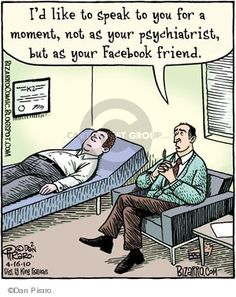
I didn’t have a happy childhood, I was often misquoted.

Ha. If only. At school we practice on each other quite a bit. I’ve listened to my fellow students in nearly all of my classes thus far, learning to hone my listening skills, learning to take in what they say and ask relevant, useful, insightful questions in an effort to help them move forward. It’s not easy. There’s so much to hold in my head and pay attention to. Details to notice. Key words to focus in on. Facts to track.

We’re learning not how to give advice, but how to ask good questions, open-ended questions, questions that will encourage our clients to explore their feelings. For example, if a client were to tell me they’re anxious about a weekend outing with their partner and the partner’s family, what might I say in order to help the client better understand and deal with the anxiety?

If I were practicing gestalt, I might ask where in the body the client feels the anxiety and if they could talk to it, what might they say? What would the anxiety say? What does the anxiety look like? What color is it? How big is it?

If I were practicing narrative therapy, I might ask the client to give the anxiety a name and to imagine a world in which the anxiety no longer existed. What would that world look like? I’d ask the client to tell me about a time they didn’t experience the anxiety and ask them what was different about that time.peanuts-cartoon-about-listening

I have so many theories and approaches rattling around in my head, sometimes I think it might explode. What theory to use? What words to zero in on? And then, in one class, the instructor told us to not work harder than the client. And, yes, that makes sense, but oy vey.

The best approach might be Carl Roger’s—he believed that the therapist should always give the client unconditional positive regard. His approach, Person Centered Therapy, came in response to psychoanalytical models popular at the turn of the last century. He believed the therapist should be warm, genuine, and understanding.

He said, “It is that the individual has within himself or herself vast resources for self-understanding, for altering his or her self-concept, attitudes and self-directed behavior – and that these resources can be tapped if only a definable climate of facilitative psychological attitudes can be provided.”

I no longer think that being a therapist will be an easy job—in fact, I’m pretty sure it will prove to be one of the more difficult I take on. Listening to people, actually hearing them and reflecting back what I’ve heard, will take practice, time, and focus. I can’t afford to space out or daydream halfway through a session.

Maybe Stephen Covey said it best: “Most people don’t listen with the intent to understand; they listen with the intent to reply.”

My success as a counselor will not be measured by what I have to say, but in how much I understand.


J is for Just Do It

J

Whatever it is that you want to do, just go for it. Do it. Move. Take action. Stop talking about it and take that first step. Yesterday in my Trauma, Disaster, and Crisis Counseling class, we watched a video about the Oso landslide. We talked about the September 11 terrorist attacks, and Brussels, Paris, Turkey, Pakistan.

The take away from all of this? Life is short. Unexpected shit happens. Don’t put off until tomorrow (or someday) what you want to do now. Don’t listen to the naysayers, especially the one that is usually the loudest, the one in your own head that says “you’re too old, too broke, too tired, too fat, too busy, too whatever.”

No one is going to intervene on your behalf to suddenly make your dreams come true–or usually that is not the case. If you want to write a book, you’re going to have to sit down and write. Want to run a marathon? Gonna have to get out there and train. Have the urge to see the world? You must book the tickets.

I know taking that first step isn’t easy–if it were we would all be out there living our dreams, and I would have no justification for pursuing my dream of becoming a therapist–no one would need me if everyone just did what they wanted to do. But we don’t. We don’t just do it when we want to make positive changes, nor do we just stop doing the things that make us miserable. This Bob Newhart video is a classic and one of my favorites. If only it were this simple!neuralpathways

Instead we take the path of least resistance, living the status quo, afraid to rock the boat or upset the delicate balance. We live in fear, unable to extricate ourselves from what seem to be proscribed paths.

And, it’s not our fault. We are creatures of habit. We get used to doing things a certain way, and our brains form neural pathways, well-worn grooves that make our responses and actions more automatic. If we’ve developed a habit of getting up every morning and reading the news on the interwebs but what we really want to do is develop a morning meditation practice, we’re going to have to work at it. We’ll have to focus on retraining our brains to not reach for the laptop or the smartphone. Just like walking in the woods–it’s a lot easier to take the defined path than it is to bushwhack through the underbrush to get to our destination.

The good news is that we can build new pathways. Our brains can rewire, thanks to neuroplasticity.

It takes effort to forge new trails, but if the old paths don’t lead to where we want to go, we have to get out our machetes and go for it.

F is for FOO


FWe would-be counselors all must take FOO (Family of Origin) before we take any other coursework in my graduate program. This class is the one in which we must sort through all of our personal Family Issues before we move on to counsel others. The idea, I suppose, is that we get our own stuff out of the way, but I’m not convinced we can do much with our FOO issues in 10 weeks. However, at 52, I definitely had an advantage over most of my younger classmates. I’d been working on FOO issues for decades.

Sitting in FOO for three hours every week was like attending group therapy—everybody cried, and I felt like I had one of the least traumatic childhoods of all. Some people had seriously mentally ill parents; others were abused by siblings, and still others grew up in remote, poverty stricken areas and no services for hundreds of miles. My heart ached for many of my classmates who still struggled mightily with their families.

Obviously, our parents leave a lasting impact on us, but one of the more fascinating aspects of FOO was how the same behavioral patterns played out over generations. Even when each generation may not even know much about previous generations. In one family, every generation included a pregnant 16 year old. How does that happen? How do we inherit such specific behaviors from our ancestors?gabor mate

Epigenetics. The research is fascinating. We inherit memories, behaviors, trauma. A 2013 article from the online Discover Magazine explains it thusly: According to the new insights of behavioral epigenetics, traumatic experiences in our past, or in our recent ancestors’ past, leave molecular scars adhering to our DNA. Jews whose great-grandparents were chased from their Russian shtetls; Chinese whose grandparents lived through the ravages of the Cultural Revolution; young immigrants from Africa whose parents survived massacres; adults of every ethnicity who grew up with alcoholic or abusive parents — all carry with them more than just memories.

Wild, yes? I find it all so fascinating. As the adoptive parent of two children, as the child of a mother who was adopted, and the sister of an adopted brother, I am well aware that more is at work in our development than simply what we experience. We are  complex beings, bundles of history and experiences that are not even our own. We are more than half mom and half dad, but carry in our very essence not just the physical traits of our foremothers and forefathers, but their memories, traumas, victories, and defeats.

I guess that’s one thing about becoming a therapist that I so look forward to—exploring with clients how they came to these difficult places in life and working with them to make positive changes. Not only will they change their own lives, but they have the power to make life better for future generations.

E is for (what else?) Ethics


EDon’t have sex with your clients. Just. Don’t.

Washington State law forbids it and even goes so far as to outlaw intimate relationships with former clients. Forever. The American Counseling Association (ACA), in section A.5 of its 2014 Code of Ethics prohibits sex with current clients as well, as do all of the other professional organizations, but they don’t put a complete ban on sexual relationships with former clients forever, instead imposing a five year moratorium on sex with former clients.

And still. Therapists have the dubious distinction of being disciplined most often for violating this particular ethical code. In fact, they (we) outpace all other helping professions in this area, leaving lawyers, doctors, and even massage therapists in the dust.mother

But say your aspirational ethics around this issue are intact. Say you are really clear that you would never, ever engage in a sexual relationship with a client or former client, or with their family members. There are still a thousand different ways to violate client trust or for a counseling relationship to go off the rails.

The ACA’s code of ethics state that the primary responsibility of the counselor is to respect the dignity and promote the welfare of the clients (Section A.1). The document goes on to say that counselors must act in such a way as to avoid harming their clients (Section A.4). It’s a lot like the Hippocratic Oath: First, do no harm.

But what causes harm, exactly?

Consider the following scenario (borrowed from my Ethics textbook): You are the only counselor in a small town. Another therapist is a two-hour drive away. When you moved here, you became good friends with the school principal, and her son and your son are best friends. She asks if you would see her son professionally. His grades are slipping. He has started acting out at home. He’s defiant and surly. She doesn’t have time to drive two hours each way to take him to a different therapist. Could you just talk to him a few times? You want to help.

What to do? What to do? What could possibly go wrong?

How about this situation: You’re seeing a client who is a writer. You, too, dabble in the written arts. The client mentions his blog during a session, and as soon as he leaves you Google his name, find his blog, and settle in to read it. Your curiosity piqued, you search for him on Facebook. Research, you tell yourself. What you find out will help you understand him better. The next time he comes in you say, “Great blog! I have one too. You should check it out. And if you have any feedback on my writing, I’d love to hear it.”

ethics cartoonWhat’s wrong here? Why not bond with a client over a shared passion? Maybe trade a few sessions for a critique of the novel you’ve been working on. After all, the writer doesn’t have a surplus of cash. It would be a win-win. Right?

No. To borrow a phrase from Cheryl Strayed’s book of quotes Brave Enough: “The short answer is No. The long answer is No.”

You are the therapist. He is the client. It is a one-way street. You must consider all the ways in which your actions could possibly harm the client. You are not friends, buddies, colleagues. You are the keeper of deep secrets, a confidant, a compassionate listener, a mirror. Just in asking, you’ve violated the trust implicit in the counseling relationship. And the client is paying you for a service. Asking for a personal favor, for feedback places an extra burden on the client, a burden he did not sign up for.

Okay. One more. How about this? You are seeing a client who struggles with self-esteem, with feeling heard and being seen. She shares with you some of the poetry she has written. You tell her it is beautiful and moving and wonderful. You email her a couple of poems from your favorite poets and hope they resonate with her the way the do with you. She sends you more of her poetry. It really is beautiful, full of amazing metaphors and gorgeous imagery. You tell her as much. She should be published, you say. She glows in your effusive praise.

What? Is there a problem?

The short answer is Yes. The long answer is Yes. Now the client is seen. Now the client is heard. But by you. Instead of helping her gather her inner resources and find her intrinsic value, you’ve taken a short cut. Basically, you have given her the needle and the spoon and pushed the plunger down, mainlining self-esteem. You are now her source, her dealer, her heroin. Congratulations, you’ve created an addict.boundary issues

There are so many other things to consider here as well. What is poetry? Who sends poems? Poetry is the language of love. People in love send poetry. Poetry is metaphor—a word can have a thousand meanings in a poem. What you read and what the client meant might be vastly different.

What would an ethical counselor do in any of these situations? And why? An ethical counselor must always consider the needs of the clients first. In some respects, a therapist has to see the future and ask herself, “How will my actions and words now impact my client down the road?” “Will I be helping or hurting my client by taking this action?” “What is my motivation?” “Am I getting my own needs met or am I meeting my client’s needs?”

Instead of praising a client’s poetry, ask them what writing poetry does for them? What do they get when they create? How do they feel when they are writing? What’s their process? Explore. Ask questions. Help the client find her own meaning in her work.

I could write for days on this topic. But the bottom line is this: There is a power differential in the therapeutic relationship. The ethical therapist uses her power for the good of the client. Never for herself.

And I’d love to hear your thoughts on the scenarios I’ve presented. What could possibly go wrong in each of these situations? Let me know what you think!

D is for Distal Contextual Affordances (ha ha, just kidding). D is for Diagnosis and DSM 5

Each quarter, as I take new classes and learn new material, I analyze and diagnose myself accordingly. I generally text a friend of mine who is a marriage and family therapist (MFT) during class. Our exchange goes something like this:

Me: OMG, I so have this.
MFT: what?
Me: I wasn’t properly attuned to as a baby. That’s why I’m so fucked up.
MFT: gawd
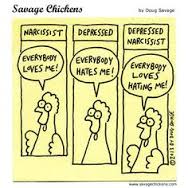
Me: well, it could be that or it could be that I experienced a trauma as an infant.narcissist chicken
MFT: maybe
Me: I was dropped on my head once.
MFT: well, that explains it.
Me: I know, right?
MFT: it’s just one lens, Pam. A theory.
Me: oh. Sorry for being so narcissistic.
MFT: You’re not a narcissist.
Me: borderline?
MFT: ugh.

And so it goes. Each quarter I learn new and fascinating ways to make sense of human behavior.

A few years ago, when I began working on my memoir, I asked my (by then former) psychologist if I could have access to my records. I wanted to reconstruct a timeline of events and double-check my memories. Since she had seen me through some of my darkest hours I figured I would find a good record of events that I had been too depressed and distraught to remember. And I did. But I also discovered how I had been diagnosed, and I found it all a bit unsettling to see the DSM codes next to the list of my symptoms.

If you read yesterday’s blog, Dear Reader, you know that I was depressed. So it came as no surprise when I decoded the DSM codes to find variations on that theme: major depressive disorder, recurrent episode; major depressive disorder, recurrent episode in partial remission; major depressive disorder, severe. And so on. I was fine with these diagnoses and also with the occasional Adjustment Disorder diagnosis that I found. I knew enough by then to know that when a mental health provider doesn’t know what else to use, when a client just needs to chat a bit to clear things up, they use the somewhat ambiguous 309.9 (Adjustment Disorder, Unspecified).

Diagnosing someone with an illness or disorder that appears in the DSM 5 is an art, not a hard science. This latest version of the Diagnostic and Statistical Manual is arranged quite differently from its predecessors with disorders arranged according to lifespan. So, disorders that affect children come first—neurodevelopmental disorders, followed by illnesses that appear in adolescence and early adulthood: schizophrenia and psychosis, depression, anxiety, OCD. These are followed by trauma related disorders, dissociative disorders, somatic (body disorders), feeding and eating disorders, elimination disorders, sexual dysfunctions, substance abuse issues, personality disorders, and paraphilia.

Gone are Axis I, II, III, IV, and V. Used to be that the most acute and familiar disorders—those requiring immediate attention fell under Axis I: schizophrenia, major depressive disorder, panic attacks; ongoing personality issues—narcissism, borderline personality disorder, intellectual disabilities, obsessive/compulsive disorder—fell under Axis II. Axis III was reserved for related medical conditions such as terminal cancer, which might contribute to a client’s depression. Axis IV diagnoses included life events: marriage, job loss, promotions, divorce, death of a parent or child, and Axis V is used for the Global Assessment of Functioning Scale, a 100 point questionnaire evaluating the client’s ability to function in daily life.

What we CMHC (clinical mental health counseling) students all learn early on in our clinical program is that diagnosis is a necessary evil if a mental health care provider wants to take insurance. Insurance companies will not pay if we don’t attach a diagnosis to our clients. At the same time we learn that our clients are much more than walking bundles of diagnoses.

The bottom line is that when a person presents in my office and tells me what’s going on in their life, how they are coping day-to-day, and want to pay for their sessions with insurance, I have to give them a diagnosis. One counselor I’ve talked to diagnoses everyone with PTSD. After all, she says, we have all had trauma in our lives. Others consult the DSM and match the client’s presentation with the best diagnosis.

Failure to attend to details? Difficulty sustaining attention with tasks? Often lose things? Easily distracted? Often forgetful? ADHD 314.

Heart palpitations? Sweating? Trembling and/or shaking? Shortness of breath? Nausea? Choking feelings? Fear of losing control? Fear of dying? Panic Disorder 300.01

Marked distress? Significant impairment in social, occupational or other areas but doesn’t meet the criteria for another mental disorder? Adjustment Disorder 309

When I left the psychologist and started seeing the counselor, I stopped feeling like a hopelessly troubled person and more like a person with some troubles that could be resolved. Instead of being treated for my “mental illness,” I was treated like a person and we looked together at why I might be feeling depressed or anxious or sad or worried. I began to see that my inability to come off my meds for depression had more to do with the fact that in my case, I had been treating the symptoms, but not the root of the issue.

Over time, I came to understand that my behaviors, moods, and thought patterns had more to do with how I had learned, over the course of the last few decades, to deal with the world. Starting in infancy we all learn how to get our needs met. Some of us learn to trust that we will be taken care of, that our needs are important, that our voices are valued. Others not so much.

There are many lenses through which to evaluate human behavior: family systems, attachment theory, behaviorism, post-modernism, Jungian. There are many schools of thought on how to best help people: cognitive behavior therapy, exposure therapy, psychoanalysis, narrative therapy, play therapy, art therapy, drama therapy.

There are a multitude of diagnoses I could apply to my future clients, but my clients deserve more than a label and to be compared against a checklist of criteria.

I must to remember Carl Rogers and not ask, ”How can I treat, or cure, or change this person?” But instead,“How can I provide a relationship which this person may use for [her] own personal growth?”

C is for Counseling, or How I Got into this New Gig


CTurns out that April is Counseling Awareness Month. Isn’t this just a serendipitous turn of events? I’m writing a blog a day, A to Z about my adventures as a graduate student in Mental Health Counseling and the American Counseling Association is making it a special month. Pretty sure I can’t take credit, but still . . . (maybe tomorrow I’ll tackle Delusional and Diagnosis).

I have a long history with counseling. I started seeing a psychologist in 1992 and have been in therapy of some sort consistently since then. For a long time, I thought of myself as having a serious character defect. I was young. I didn’t really understand how counseling worked, or could work. I had only a vague notion of Freud and his couch and Woody Allen’s neuroses.

Prozac and SSRIs hit the market about the time I began therapy* and not long after my psychologist diagnosed me with depression, she and my general practitioner agreed I would do well to try the new wonder-drug, Prozac. And, honestly, I looked forward to some relief. At 29, in 1992, I was a fairly new mom of an adopted bi-racial daughter, in a relationship with a woman 13 years my senior. I had just sold the bookstore I started, owned, and operated for three years, and I had moved back home full-time after living 90 miles away for most of each week. To complicate things, my fundamentalist Christian parents were only just beginning to adjust to my, er, lifestyle (as we called it then) and its unconventionality.

There’s more, but that’s enough. You get the idea. I was a stress monster. The crinkling of a tissue set my teeth on edge. The noise of someone actually blowing their nose sent me over the edge. The first time I swallowed one of those little green and white pills, I felt like I was taking communion. I crossed myself and sent up a prayer.rumi

After four weeks of taking that precious little capsule every morning, I no longer cared who sneezed or how loud. Irritation rolled off my back. The grey veil that separated me from the rest of the world lifted, and I started seeing in color again. Cliché, I know, but accurate. Everything sparkled. I got a good job as the bookstore manager at the local technical college with a great boss as well as health and retirement benefits. Did the little pill have anything to do with my new job? I believe happier, less-stressed, less-depressed people tend to have more self-confidence and do better in job interviews, so yes. But I digress.

I felt good, and I loved talking to my therapist. I loved paying someone to listen to me. I loved the 50 minutes of uninterrupted attention. I could do this for a living, I thought. I’d love to listen to people’s stories, to help them make sense of their feelings, to help them gain the confidence to reach for their high dreams. I had no idea that someone who went to counseling could actually ever become a counselor. I thought my diagnosis and being on meds precluded me ever being in the field.

I had never heard of Jung’s Wounded Healer. I was an English major who, stupidly and stubbornly, avoided all social science classes. The books cost too much. The classes met on Fridays. What can I say?

I wanted to get off the meds, though, yet every time I quit taking them, things in my life would head south, and the psychologist would exhort me to stay on the meds. I got stuck in a loop and never really got to the issues that were causing me to become depressed. I’d just start popping the pills again, and things would improve. Etc.

franklquoteI spent about twenty years with the psychologist before I found a new therapist, and the woman I chose to see was an LMHC (Licensed Mental Health Counselor). I didn’t know what the difference was when I made the switch, I was just seeking someone a little more flexible and spiritual, a little less dogmatic and not so pharmacologically oriented. Turns out the switch worked very well for me then. I made several changes in my life at the same time: I got a new job, I relocated, I started taking writing classes and running, and found new community with both activities.

The psychologist got me up and out of the depression and quite literally saved my life on many occasions. And the LMHC has helped me move forward from there, developing self-confidence, practicing mindfulness, introducing me to non-Western philosophies. I have learned so much about myself, about why I am the way I am, and how I can move forward.

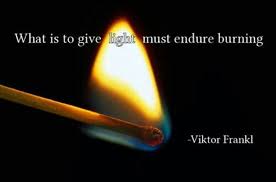
I’ll never be done working on myself, but it turns out, I can become a counselor anyway, not in spite of my past, but because of it. Jung believed that disease of the soul could be the best possible form of training for a healer. And as Victor Frankl wrote, “What is to give light must endure burning.” By these measures, I am perfect for this job.

*for a more in-depth—but still inadequate—explanation of the differences among therapy, counseling, psychotherapy, and psychology see this previous blog

Getting My Counseling Feet Under Me (or I’m Two Years into This Program, are We Done Yet?)

Writers and therapists live twice—first when they experience events and a second time when they use them in their work. Mary Pipher, Letters to a Young Therapist

A few months ago, I met up with a former therapist, a woman I hadn’t been to see in about 20 years and who had since retired. I wanted to talk to her about adoption and addiction since she had been known as something of an adoption guru while she was still practicing. As I explained my course of study and my intentions for becoming a counselor, she exhorted me to pick a theory, a modality to call my own. “You need to decide which theoretical model you’ll work from,” she said. “You need to pick one to ground yourself in and work from there.” She then ticked off a list: Bowen, Adler, Rogers, Jung. I looked across the table at her and shrugged. “I think they all have something to offer,” I said. “I guess if I had to describe my orientation, it would be diverse.”

“That won’t do,” she exclaimed. “You need to be grounded in something. Anything. Just pick one. Bowen is good.”
parents cartoonI shook my head slowly at the thought of Murray Bowen taking up permanent residence in my head. Sure, I can see the value in looking at a person’s issues through the lens of intergenerational patterns and family systems, but as my only, primary orientation? No. So many others had much more to offer, from Jung’s wounded healer to the post modernists and narrative therapy, feminist theory, attachment theory. I couldn’t imagine latching onto just one way of being a counselor when so many modalities offered so many ways to work with people with a variety of needs.

And now this quarter we added Carl Rogers’ Person Centered Therapy and his Unconditional Positive Regard, along with Fritz Perls and Gestalt, John Cabot-Zinn’s mindfulness as well as Pema Chodron to the mix. I am even more convinced that limiting myself to one theoretical lens would be a mistake. Shortsighted.

The metaphor is overdone, but apt—the more tools I have in my tool belt, the more useful I can be to more people. Every client is going to be different. I need to be able to adapt. There aren’t many similarities between working in technology and working as a counselor, except this one: sometimes there are a variety of ways to approach a problem and finding a good solution is often a matter of “testing and tweaking” to see what works best.

As a writer, reader, and storyteller, I’ve always found narrative therapy to be the modality that draws me in. I am attracted to counseling for the same reasons I am a writer—I want my misery, and indeed everyone’s—to be meaningful. As Mary Pipher writes in her Letters to a Young Therapist, as counselors and writers, we get to use our experiences twice and encourage others to do the same. Additionally, I am attracted to narrative therapy’s post-modernist bent, the idea that it is not the individual who is sick, but the culture in which the individual lives. That depression, anxiety, PTSD for example, are legitimate responses to living in a culture that too often demands we abandon our authentic selves. Not to mention that we live in a world that insists on dividing us by race, socioeconomic status, ability, sexual orientation, gender, ethnicity, religion, and more.chickencouch

I began this graduate program with the vague notion that I would emerge in two years, somehow qualified to sit and listen to people for a living. As I progress through each quarter, I become evermore convinced that two years is not nearly enough time in which to prepare me to not just listen to people’s stories, but to help them make sense of their stories, make meaning in their lives, forge on into the future with hope and a sense of purpose, with a deeper understanding of what serves them, what doesn’t, how to make good choices, how to hold onto their dreams, how to have a voice, leave an abuser, nurture their children, their relationships, find meaningful work.

How do I become that mirror, sounding board, holder of stories, cheerleader, confidant, advocate?

From the client side of the couch, I have found Gestalt and mindfulness to be the most effective therapeutic methods. Most breakthroughs in my personal therapy have come when I’ve been talking to the chair, role playing, or acting something out with my therapist. Mindfulness and meditation have worked for me outside of the therapist’s office as a way to self-regulate and deepen personal awareness. So, it’s not really surprising that over the course of this quarter I have gravitated to both, though I see Gestalt methods as being more relevant to therapy and mindfulness as a useful (and indeed maybe even necessary) adjunct for clients to use between sessions.

Gestalt therapy with its focus on the body/mind connection, lends itself well to supporting other interventions and modalities. Rogerian Person-Centered Therapy (PCT) with its mandate for unconditional positive regard seems like it should underlie every therapeutic encounter, particularly the initial few sessions.

chairGestalt works well, too, with mindfulness, attachment, and sensorimotor therapies, which focus not only on how the body holds trauma and past experiences, but also on awareness and connection between the client and therapist. By encouraging clients to stay in the here and now, Gestalt leaves room for the therapist to introduce the client to mindfulness techniques which support being present and staying in the moment when things get emotional or difficult in session.

In my initial session with my practice client, employing PCT worked well to establish rapport and an initial baseline of trust. Once we got to the primary issue, however, Gestalt would have been a great way in to exploring how she was feeling in the “here and now.” I might have employed the empty chair technique had the session gone longer—I could have had my client talk to any number of representatives from her past: her parents, her younger self.

I also might have had her explore her stress about her issue and how it was sitting in her body—what does the stress feel like? Look like? How big is the stress? What color is it? Where does she feel it the most? My therapist often tells me to invite my distressing emotion in rather than trying to banish it. “Invite the stress in,” she says. “Ask it what it wants. Have tea with it.” This technique, of anthropomorphizing the disturbing emotion or feeling and dwelling on it, illustrates one way of working with an issue. When we avoid something, it gets bigger and more intense. By inviting our distressing emotion in and asking it to stay, by getting to know it, we rob it of its power.

In our second practice session, I employed both Gestalt and mindfulness (as well as Roger’s unconditional positive regard), encouraging the client to make her physical agitation bigger (I had her stand up and shake out her anxious feelings) and to incorporate some breathing techniques. This session took the client deeper emotionally than the first session, even though both sessions lasted about 20 minutes and demonstrated my improved ability to sit with a client in their discomfort. I was able to witness her experiencing emotion and hold the experience rather than try to rush her through it in order to alleviate my own discomfort.

As always, I need to be mindful of my clients’ particular culture. Every client, regardless of how they present at first glance, brings with them an individual set of circumstances that sets them apart from every other client. To be an effective therapist, I must refrain from making assumptions, and instead listen, learn, ask clarifying questions, and give the client the space and safety they need in order to fully reveal themselves, their wants, their needs, their problems.lucy

Probably one of the most challenging aspects of counseling this quarter has been keeping tabs on my biases, assumptions, and privileges. While I am nearly always aware of my sexual orientation, my age, and do think a lot about race and how these parts of my identity might influence my interactions with a client, I’m not always thinking about ethnicity, socioeconomic status, or disability. We are, often and on the surface, a homogenous population at Antioch. I have not counseled a person of color or a person with a visible disability. I’m sure I’ve worked with clients who come from a different socioeconomic background, and though I am currently as broke as the next graduate student, I do have to remind myself that I come from a relatively privileged background and have robust support systems should I need them.

As this quarter wraps up, I feel as if I am finally getting my counselor feet under me, that I can work effectively and comfortably within a specific therapeutic framework. This quarter is the first time I have experienced authentic connection with a client, where I seem to have actually helped another person via a counseling session. I am excited to hear my clients’ stories, to listen to them as together we find meaning in and a way out of their suffering.

Lesbian Shame, Attachment Theory, and Identity Integration. (Or, I am so f*ing tired of this sh*t)

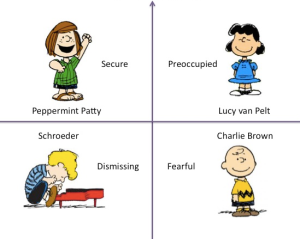
peanuts attachment
I love that Peppermint Patty is the securely attached one in this graphic

I’m currently working on a group project for my Counseling Sexual Minorities class. We are looking at Attachment Theory as it applies to LGBTQ people and the clinical implications for counseling this population. For my part, and to help the cause along, I decided to take a look at the relationship between attachment styles (secure, fearful/avoidant, dismissive, and preoccupied), identity integration and lesbian shame.

Attachment theory suggests that how well our primary caregivers met our needs as infants and children determines how we relate in relationships later in life. (For a more complete discussion, check out this site).

cass_2
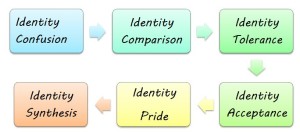
Cass Identity Integration Model

The Cass Identity Model is one of the primary ways of evaluating how well gays and lesbians have integrated their sexual orientation into their lives. It has six stages, beginning with Identity Confusion (am I a lesbian?) and ending with Identity Synthesis (I am a lesbian and I am out in all areas of my life). (For a more complete discussion on the Cass Model, click here).

The Internalized Shame Scale is an assessment tool used to rate individual’s levels of internalized shame.

Turns out there is a correlation between a lesbian’s attachment style and the amount of shame she experiences. The two studies I looked at gathered data on about 500 lesbians and discovered that those lesbians with a secure attachment style had lower levels of shame (as measured on the Internalized Shame Scale) than those lesbians with other attachment styles (fearful, dismissive, and preoccupied).

The first study (published in 2003) looked at 380 women who self-identified as lesbians and as a level 4, 5, or 6 on the Cass Identity Integration Model. The results aren’t really that surprising. What’s surprising is that overall, lesbians scored 49.8 on the shame scale where 50 is a clinically significant result (i.e. pathological). As a comparison, heterosexual women average a score of 33.

attachment cartoonIt’s important to note that most infants and children who escape childhood with a secure attachment style tend to remain securely attached in other relationships as their lives go on. Not so with LGBTQ children. Even those who begin life securely attached run a high risk of shifting attachment styles later in life due to particularly severe breaks in important relationships: rejection by their family when they come out, for example. Rejection by peers, teachers, clergy, friends.

One paper I read for my presentation reported that 43% of LGBTQ youth experience some form of physical violence. In addition, a significant number get kicked out of their homes when they come out to their families. LGBTQ people are barraged daily with messages that it’s not okay to be LGBTQ. I just have to open my laptop and scan the headlines on any given morning to read that politicians want to strip me of my rights, that “christians” want to round us up and put us in camps, that self-appointed guardians of morality want to outlaw me, and that people like me are threatened with death just for being who we are.

Sure, we’re gaining rights, but we also face a backlash from those who believe we are less than human, less than deserving of equal rights. The Kim Davis’s, Antonin Scailias, Michelle Bachmans, Ann Coulters, Ted Cruzs, Marco Rubios of this world. We have the right to marry, for now. But how long will that last? Will a change in our country’s administration threaten my rights again? Will I ever be able to relax or must I remain vigilant?

The second study, published a year later looked at 100 lesbians who scored a 6 on the Cass scale and who had also spent at least three years in therapy. What this study showed was that these lesbians scored 43 on the shame scale and 58% were securely attached, compared to 49% in the previous study.

What are the clinical implications of reduced lesbian shame, more secure attachment styles, and higher rates of identity integration? Therapy may work to repair attachment by providing a new secure base, resulting in reduced internalized shame. This is good news.

Why am I interested? Funny you should ask. One of the amazing (and awful) aspects of this graduate program I am in, is that I am constantly analyzing myself, challenging my assumptions about myself and monitoring the way I am in the world. I can’t think of a single class I’ve taken that didn’t shove me right up into the shit, from the initial Family of Origin Issues class, where we looked at intergenerational patterns and all the ways we have unfinished business with the people in our lives to Human Development: Gender in which my mind was blown regarding the social constructs of gender roles and the false dichotomy of binary genders (i.e. boy/girl, male/female).

Every class has taught me something about myself: Ethics, Psychopathology, Psychodiagnostics, Group Therapy, and so it has been with this class, Counseling Sexual Minorities. I signed up for the class with a level of excitement and anticipation I’d not had for other classes because we were finally in my wheelhouse. I thought I knew a thing or two about this topic, at least from the client side of the couch. I wasn’t prepared.

In general, the class has been less than stellar, but even still, I wasn’t prepared for how digging into all the ways in which LGBTQ folks are discriminated against would impact me. I figured that I’ve been out of the closet for the past 40 years and had dealt with my internalized homophobia and had come to terms with my sexual orientation, but what I have realized so far this quarter is just how exhausted I am, how much I shut out on a daily basis in order to protect myself, and that there’s a simmering rage just below the surface that is eating away at me.

The other day I ran across a story on some county clerk in Texas who likened her fight against same sex marriage to the fight against Nazi Germany. Really? And the rhetoric amongst the GOP candidates who want to roll back what few legal protections LGBTQ folks have terrifies me. One candidate whose name shall not grace this blog has stated he would nominate Supreme Court justices who would repeal same sex marriage.

And that’s the thing that just kills me a little inside all the time—other people think they have a right to determine what is best for me simply based on whom I love. Everyone has an opinion and sometimes even a vote about what rights I should have. Just this morning there’s a story on the front page of my local paper about a debate in Charlotte, NC on LGBT protections. A debate. About my rights as a human.

As I grew up, instinctively knowing that there was something different about me, I tried hard to keep that difference under wraps, to not let my true self out for fear of rejection. But eventually the need to be true to myself overruled cultural mandates to fit in. Being authentic, regardless of sexual orientation, can be challenging for many of us, but I would posit that most people don’t spend most of their time with this level of anxiety.

As I came out over the years (coming out happens over and over and over again, by the way, not just once), comingout_rainbow doorrelationships fell away. Some repaired, others did not. I remember writing to a friend from my high school days when I adopted my oldest daughter. My friend wrote back that I was an abomination, that my daughter deserved better, that I was going to hell.

Eventually, I learned to be more discriminating, oftentimes pushing people away and shutting others out who may not have rejected me. Better to protect my heart than to have it shattered over and over again. Even now when I know better, when I am pretty certain that the folks around me are open and accepting, I still armor myself against betrayal, though occasionally I let down my guard and show up as completely out, completely me, defenseless, and vulnerable because I feel safe, because the environment seems to exude acceptance and warrant trust. Sometimes I’m right. Sometimes I am very wrong.

I am tired. I want to lay down my shame. I want to live in a world where I am not afraid, where no one cares who I sleep with, where no one is threatened by my relationships, where no one wants to strip me of my dignity, humanity, my rights. I want to live in a world where no one gets to vote on my right to marry, work, buy a house, use a restroom, adopt children. I want to live in a world where who I am is not up for debate.

Lesbian Identity: A Quiz, the Results, and What I Learned

This quarter, as I continue working towards my Master’s degree in Clinical Mental Health Counseling, I am taking a course on counseling the LGBTQ population. Here is the course description as it appears in the syllabus: This course provides an overview of clinical issues, contemporary theories, interventions, and research relevant to the treatment of sexual minorities. This population includes Lesbian, Gay, Bisexual, and Transgender clients, as well as those clients who identify as other than heterosexual (e.g. Queer, Pansexual, Omnisexual, etc.), or are questioning their sexual orientation or gender in any way. Psychological, social, cultural, and developmental issues are explored within the contexts of theory and practice. Emphasis is on affirmative mental health services for sexual minorities, including the importance of developing an awareness of the cultural, historical, and social realities of gay, lesbian, bisexual, and transgendered individuals. Readings, discussion, videos, presentations, experiential activities, and guest lectures/panels will serve to heighten awareness of problems such as homophobia and heterosexism as they affect the therapeutic setting, the counseling relationship, and the process of psychotherapy.

Students have to pair up to lead class discussion each week, so I signed up for week two (last week), which was to cover Lesbian Identity. I wanted to be done with the assignment early on in the quarter, AND who better to lead the discussion on Lesbian Identity than an actual lesbian?

Imagine my dismay when I realized the articles we’d been assigned to read were all sadly out of date. Two were at least ten years old, and the third, a study done on 15 lesbians who lived in the UK, looked at clothing and hairstyle choices and how they correlated to coming out, data that hardly seemed relevant for a counselor in training in the Pacific Northwest.

The findings certainly didn’t match up at all with my own experience. Coming out for me had nothing to do with how I dressed—I started shopping in the boys’ department when I was a child. Ask my mom. My short haircut has nothing to do with being a lesbian and everything to do with being lazy. And the fact that I look hideous in long hair. Never mind that all the women in Bellingham—lesbian, straight, queer, bisexual—look and dress alike. There’s a uniform: fleece, jeans, hiking shoes, short hair. We all look the same, a confounding and complicating fact of life for the women (and men!) who reside here.

So, armed with my indignation and determined to find more useful data, I put out a call to my Facebook friends. Would any of them give me permission to use their pictures and their sexual identities for a Lesbian Identity Quiz? The responses overwhelmed and heartened me. Assent and identities flooded my inbox. My friends—lesbians, straight women, bisexual women, queer women, were all intrigued and excited about this project. I began creating a PowerPoint slide show, the most stunning one I have ever made, full of my friends’ bright, shining, and beautiful faces.

And it wasn’t just about the pictures. Women sent me stories too, about their sexual orientations, their choices, their gender identities. Intimate stories. I had been gifted with very personal revelations. My excitement for the project grew as I realized I had tapped into something elemental here. Don’t we all want to be seen? Don’t we all want to know how others see us?

The enthusiasm for this project caught me a bit off guard. I heard from some Facebook friends I hardly know, from others I hadn’t heard from in years, from some I have never even spoken to in person. A few I had been close to once upon a time. And a handful with whom I have just a nodding acquaintance. The eagerness surprised me, heartened me.

A couple of people sent me specific pictures, but the rest told me to use whatever I wanted from their Facebook photos. I set about culling just the right pictures from dozens of Facebook feeds. Some were easy to find, others not so much. Many pictures were taken with significant others: wives, husbands, lovers, kids. I needed clear, easy to see photos that wouldn’t reveal anyone’s identity in an obvious manner, i.e. no wedding or family pics.

I didn’t want to bias the results via the pictures I chose, but I faced a dilemma: what picture actually best represents someone? Given the opportunity to choose a picture of a straight woman in a dress or a cowboy hat, which would I opt for? Or, my friend who has a biracial baby—what message would it send if I included a photo of her holding her child? For my lesbian friends, would I choose photos of them that emphasized their more masculine traits or their more feminine sides? I have to say in retrospect that my choices probably skewed the results.

I set up the slideshow with six pictures per slide, and when I clicked the mouse, the pictures disappeared one at a time, revealing each woman’s sexual identity (lesbian, bisexual, queer femme, or straight). I printed slideshow handouts to give to each class member, so they could write their best guesses next to each picture. I looked at my work and was proud. This was going to be a kickass class discussion and presentation. I could hardly wait.

Imagine my surprise then, when I introduced the quiz in class and the instructor immediately objected. “Wait a minute,” she said. “Is everyone comfortable judging other people like this? I’m not sure this is okay.”

I stood there, stunned, and wondered for a moment if I had made a serious error in judgment. I explained that I had everyone’s permission, that each participant hadn’t just agreed but had enthusiastically and wholeheartedly opted in. My classmates rallied to my defense, shutting down the instructor’s objections in short order. I passed around the handouts and fired up the slide show.

When they had finished the quiz, I went through the slide show quickly so they could compare their answers. I didn’t linger over individual identities, nor did we discuss anyone’s picture or what made someone look like a lesbian or a straight woman. Instead we talked about what it was like to judge people based on appearance. One female student said she refused to make any judgments about the individuals, saying they all looked like beautiful women to her. The instructor refused to take the quiz, as well. But she also refuses to label herself. Honestly, I have to say I have some judgments about that.

We discussed the safety of being identifiable, the politics of passing for straight. I (being the only self-identified lesbian in the room) talked about the changes in the past ten or fifteen years. How I used to feel like no one would know I was a lesbian because gays and lesbians weren’t part of the social or political discourse. Now, I feel like I’m always identified, categorized, and labeled. The discussion meandered from there, eventually covering a variety of topics, but one that we kept bumping up against and then turning away from, how to meet this population in our counseling offices.

And there’s the lesson—or should have been. How will we counsel lesbians when they come to us? What will we know about Lesbian Identity? Is it important that we know how a dozen or so UK lesbians changed the way they dressed when they came out? Or better that we know it’s nearly impossible to identify someone by the way they look? That 50% of the time we can tell a straight woman from a lesbian? That hardly anyone will know a queer femme when they see one, and more often than not bisexuals are invisible?

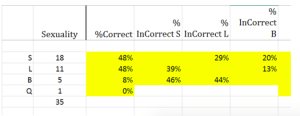
My tiny experiment revealed that, in this instance at least, we are right about our assumptions approximately 50% of the time regarding sexual orientation. I’m sure there are many more ways I can exploit the data for better/more interesting information, and I have my more mathematically inclined friends working on that for me. I’ll publish those results when I get them. In the meantime, here is what I have.

What are your thoughts, Readers?

Screen Shot 2016-01-20 at 12.26.41 PM
Quiz Results: Number of guesses in each identity. The * indicates the correct identity
Screen Shot 2016-01-20 at 12.28.04 PM
Percentage of correct guesses, broken down by orientation.
Screen Shot 2016-01-20 at 12.27.13 PM
Bar Graph representing guesses. Correct orientation is across the bottom, number of guesses in each category
Screen Shot 2016-01-20 at 12.27.21 PM
Percent of correct guesses of each photograph

U is for Unwritten

UI am on a writing retreat as I type this. For the past two days I’ve been sequestered away with two very quiet and serious writers in a lovely home in a lovely valley. We’ve been very dedicated since we arrived, but I have to say I am having a hell of a time producing much. I need to write a paper for class by Saturday, and I am struggling. I can’t get the words out. My failure has nothing to do with lack of effort on my part. In my attempts to jar something useful loose, I’ve read books and scholarly articles, I have watched videos—some deadly boring (really, if you ever have insomnia watch a video of someone else conducting a counseling session). I’ve listened to relevant and riveting podcasts. Yet, I’ve only managed to squeeze out about 300 words. I am interested in the topic. I enjoy the class. But I’ve got a terrible block around this paper. I’ve even asked for an extension, a request about which I am ambivalent. Is it wise to extend my struggle or should I just grit my teeth and power through?

Perhaps I’m feeling resentful that all during my three-day writing retreat I have felt besieged by this paper. Rather than working on my more creative pursuits, I’ve been straitjacketed by academia. I’ve also been thrown off my game a bit because I haven’t been for a run since Tuesday and it’s now Friday. That, and you know how the digestive system can go awry when it leaves home for more than a day or two. Should I have stayed home this week? Would the words be flowing any easier if I were wrapped in the stifling yet familiar embrace of my normal routine? Doubtful. All quarter, each time I’ve sat down to write anything for either of my classes, I’ve felt this tightness, this overwhelming ennui, and a great urge to close my eyes for a nap. Yet, somehow I have managed to keep up, to crank out the papers and turn them in, complete and on time. Mostly they’ve received excellent feedback, and, upon rereading what I’ve written, I am struck by my ability to string coherent thoughts together, paragraph by grueling paragraph.

So, what gives? Why this epic struggle to engage with the material and shape it into a useful form this week? What am I resisting? I think part of the problem may be that I am emotionally engaged elsewhere—that is, my heart just isn’t in it. My subconscious is busy working on other more compelling issues. If I could write a paper on love and loss, obsession and compulsion, friendship and forgiveness, I would be nearly done by now. If I could write a treatise on the human heart, what drives us in life and love, I would ace this assignment. And even as I type these words, I realize that in a way, this is exactly what I am doing—

My assignment, for my Group Therapy class (it’s a class on how to lead group therapy/group counseling sessions), is to write a proposal for a group that I would like to lead. Since I began my Master’s program in Clinical Mental Health Counseling last year, I have written a few papers about and done more than a little research on counseling transgender individuals. The group I am attempting to write a proposal for now is a transgender support group. I have all of my information. I know the material, the issues, the format, but I’m fighting a major battle to put it all together and get it all down on paper. Why?

I decided to step away for a bit. Stripped my bed. Did some laundry here at the retreat center. I took a shower. And that’s where I was when it hit me—I need to give this paper a more personal twist, breathe some actual life into it, make it less abstract, more tangible. But how? I’m not transgender. I am a cisgendered female (biologically the same gender I was labeled at birth) with no desire to change my identity. Oh sure, every now and then I think it might be awesome to have a penis, if only to experience the power and privilege the penis inspires. Like my occasional fantasy of taking one hit of heroin or meth to experience what must be an awesome high—I ponder the sensations that must accompany the penis. How must that feel? All those nerve endings concentrated in that one place, exposed, expectant, exquisite?

I don’t want to have a full time penis any more than I want a heroin addiction, but I am often misgendered, that is, I am mistaken for a man. Even though I have no desire to change my gender, feel no compunction to make an anatomical correction, I sometimes present as something other than the culturally accepted female norm. I am not tiny. I don’t wear makeup. I keep my hair short. I sometimes wear clothes purchased in the men’s department, but mostly I wear clothes made for women that don’t have ruffles, sparkles, bows, bright colors, or plunging necklines. I eschew high heels and dresses and pretty much anything tight, clinging, or revealing. Do these preferences make me less of a woman? The occasional stranger apparently thinks so.

Last summer I had an experience that brought home for me the fear and real dangers facing trans* folk. I was dressed to go for a run—bright orange racer back tank top, quick dry shorts (men’s since they are longer and don’t ride up as I run), socks, shoes, iPhone in my armband. I parked my Jeep at my favorite running spot, locked the truck, and headed to the bathroom. It was early, maybe 7:30 in the morning. As I opened the bathroom door, a voice behind me hollered something I didn’t quite catch at first. I turned around to find the owner of the voice standing about 20 yards away.

“Did you say something to me?” I asked, genuinely curious.

“Never mind,” he said with a surprised look on his face.

As I entered the women’s restroom and headed for a stall, the words he had yelled rearranged themselves and suddenly made sense: “Hey bro, that’s the women’s bathroom.” Ah, I realized as I sat down to pee, he thought I was a dude going in the wrong restroom. Nice of him to warn me, but how could he have possibly mistaken me for a guy in these tight running clothes? I’m not some thin, lanky runner. I have, shall we say, noticeable curves.

And then the fear settled around me. What if he thinks I am trans*? What if he wants to harm me? What if he realizes I’m a lesbian? Will he think he can do with me as he pleases? What if he hates gays and trans* people (or anyone on the LGBTQQIAP–jesus, that gets longer everyday– spectrum)? What if he is one of those guys whose masculinity is threatened by our very existence? I occasionally worried about running this sometimes lonely trail by myself, but generally shrugged my fears off as unfounded. Now, seeing myself through this particular lens, I felt more vulnerable than ever.

This vulnerability is the way into my paper for Group Therapy. This vulnerability is why the trans* counseling group needs to exist. Thanks for reading. I’m off to finish my paper now.