Lesbian Shame, Attachment Theory, and Identity Integration. (Or, I am so f*ing tired of this sh*t)

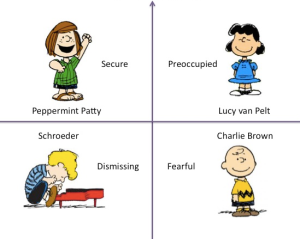
peanuts attachment
I love that Peppermint Patty is the securely attached one in this graphic

I’m currently working on a group project for my Counseling Sexual Minorities class. We are looking at Attachment Theory as it applies to LGBTQ people and the clinical implications for counseling this population. For my part, and to help the cause along, I decided to take a look at the relationship between attachment styles (secure, fearful/avoidant, dismissive, and preoccupied), identity integration and lesbian shame.

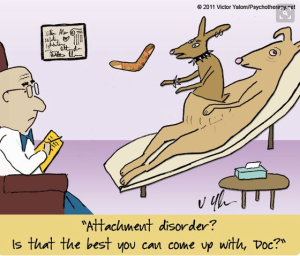
Attachment theory suggests that how well our primary caregivers met our needs as infants and children determines how we relate in relationships later in life. (For a more complete discussion, check out this site).
cass_2
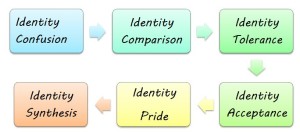
Cass Identity Integration Model

The Cass Identity Model is one of the primary ways of evaluating how well gays and lesbians have integrated their sexual orientation into their lives. It has six stages, beginning with Identity Confusion (am I a lesbian?) and ending with Identity Synthesis (I am a lesbian and I am out in all areas of my life). (For a more complete discussion on the Cass Model, click here).

The Internalized Shame Scale is an assessment tool used to rate individual’s levels of internalized shame.

Turns out there is a correlation between a lesbian’s attachment style and the amount of shame she experiences. The two studies I looked at gathered data on about 500 lesbians and discovered that those lesbians with a secure attachment style had lower levels of shame (as measured on the Internalized Shame Scale) than those lesbians with other attachment styles (fearful, dismissive, and preoccupied).

The first study (published in 2003) looked at 380 women who self-identified as lesbians and as a level 4, 5, or 6 on the Cass Identity Integration Model. The results aren’t really that surprising. What’s surprising is that overall, lesbians scored 49.8 on the shame scale where 50 is a clinically significant result (i.e. pathological). As a comparison, heterosexual women average a score of 33.
attachment cartoonIt’s important to note that most infants and children who escape childhood with a secure attachment style tend to remain securely attached in other relationships as their lives go on. Not so with LGBTQ children. Even those who begin life securely attached run a high risk of shifting attachment styles later in life due to particularly severe breaks in important relationships: rejection by their family when they come out, for example. Rejection by peers, teachers, clergy, friends.

One paper I read for my presentation reported that 43% of LGBTQ youth experience some form of physical violence. In addition, a significant number get kicked out of their homes when they come out to their families. LGBTQ people are barraged daily with messages that it’s not okay to be LGBTQ. I just have to open my laptop and scan the headlines on any given morning to read that politicians want to strip me of my rights, that “christians” want to round us up and put us in camps, that self-appointed guardians of morality want to outlaw me, and that people like me are threatened with death just for being who we are.

Sure, we’re gaining rights, but we also face a backlash from those who believe we are less than human, less than deserving of equal rights. The Kim Davis’s, Antonin Scailias, Michelle Bachmans, Ann Coulters, Ted Cruzs, Marco Rubios of this world. We have the right to marry, for now. But how long will that last? Will a change in our country’s administration threaten my rights again? Will I ever be able to relax or must I remain vigilant?

The second study, published a year later looked at 100 lesbians who scored a 6 on the Cass scale and who had also spent at least three years in therapy. What this study showed was that these lesbians scored 43 on the shame scale and 58% were securely attached, compared to 49% in the previous study.

What are the clinical implications of reduced lesbian shame, more secure attachment styles, and higher rates of identity integration? Therapy may work to repair attachment by providing a new secure base, resulting in reduced internalized shame. This is good news.

Why am I interested? Funny you should ask. One of the amazing (and awful) aspects of this graduate program I am in, is that I am constantly analyzing myself, challenging my assumptions about myself and monitoring the way I am in the world. I can’t think of a single class I’ve taken that didn’t shove me right up into the shit, from the initial Family of Origin Issues class, where we looked at intergenerational patterns and all the ways we have unfinished business with the people in our lives to Human Development: Gender in which my mind was blown regarding the social constructs of gender roles and the false dichotomy of binary genders (i.e. boy/girl, male/female).

Every class has taught me something about myself: Ethics, Psychopathology, Psychodiagnostics, Group Therapy, and so it has been with this class, Counseling Sexual Minorities. I signed up for the class with a level of excitement and anticipation I’d not had for other classes because we were finally in my wheelhouse. I thought I knew a thing or two about this topic, at least from the client side of the couch. I wasn’t prepared.

In general, the class has been less than stellar, but even still, I wasn’t prepared for how digging into all the ways in which LGBTQ folks are discriminated against would impact me. I figured that I’ve been out of the closet for the past 40 years and had dealt with my internalized homophobia and had come to terms with my sexual orientation, but what I have realized so far this quarter is just how exhausted I am, how much I shut out on a daily basis in order to protect myself, and that there’s a simmering rage just below the surface that is eating away at me.

The other day I ran across a story on some county clerk in Texas who likened her fight against same sex marriage to the fight against Nazi Germany. Really? And the rhetoric amongst the GOP candidates who want to roll back what few legal protections LGBTQ folks have terrifies me. One candidate whose name shall not grace this blog has stated he would nominate Supreme Court justices who would repeal same sex marriage.

And that’s the thing that just kills me a little inside all the time—other people think they have a right to determine what is best for me simply based on whom I love. Everyone has an opinion and sometimes even a vote about what rights I should have. Just this morning there’s a story on the front page of my local paper about a debate in Charlotte, NC on LGBT protections. A debate. About my rights as a human.

As I grew up, instinctively knowing that there was something different about me, I tried hard to keep that difference under wraps, to not let my true self out for fear of rejection. But eventually the need to be true to myself overruled cultural mandates to fit in. Being authentic, regardless of sexual orientation, can be challenging for many of us, but I would posit that most people don’t spend most of their time with this level of anxiety.

As I came out over the years (coming out happens over and over and over again, by the way, not just once), comingout_rainbow doorrelationships fell away. Some repaired, others did not. I remember writing to a friend from my high school days when I adopted my oldest daughter. My friend wrote back that I was an abomination, that my daughter deserved better, that I was going to hell.

Eventually, I learned to be more discriminating, oftentimes pushing people away and shutting others out who may not have rejected me. Better to protect my heart than to have it shattered over and over again. Even now when I know better, when I am pretty certain that the folks around me are open and accepting, I still armor myself against betrayal, though occasionally I let down my guard and show up as completely out, completely me, defenseless, and vulnerable because I feel safe, because the environment seems to exude acceptance and warrant trust. Sometimes I’m right. Sometimes I am very wrong.

I am tired. I want to lay down my shame. I want to live in a world where I am not afraid, where no one cares who I sleep with, where no one is threatened by my relationships, where no one wants to strip me of my dignity, humanity, my rights. I want to live in a world where no one gets to vote on my right to marry, work, buy a house, use a restroom, adopt children. I want to live in a world where who I am is not up for debate.

Lesbian Identity: A Quiz, the Results, and What I Learned

This quarter, as I continue working towards my Master’s degree in Clinical Mental Health Counseling, I am taking a course on counseling the LGBTQ population. Here is the course description as it appears in the syllabus: This course provides an overview of clinical issues, contemporary theories, interventions, and research relevant to the treatment of sexual minorities. This population includes Lesbian, Gay, Bisexual, and Transgender clients, as well as those clients who identify as other than heterosexual (e.g. Queer, Pansexual, Omnisexual, etc.), or are questioning their sexual orientation or gender in any way. Psychological, social, cultural, and developmental issues are explored within the contexts of theory and practice. Emphasis is on affirmative mental health services for sexual minorities, including the importance of developing an awareness of the cultural, historical, and social realities of gay, lesbian, bisexual, and transgendered individuals. Readings, discussion, videos, presentations, experiential activities, and guest lectures/panels will serve to heighten awareness of problems such as homophobia and heterosexism as they affect the therapeutic setting, the counseling relationship, and the process of psychotherapy.

Students have to pair up to lead class discussion each week, so I signed up for week two (last week), which was to cover Lesbian Identity. I wanted to be done with the assignment early on in the quarter, AND who better to lead the discussion on Lesbian Identity than an actual lesbian?

Imagine my dismay when I realized the articles we’d been assigned to read were all sadly out of date. Two were at least ten years old, and the third, a study done on 15 lesbians who lived in the UK, looked at clothing and hairstyle choices and how they correlated to coming out, data that hardly seemed relevant for a counselor in training in the Pacific Northwest.

The findings certainly didn’t match up at all with my own experience. Coming out for me had nothing to do with how I dressed—I started shopping in the boys’ department when I was a child. Ask my mom. My short haircut has nothing to do with being a lesbian and everything to do with being lazy. And the fact that I look hideous in long hair. Never mind that all the women in Bellingham—lesbian, straight, queer, bisexual—look and dress alike. There’s a uniform: fleece, jeans, hiking shoes, short hair. We all look the same, a confounding and complicating fact of life for the women (and men!) who reside here.

So, armed with my indignation and determined to find more useful data, I put out a call to my Facebook friends. Would any of them give me permission to use their pictures and their sexual identities for a Lesbian Identity Quiz? The responses overwhelmed and heartened me. Assent and identities flooded my inbox. My friends—lesbians, straight women, bisexual women, queer women, were all intrigued and excited about this project. I began creating a PowerPoint slide show, the most stunning one I have ever made, full of my friends’ bright, shining, and beautiful faces.

And it wasn’t just about the pictures. Women sent me stories too, about their sexual orientations, their choices, their gender identities. Intimate stories. I had been gifted with very personal revelations. My excitement for the project grew as I realized I had tapped into something elemental here. Don’t we all want to be seen? Don’t we all want to know how others see us?

The enthusiasm for this project caught me a bit off guard. I heard from some Facebook friends I hardly know, from others I hadn’t heard from in years, from some I have never even spoken to in person. A few I had been close to once upon a time. And a handful with whom I have just a nodding acquaintance. The eagerness surprised me, heartened me.

A couple of people sent me specific pictures, but the rest told me to use whatever I wanted from their Facebook photos. I set about culling just the right pictures from dozens of Facebook feeds. Some were easy to find, others not so much. Many pictures were taken with significant others: wives, husbands, lovers, kids. I needed clear, easy to see photos that wouldn’t reveal anyone’s identity in an obvious manner, i.e. no wedding or family pics.

I didn’t want to bias the results via the pictures I chose, but I faced a dilemma: what picture actually best represents someone? Given the opportunity to choose a picture of a straight woman in a dress or a cowboy hat, which would I opt for? Or, my friend who has a biracial baby—what message would it send if I included a photo of her holding her child? For my lesbian friends, would I choose photos of them that emphasized their more masculine traits or their more feminine sides? I have to say in retrospect that my choices probably skewed the results.

I set up the slideshow with six pictures per slide, and when I clicked the mouse, the pictures disappeared one at a time, revealing each woman’s sexual identity (lesbian, bisexual, queer femme, or straight). I printed slideshow handouts to give to each class member, so they could write their best guesses next to each picture. I looked at my work and was proud. This was going to be a kickass class discussion and presentation. I could hardly wait.

Imagine my surprise then, when I introduced the quiz in class and the instructor immediately objected. “Wait a minute,” she said. “Is everyone comfortable judging other people like this? I’m not sure this is okay.”

I stood there, stunned, and wondered for a moment if I had made a serious error in judgment. I explained that I had everyone’s permission, that each participant hadn’t just agreed but had enthusiastically and wholeheartedly opted in. My classmates rallied to my defense, shutting down the instructor’s objections in short order. I passed around the handouts and fired up the slide show.

When they had finished the quiz, I went through the slide show quickly so they could compare their answers. I didn’t linger over individual identities, nor did we discuss anyone’s picture or what made someone look like a lesbian or a straight woman. Instead we talked about what it was like to judge people based on appearance. One female student said she refused to make any judgments about the individuals, saying they all looked like beautiful women to her. The instructor refused to take the quiz, as well. But she also refuses to label herself. Honestly, I have to say I have some judgments about that.

We discussed the safety of being identifiable, the politics of passing for straight. I (being the only self-identified lesbian in the room) talked about the changes in the past ten or fifteen years. How I used to feel like no one would know I was a lesbian because gays and lesbians weren’t part of the social or political discourse. Now, I feel like I’m always identified, categorized, and labeled. The discussion meandered from there, eventually covering a variety of topics, but one that we kept bumping up against and then turning away from, how to meet this population in our counseling offices.

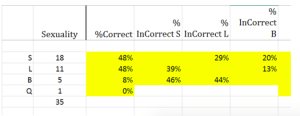
And there’s the lesson—or should have been. How will we counsel lesbians when they come to us? What will we know about Lesbian Identity? Is it important that we know how a dozen or so UK lesbians changed the way they dressed when they came out? Or better that we know it’s nearly impossible to identify someone by the way they look? That 50% of the time we can tell a straight woman from a lesbian? That hardly anyone will know a queer femme when they see one, and more often than not bisexuals are invisible?

My tiny experiment revealed that, in this instance at least, we are right about our assumptions approximately 50% of the time regarding sexual orientation. I’m sure there are many more ways I can exploit the data for better/more interesting information, and I have my more mathematically inclined friends working on that for me. I’ll publish those results when I get them. In the meantime, here is what I have.

What are your thoughts, Readers?

Screen Shot 2016-01-20 at 12.26.41 PM
Quiz Results: Number of guesses in each identity. The * indicates the correct identity
Screen Shot 2016-01-20 at 12.28.04 PM
Percentage of correct guesses, broken down by orientation.
Screen Shot 2016-01-20 at 12.27.13 PM
Bar Graph representing guesses. Correct orientation is across the bottom, number of guesses in each category
Screen Shot 2016-01-20 at 12.27.21 PM
Percent of correct guesses of each photograph

N is for Names or What Am I?

NLast week in my counseling and professional identity class, a class I should have taken four quarters ago, we spent a good hour and a half debating what we should call ourselves: counselors or therapists? I like therapist, personally, and was more than a bit frustrated that we’d spent so much time splitting hairs, focused on semantics rather than content. At my current tuition rate, this inane conversation cost me approximately $150. Yes, we are studying in the Clinical Mental Health Counseling program. And yes, as a group, we are referred to as counselors. But on a daily basis, in my practice, I will call myself a therapist.

Evidently, in the fine state of California, the marriage and family therapist lobby has legally taken the name of therapist for themselves. No one can call themselves a therapist if they are not, in fact, a licensed MFT. But I do not live and practice in California. Nor do I plan to.keep-calm-the-therapist-is-here-9

Some of my classmates (well, one in particular) thought that therapist reeked of white, upper class privilege. She actually looked across the classroom at me and said something to the effect of “therapy implies rich housewives going to whine about their lives once a week.” Others in the class thought therapist has a negative, destructive connotation, as in electroshock therapy and reparative therapy.

I tried not to take these opinions personally, but I do use the term therapy when I go to see my Licensed Mental Health Counselor once a week. I do not go to whine about my life, however. I go seeking healing and strategies for making my life richer and more meaningful. I go to get help making sense of my history, to learn how it impacts me now. I go to figure out how I can be happier, more fulfilled, less stressed. In short, I seek therapy in order to heal and live better.

In fact, the root of the word, thera, traced back to its origins means “forward” “progress” and “healing,” all of which make me want to be a therapist, to call myself a therapist, even more. To be someone who helps others move forward, to progress, and to heal? Sign me up.

BLOG-counselor-inundatedCounselor, on the other hand, to my ear sounds like someone who gives advice, and, in particular, legal advice. Or, like a school counselor–someone who talks to children who have misbehaved. If there’s one thing I don’t want to do it’s work with children. And, if there’s one thing I’ve learned in my five quarters of school, it’s that we counselors/therapists are not to dispense advice. We are to listen, to guide, to inquire, to reflect, to mirror, to ask questions, but we are not to give advice or tell our clients what they should or should not do.

The American Counselors Association (ACA) Code of Ethics tells us that we are to avoid imposing our values on clients (Section A.4.b.) What is advice if not an imposition of values?

The bottom line is that it doesn’t matter what I call myself if I practice in Washington State. I can get my degree in mental health counseling and call myself a therapist or I can call myself a counselor. I can see upper middle class white housewives or I can see lower socioeconomic white people. I can see whoever wants to come and sit across from me and tell me their struggles. I can offer them a chance to heal, a way forward, a path of progress. I can give them therapy.

U is for Umbilical Cord

leave-it-to-beaver2

Visiting Mother
Our past. My future. Her womb.
Cord blood. Still tethered.

The other class I’m taking this quarter is Family of Origin Systems, or FOO for short. Here’s the course description: The purpose of this course is to facilitate the development of competencies in understanding family of origin systems theories of human development and differentiation. Particular emphasis will be placed on students examining their personal and professional development in terms of their own family history, relationships, and conflicts.

In other words, in this class we will take a close look at how our families, the ones in which we grew up, completely fucked us over and caused us to be the hot messes we currently are. I’ve done a fair amount of self-work over the years and have looked closely at my parents, our relationships, how they raised my brother and me. I’ve listened in many workshops as other people describe their upbringings, how they survived everything from drug and alcohol addicted parents, sexual abuse, beatings, to benign neglect and hostile indifference. Compared to most people, I am practically Beaver Cleaver. In many respects, my parents rivaled June and Ward.

But still. The one thing this class makes crystal clear is that none of us leave childhood unscathed. Sure, maybe my parents, like so many, “did the best they could with what they knew at the time,” but they too were products of their environments. And like their parents before them, they carried on, operating within family systems that have perpetuated all the conscious and unconscious family secrets, tragedies, coping methods, and survival mechanisms.

Take for example just two facts from my childhood: We moved to a small logging town when I was four, and my parents became Born Again not long after. These events alone generated major repercussions for my brother and me.

Our parents subscribed to the “spare the rod, spoil the child” parenting style. They raised us to believe that god knew our every move—He knew when we were naughty and nice with implications far more sinister than any Santa might have dreamed up. I grew up believing I could be struck dead (or at least turned into a pillar of salt) should I displease god.

I learned early on that if Jesus returned in The Rapture and I hadn’t caught up on asking for forgiveness for my sins, I might be Left Behind to withstand horrible trials and tribulations. Should I die with my sins unforgiven (because I’d forgotten to pray in a timely fashion), I’d go straight to hell where I would burn for all of eternity. Never mind what the church had to say about being a lesbian.

So there was that. And I’m just scratching the surface of the religious implications. Then there was life in the logging town. Like I wrote in my blog about my brother, we had a fairly idyllic and unfettered (if you don’t count god always watching) childhood. Freedom to roam was one of the many upsides growing up in a small town offered.

Inferior schools presented one major downside.  I was a pretty bright kid. I scored high on tests, always tested into the advanced groups whether they were for math or reading, and I brought home stellar report cards year in and year out. But the schools we attended were full of first year teachers who were all on their way to someplace bigger and better, and I ended up attending four different high schools. By the time I realized I needed a better education, I was in college wondering why I couldn’t figure out pre-calc and why I was failing basic chemistry.

I didn’t take a foreign language (well, I took a quarter of it at the church-affiliated pseudo high school I attended most of my junior year); I stopped taking math in 10th grade. I dropped out of biology my sophomore year and didn’t take any more science until college. Thankfully, standards for college admission were fairly low in 1981.

To be fair, my parents hadn’t been to college. They didn’t know what a college bound high-school student needed in order to be fully prepped for a higher education. Many people I grew up with didn’t go to college. Many had parents who didn’t think girls even needed to pursue anything beyond an MRS degree.  So, in many respects, I count myself fortunate and very blessed. Yet, what might have transpired had we stayed in Bellevue when I was four? What sort of education might I have received there? How might things have played out differently?

Yet it’s not just about what I know. Families are full of secrets and generational patterns. We all move forward under an ancestral burden (or so they say in FOO). What implications did grandpa’s dead brother have on our holidays? What about grandma’s drinking? How did the antagonism between grandma and her sister get mirrored in my aunts’ relationships with one another and with my parents? What about my grandfather’s upbringing made him so hard on my father, his only son? And why did my grandparents adopt my mother? What was the true story there? Did we move far away to escape these legacies? So many questions.

We have to fill out a questionnaire for class tomorrow, one that describes our roles in our family of origin—for example what sort of child was I? Was I The Rulebreaker? The Delegate (strong self-sufficient and competent)? The Companionate (a friend and peer to one of my parents)? The Rejected Kid? And, why? How did my role in my family of origin affect the choices I made later in life? The partners I chose. The roles I play now. It’s fascinating to ponder.

 ***

I’m not writing all of this to lay any blame on my parents. I’m writing to point out that even when we do the best we can (or the best we think we can do), we still pass on to our kids (and I’m a parent, so I have done this too) a legacy with which they, in turn, will need to grapple in order to fully realize their own hopes and dreams.

I know that my parents discussed parenting before they married. I know that they both had dreary childhoods and problematic relationships with their own parents. Together they resolved that they would do better than their parents. And in turn, I resolved the same thing when I had my kids. And, most likely, if my kids have children of their own, they too will make a similar commitment.

I sat in my FOO class and listened to my classmates tell their stories—felt the hair on my arms rise as they recounted tales of abuse, neglect, grinding poverty, drug addiction, mental illness.  And I felt a sense of hope wash over me because in spite of all the various hardships, and perhaps because of them, here we all were, eager to learn, to move on. To help.