M is for Monday, Mean Ladies, and Mindfulness

No Mud, No Lotus.

—Thich Nhat Hanh

MI hadn’t gone running in a few days, so the fact that it was Monday today had slipped my mind this morning when I headed out to my favorite trail. I was more preoccupied with how I was going to fare on this warm day, more interested in how well I would run rather than on the day of the week it was. But, when I pulled into the parking lot and noticed the proliferation of Priuses with Bernie Sanders stickers, I suddenly remembered.

Dammit. I hate running on Monday mornings when the Mean Ladies walk. Usually I try to arrive later in the morning in order to avoid them. I’ve been running on this particular trail most mornings for the past two years, but only in the past six months or so have the Mean Ladies become a problem. I’m not exactly sure how it all started, but a couple of months ago the issue kind of came to a head.

One of the things I like most about my favorite trail is that I see the same people there. After two years, I’m on a friendly basis with many of them. We smile and nod, wave, say “good morning” day after day, week after week, season after season. I’ve even gotten to be on a first name basis with some of the folks there: Danny, Lisa, Diane, Jeff. I often also see many people I know from various other contexts. After 35 years in this town, I know a few folks. Generally these encounters are friendly, so I’m a bit perplexed as to how I came to be at such odds with this group of ten or so mostly older (say, oh, over 60) women.no mud no lotus

Part of the problem is that they always walk side by side and have a tendency to not move over when I either come running up behind them and need to get by nor when I come running from the opposite direction. They meander four or five abreast across the whole trail, ignoring my need to get by and presumably the needs of other trail travelers as well.

And it’s not like I sneak up on them. I am a noisy runner: breathing heavily, my water bottles sloshing on their belt around my waist, my shoes flapping and splooshing in the mud. I am not a swift nor elegant gazelle. Most people hear me coming and, if they are walking two or three across, move over courteously to let me by. I do the same for others. I run on the far right side of the path, moving toward the center only to avoid hazards or large mud puddles.

But these ladies . . . if they were cars, they’d be driving in the wrong lane. There’s a larger one, more school bus than smart car, who always walks on the left, on the inside of the path and for whatever reason refuses to get out of the way or step a bit to the right. She will not cede the right of way, and her obstinance (or obliviousness) makes me crazy. Nearly everyone treats the running/walking trail like a road—slower traffic keeps right except to pass. Occasionally someone will walk on the left, against the grain, but generally they move aside to let others pass.

dontmessA couple of months ago, on a Monday (for I only ever see them on Mondays), I met the Mean Ladies on a wider part of the trail, but it didn’t matter because they were spread all the way across. I had to step off the path and into the brush to get by. They did not budge. Of course because I am running and they are walking, I met them again during my run, and this time, I resolved I would not step off of the path. I would hold my narrow bit of ground.

Also about this time, I had been meditating in the mornings before my runs as an assignment for my Transpersonal and Eastern Philosophies counseling class. One of the modalities we were studying was Mindfulness. So, as I approached this maddening group of matrons, I had a bit of an argument with myself. “Remember the sacred pause,” I admonished. “Take a breath.” But as I drew closer and as it became increasingly apparent that linebacker lady wasn’t going to move, I lost my mind a little. And, in my defense, if I moved a foot to the right, I would, in fact, land in the lake.keep-right-except-to-pass-8

I tried to make eye contact, but the Mean Ladies refused to see me. They continued walking and talking across the entire trail, ignoring my approach. I held my ground and continued running forward. I got closer and still they didn’t move, did not cede a single inch. I braced myself and continued apace, hoping for a last second miracle. But no. My left arm (where, incidentally, I wear my iPhone in a “tunebelt”) smacked into the left arm of the Largest of the Ladies.

In that moment of impact, I felt smugly satisfied and a little scared. What if she came after me? I could outrun her, sure, but I felt kind of bad. I mean, yes, she and her Matronly Mavens had Most of the trail, but why couldn’t I have remembered in that Moment to take the Sacred Pause? To be the bigger (metaphorically speaking, at least) person. Why couldn’t I have just stopped, waited for the Mean Ladies to meander on by, and then continued my run? Why wasn’t I More Mindful? I berated myself and vowed to do better.

The next Monday I again forgot what day it was and encountered them, but this time I was able to be more mindful. I managed to come upon them at a particularly wide spot on the trail that even they could not fill up, and then upon completing my first lap, I reversed direction in order to avoid seeing them again, at least that day. I took to running a bit later on Mondays for a few weeks and avoided them altogether, until last Monday when I approached them from behind. I mustered up my courage and my voice and bellowed out (nicely) “Excuse me!” And miracle of miracles, the large lady moved over. I think I surprised her, and she couldn’t see who it was coming up behind her. I plowed by, grateful, and gave a little wave of thanks as I passed. Maybe she was learning some Manners after all. Or maybe I was.

Today when I met them midway around the lake, I slowed down and made room for them—as well as I could—and again reversed directions after my first lap. I didn’t encounter them again until we all ended up in the parking lot together, where, I again gave them all very wide berth. Before I even started my car, I let them all climb into their Priuses and drive away. Then I made more than a mental note about Mondays. This time, I put Mean Ladies in my calendar. With an alert. Sometimes, being mindful requires a reminder.

L is for Listening, or Oh? How Do You Feel About That?

LI can’t think of anything better than having a conversation with someone and really being heard. Walking away from an intimate exchange with another human being and leaving with that warm, fuzzy feeling that not only did that person give me the time and the space to express what was on my mind, but they really listened to me.

How do I know if someone has listened? Well, they reflect back to me what they heard me say. They ask questions related to what I’ve said, and they engage in active listening skills—nodding when appropriate, making sympathetic noises, maybe reaching out to touch my arm, hand, or leg in empathy and understanding. I had a therapist once who would get teary-eyed when I told a particularly poignant story about my child custody struggles. Her tears made me feel heard and validated.

One of the most challenging aspects of training to become a therapist has been learning to listen in a way that will help my clients not only feel heard, but helped, assisted, valued, and worthy. I remember when I used to think that being a therapist would be so easy—how hard could it be to sit and listen to people all day, throwing out only the occasional, “how does that make you feel?”

I didn't have a happy childhood, I was often misquoted.
I didn’t have a happy childhood, I was often misquoted.

Ha. If only. At school we practice on each other quite a bit. I’ve listened to my fellow students in nearly all of my classes thus far, learning to hone my listening skills, learning to take in what they say and ask relevant, useful, insightful questions in an effort to help them move forward. It’s not easy. There’s so much to hold in my head and pay attention to. Details to notice. Key words to focus in on. Facts to track.

We’re learning not how to give advice, but how to ask good questions, open-ended questions, questions that will encourage our clients to explore their feelings. For example, if a client were to tell me they’re anxious about a weekend outing with their partner and the partner’s family, what might I say in order to help the client better understand and deal with the anxiety?

If I were practicing gestalt, I might ask where in the body the client feels the anxiety and if they could talk to it, what might they say? What would the anxiety say? What does the anxiety look like? What color is it? How big is it?

If I were practicing narrative therapy, I might ask the client to give the anxiety a name and to imagine a world in which the anxiety no longer existed. What would that world look like? I’d ask the client to tell me about a time they didn’t experience the anxiety and ask them what was different about that time.peanuts-cartoon-about-listening

I have so many theories and approaches rattling around in my head, sometimes I think it might explode. What theory to use? What words to zero in on? And then, in one class, the instructor told us to not work harder than the client. And, yes, that makes sense, but oy vey.

The best approach might be Carl Roger’s—he believed that the therapist should always give the client unconditional positive regard. His approach, Person Centered Therapy, came in response to psychoanalytical models popular at the turn of the last century. He believed the therapist should be warm, genuine, and understanding.

He said, “It is that the individual has within himself or herself vast resources for self-understanding, for altering his or her self-concept, attitudes and self-directed behavior – and that these resources can be tapped if only a definable climate of facilitative psychological attitudes can be provided.”

I no longer think that being a therapist will be an easy job—in fact, I’m pretty sure it will prove to be one of the more difficult I take on. Listening to people, actually hearing them and reflecting back what I’ve heard, will take practice, time, and focus. I can’t afford to space out or daydream halfway through a session.

Maybe Stephen Covey said it best: “Most people don’t listen with the intent to understand; they listen with the intent to reply.”

My success as a counselor will not be measured by what I have to say, but in how much I understand.


K is for Karma, or Newton’s Third Law of Physics, or Comeuppance if you’re not particularly Buddhist or Scienc-y

KKarma is the Buddhist notion of moral causation, the idea that we all get what we deserve in this lifetime based on what we’ve done in previous lifetimes. It’s an interesting thought—and one that explains the discrepancies in fortune along the human spectrum, i.e. why some of us suffer and others don’t.

Whenever I ponder karma, I think of Newton’s third law of physics: For every action, there is an equal and opposite reaction. I don’t know why—I’m not much of a scientist, but that’s what comes to mind. Also, the law of the conservation of mass—that mass is neither created nor destroyed but remains constant over time. If science can have these sorts of intractable laws, why not the human condition?karma_dominoes

Last summer I had an encounter with a spiritual advisor of sorts—a seer, a psychic, someone who purported to see into my past lifetimes. Her instructions before our meeting were that I should come with seven questions about my life. To be honest, the timing wasn’t very good. Immediately after our session I had an appointment at the lawyer’s office to sign my final divorce papers.

Anyway, I asked her about my writing and she waxed on for a bit, but didn’t really tell me anything I didn’t know, or anything I wanted to hear, as in nothing about my memoir writing itself and making the NYT bestseller list. So, I waved her off and asked my next question: What is up with the pain in my body?

I’d been experiencing a strange array of symptoms in my shoulder, liver, back, arms, and feet. But it was the weird sensation in my shoulder that caused me the most grief and discomfort. I expected an alien to pop out at any time. My physical therapist determined it was nerve pain, an assertion backed up by MRIs. Various massage therapists told me I needed to breathe more deeply or explained that I had steel cables running down my spine instead of the expected flat ribbons of muscle. The psychic consulted my Akashic records. Initially she reported that she couldn’t see anything—my records were blank, or, perhaps, closed.

Why would my records be closed, I asked, having absolutely no idea what an Akashic record even was, but imagining a very large filing cabinet in the sky. She replied that I might not be ready to see them, that whatever information they held might prove to be too much for me. Well, ask again, I admonished. I’ll be fine. So she asked again—and this time, after a few minutes with her eyes closed, told me a story.

“Do you have much experience with betrayal?” she asked.

I rolled my eyes. “Let me count the ways,” I said. “More than my fair share.”

karma_next tattooShe nodded. “The pain you feel in your back is the pain of betrayal, of your heart being broken. Of being stabbed in the back, metaphorically speaking.” And she went on to tell me a story.

Evidently, many, many, many lifetimes ago, I was a gay man with a devoted lover. We were very close, very respected in our community. We worked together as builders and architects. I thought we were happy and committed, but then I found out my lover was having an affair. My world crumbled then, and I never recovered. Three thousand years and many lifetimes later, she told me, I am still searching for that kind of love, trying to recreate that relationship.

Her words rang true. I’d never before heard of Akashic records. I’d never given much credence to past lives, though I tried to keep an open mind about such things. I felt the pain in my back more acutely at that moment and pushed away from the table, looking at my watch.

“I’ve gotta go,” I said. “Got an appointment.”

I thanked her and stumbled out into the sunshine and made my way to the lawyer’s office nearby. As I walked through the bright and warm summer day, I replayed in my mind every betrayal I had experienced in my 52 years. The ache behind my shoulder thrummed more intensely as each one sprung to mind. Had I really been trying to recreate this perfect relationship from millennia ago? Would I ever be rid of the pain? Did I even believe in Akashic records? Did it matter?

What I know is that her words rang true. What she said made sense to me on some deep, previously unexplored level. There’s so much we don’t know, so much we can’t see, so much happening beneath and beyond consciousness. Is karma real? I don’t know, but it feels like it might be.

J is for Just Do It

J

Whatever it is that you want to do, just go for it. Do it. Move. Take action. Stop talking about it and take that first step. Yesterday in my Trauma, Disaster, and Crisis Counseling class, we watched a video about the Oso landslide. We talked about the September 11 terrorist attacks, and Brussels, Paris, Turkey, Pakistan.

The take away from all of this? Life is short. Unexpected shit happens. Don’t put off until tomorrow (or someday) what you want to do now. Don’t listen to the naysayers, especially the one that is usually the loudest, the one in your own head that says “you’re too old, too broke, too tired, too fat, too busy, too whatever.”

No one is going to intervene on your behalf to suddenly make your dreams come true–or usually that is not the case. If you want to write a book, you’re going to have to sit down and write. Want to run a marathon? Gonna have to get out there and train. Have the urge to see the world? You must book the tickets.

I know taking that first step isn’t easy–if it were we would all be out there living our dreams, and I would have no justification for pursuing my dream of becoming a therapist–no one would need me if everyone just did what they wanted to do. But we don’t. We don’t just do it when we want to make positive changes, nor do we just stop doing the things that make us miserable. This Bob Newhart video is a classic and one of my favorites. If only it were this simple!neuralpathways

Instead we take the path of least resistance, living the status quo, afraid to rock the boat or upset the delicate balance. We live in fear, unable to extricate ourselves from what seem to be proscribed paths.

And, it’s not our fault. We are creatures of habit. We get used to doing things a certain way, and our brains form neural pathways, well-worn grooves that make our responses and actions more automatic. If we’ve developed a habit of getting up every morning and reading the news on the interwebs but what we really want to do is develop a morning meditation practice, we’re going to have to work at it. We’ll have to focus on retraining our brains to not reach for the laptop or the smartphone. Just like walking in the woods–it’s a lot easier to take the defined path than it is to bushwhack through the underbrush to get to our destination.

The good news is that we can build new pathways. Our brains can rewire, thanks to neuroplasticity.

It takes effort to forge new trails, but if the old paths don’t lead to where we want to go, we have to get out our machetes and go for it.

I is for . . .

IInternship. Intention. Intelligence. Introvert.

I can’t decide. My year-long internship should start this Fall, but I first have to complete a six month practicum. My intention is to graduate by the end of next summer, but perhaps I should have used more of my innate intelligence to better organize myself toward this end.

On a completely different note, I have recently been thinking about whether or not I am an introvert. Whenever I take a personality test along the lines of the Myers-Briggs, I generally score right in the middle, usually with a tiny preference toward introversion.

The definitions of introversion and extraversion (yes, that’s the correct spelling) have less to do with how much one enjoys meeting new people and more to do with how one gets one’s energy. Does being with people leave you energized or drained? If the former, you’re probably an extravert. If the latter, if you get energy from being alone and recharging, you are more likely to be an introvert.

People often confuse shyness with introversion, but shyness isn’t about where one gets energy, it’s about social anxiety. At a recent AWP panel, Networking for Introverts, the moderator introduced the intersections of shyness and intro/extraversion in which we find shy extroverts and calm introverts, i.e. extraverts with social anxiety and introverts who have no problem interacting at, say, a cocktail party.ExtrovertVSIntrovert

I’m pretty sure that I’m a shy extravert, even though I’ve almost always test as an introvert. I realize I do get my energy from being around other people. I love interacting with groups of people that I know. Not so much with people that I don’t know. If I have to meet a new group of people, I have terrible anxiety. But, I know that being alone is not how I get my energy nor how I renew. I love a peaceful bubble bath as much as the next person, but I’d much rather go hang out and drink beer with a bunch of writers and talk about our blogs. That’s what gives me juice, and I do just that at least twice a week. If you’re interested in reading more about Carl Jung and his thoughts on introversion/extraversion, check out this article from Psychology Today.

As I contemplate my counseling career, I am looking forward to spending my days listening to and talking with people day in and day out. I know I might be a bit naive at this point, and maybe I’m just anxious to be done with school and in the field already, but I am not good at small talk and enjoy diving into the deep stuff. Seems like it’ll be a good fit.

H is for Haiku

HI figured we all needed a break from mental health for a day. So, since April is not only A-to-Z Blog a Day Challenge Month, Poetry Month, BUT also NaPoWriMo (National Poetry Writing Month), I’m trying to write a poem a day, following these prompts. I’ve done a few, not in order, however, but whenever my muse taps me on the shoulder and drops a few good lines into my lap. Enjoy!

April 1/Day One (which I just wrote today, April 12):
Write a lune, a poem with a 5-3-5 structure (either words or syllables):

I, too, run here blindly
Trusting my feet
Since cataracts cover my heart

April 3/Day 3
Write a poem that is a fan letter to a hero or celebrity. Martina Navratilova’s autobiography, published in the summer of 1985 gave me hope and courage when I felt very alone.

Dear Martina Navratilova,

Love. Love.
That’s the score, right?

Add.
Add-in. Add-out.

Out. Let.
Long.

Rush the net.
Backhand.

Overhead
Smash.

Summer.
1985.

I learned a new language.
Reading you.

Thank you.
Sincerely.

April 4/Day 4
In the spirit of TS Eliot’s The Waste Land, write a poem about the cruelest month.

March is the cruelest month.
I am drenched
In fish and scales–
Watery.
Nearly asphyxiated
Then. Pulled
From the warm
Sloshing where I could
Hear your heart swish,
my own steady with
your beat.
My surrogate,
You cut the cord
And left me to
To nourish myself,
To find breath
On my own.
With gills.

April 5/Day 5
We were supposed to write about heirloom seeds—I wrote about weeds and how what we see isn’t always what it seems. Heirloom seed-like-ish.

Monsters skulk at the garden’s edge
Ten feet tall and hairy

Momma said I shouldn’t cry—
He wasn’t really scary

Dangers lurk in the fertile ground
And nourish dormant seeds

Fallow fields lie quiet now
But soon there will be weeds

I’m currently working on a Family Portrait poem so I can cross Day 2 off my list and move on to Days 6-12. Stay tuned for another mental health break in the not to distant.

G is for Gender–Way Beyond Pink and Blue

GThis is going to be a long and rambling blog. My apologies up front. Gender is a complicated minefield of a topic, and I have a lot to say about it. I am no expert, just someone trying to make sense of it all without offending anyone. 

No matter what class I seem to land in seems to bring up gender as a recurring theme. I have to say, I know a whole lot more about gender now than I did two years ago when I started this program. Gender used to be binary—or at least we only ever talked about it in terms of the male/female binary. Now we discuss gender as occurring in a sphere. Two years ago, I had never heard of a pansexual or a demi-girl, or even the idea that gender occurs on a spectrum and not as the binary male/female boy/girl man/woman paradigm.

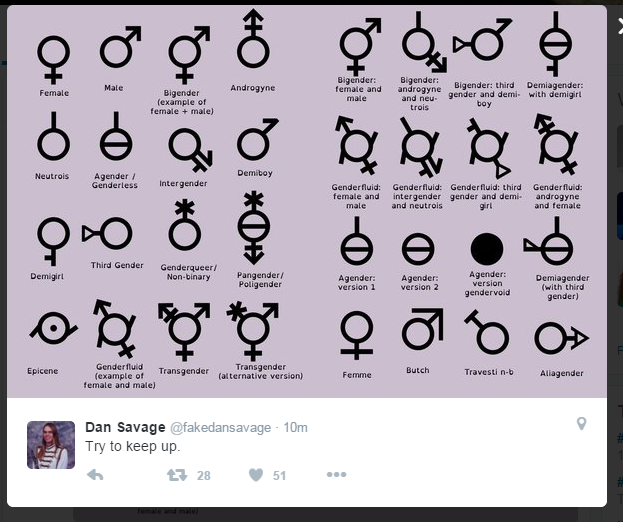
Take a look at this chart. It’s not a joke (although, I have to admit, when I first saw it I thought it was). Mind blowing, yes? These symbols represent the current (and rapidly changing) gender landscape.

gender symbols


If you’re like me, somewhere between the ages of 40 and 60, you grew up in a time when gender norms just started breaking down. I remember being a child and overhearing my parents and grandparents complain about the hippies, going on and on about how they could no longer tell the boys from the girls now that the boys had long hair. You grew up when girls no longer had to wear dresses to school and were no longer confined to three careers: nurse, teacher, secretary. If you were an athletic girl, you may have even tried out for the little league team. Title IX had an impact in that girls’ sports got funded, finally.

Women became doctors, lawyers, dentists, fire fighters, and police officers. Men became flight attendants and nurses, started taking care of children, changing diapers. Stay at home dads became a thing. Gender roles became more flexible, but generally males remained males and females remained females. Gay men may have been more effeminate and lesbians more masculine, but boys wore blue, and girls wore pink and nobody played coy about the biological sex of their newborn child.

I grew up as a gender nonconforming child, never fully comfortable in the trappings of girlhood. I preferred my Red Ryder BB gun to dolls and spent my free time outside, building tree forts, fishing, and playing baseball with my brother. I wanted to be a boy but not because I felt uncomfortable in my body. I wanted to be a boy because boys had more freedoms, fewer constraints.

When I was about six, somehow I had heard about sex change operations (what is now called sexual reassignment surgery). Since we didn’t have a television and were fairly isolated in our small community, I have no idea how I might have learned about such a thing. Nor do I know what possessed me to ask my Mema about it, maybe a sense that if I expressed my desire to not be a girl, she would stop buying me girl stuff. But there we were in her Gran Torino—I leaned over the console from the back seat. “Mema, there’s an operation you can have if you don’t want to be a girl anymore. I could be a boy,” I ventured.

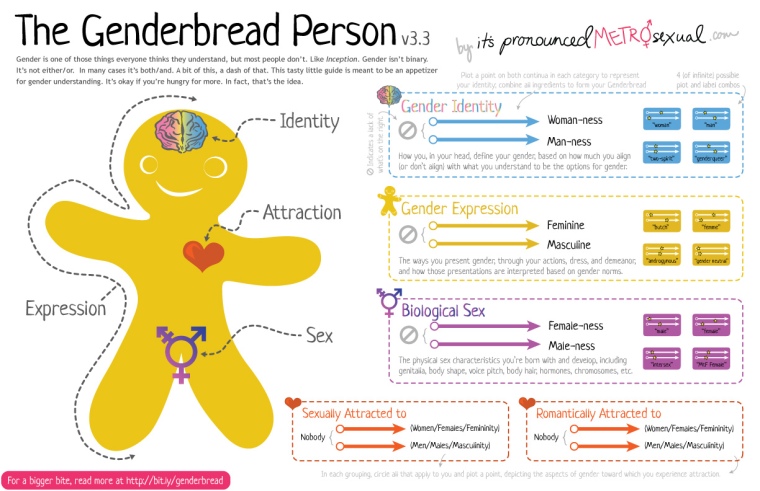
She turned to look at me, taking a long drag off of her cigarette. After a moment she blew the smoke out the side of her mouth away from me. “Those people are sick,” she announced and turned around to back the car out of the driveway. End of discussion, but message received loud and clear.Genderbread-Person-3.3

These days I sit in classes with people who introduce themselves and then announce their preferred pronouns, as in, “My name is Jennifer and I prefer the pronouns ‘she’ and ‘her’.” I have to admit, the first time I heard such an introduction I didn’t quite know what to make of it. Many of my classmates identify as queer or pansexual, and there are a lot of trans* people at Antioch. I generally introduce myself as a lesbian, but I recently learned that many younger people believe that to be a lesbian is to be transphobic.

I am not transphobic, though I have a lot to learn and am still wrapping my head around what it means to be trans*. I’m pretty sure it’s more than feeling like a boy who is trapped in a girl’s body or vice versa. Recently, I’ve listened to speakers who identify as trans* but not as transwomen or transmen, just trans, as in somewhere in between or not even.

One speaker said that he (and he did identify as a transman) probably wouldn’t have transitioned from female to male had he stayed in his native country. In his homeland, being a butch lesbian pushed the cultural boundaries enough. But when he moved to the U.S., he decided to transition because being a butch lesbian wasn’t far enough out there, culturally speaking. He wanted to push the boundaries further.

I don’t think I want to be something other than a cisgendered lesbian. But I do understand what it’s like to be misgendered and misunderstood.

I’ve written about this before here, but it’s a story worth repeating. A number of years ago, I took my then four-year-old nephew to the community pool near his home in a very upwardly mobile suburban enclave in the Pacific Northwest. I wore my one-piece speedo swimsuit and a pair of cargo shorts, and sat on the edge of the hot tub where he enjoyed a soak and roughhoused with a couple of friends. He looked up at me as I dangled my legs in the bubbling water.

“Auntie Pammie,” he said, “are you a boy or a girl?”

I looked back at his wide open and innocent face, and I could tell immediately that he was genuinely puzzled, that his four-year-old awareness of what made a boy a boy and a girl a girl was in direct conflict with what he saw represented in me. In his world, girls did not have short hair and wear cargo shorts. In his world there was one way to be a girl and another to be a boy, and he could not figure out where to put me.

“It must be confusing,” I said to him. “You don’t usually see girls with such short hair or wearing clothes like I wear. But, I’m here to tell you, I am a girl, buddy. I’m definitely a girl.”

I smiled at him and thought about all of the ways I could identify myself as a female. I have big boobs for one thing, but I wasn’t going to go there with a four-year-old. I wore diamond earrings, but that didn’t make me a girl anymore, not like it did 25 years ago. I shaved my legs. I was, in fact Auntie Pammie. I tried to think of how else I could convince him that I was a girl, beyond the obvious.

“Okay,” he smiled and went back to playing with his friends in the water.

I breathed a sigh of relief, and his question has become a bit of family folklore. My brother and sister-in-law were slightly mortified when I relayed the question to them later, but once I started explaining his confusion, they began to understand. He wasn’t being impolite or impertinent. He simply had no social construct for me.

While I can easily forgive my nephew his four-year-old’s confusion and innocent question, I’m more hesitant to grant a pass to the woman who mistook me for a man in the women’s restroom awhile back. I had just finished washing my hands in the public bathroom at an Oregon beach when a woman entered, saw me, and, obviously startled, went back out to look again at the sign on the restroom door. I just shook my head and walked by her, leaving her to puzzle things out on her own.

Incidents like the one at the beach happen to me fairly often, more so recently. I would like to say that I am unfazed by people’s confusion, but their obliviousness continues to bother me.

We need to push the boundaries in order to stretch the social construct. That’s what this shift in gender identity is all about. And while many of us are beginning to understand and accept that some people are born “in the wrong bodies” and want their minds and bodies to match (though, there is a school of thought that purports if we could culturally accept gender as nonbinary, and accept everyone just as they are, there would be no need to make our bodies and and our minds match vis a vis sexual reassignment surgery, but it’s a controversial stance. For more info, check out Alice Dreger and her TED Talk), it’s still pretty radical (and, frankly challenging to grasp) to consider gender as nonbinary, as not an either/or but as a whatever.

Changing (or negating) our genders to push the boundaries? I guess that’s where change happens. On the boundaries. If no one ever pushed, nothing would ever change.


F is for FOO


FWe would-be counselors all must take FOO (Family of Origin) before we take any other coursework in my graduate program. This class is the one in which we must sort through all of our personal Family Issues before we move on to counsel others. The idea, I suppose, is that we get our own stuff out of the way, but I’m not convinced we can do much with our FOO issues in 10 weeks. However, at 52, I definitely had an advantage over most of my younger classmates. I’d been working on FOO issues for decades.

Sitting in FOO for three hours every week was like attending group therapy—everybody cried, and I felt like I had one of the least traumatic childhoods of all. Some people had seriously mentally ill parents; others were abused by siblings, and still others grew up in remote, poverty stricken areas and no services for hundreds of miles. My heart ached for many of my classmates who still struggled mightily with their families.

Obviously, our parents leave a lasting impact on us, but one of the more fascinating aspects of FOO was how the same behavioral patterns played out over generations. Even when each generation may not even know much about previous generations. In one family, every generation included a pregnant 16 year old. How does that happen? How do we inherit such specific behaviors from our ancestors?gabor mate

Epigenetics. The research is fascinating. We inherit memories, behaviors, trauma. A 2013 article from the online Discover Magazine explains it thusly: According to the new insights of behavioral epigenetics, traumatic experiences in our past, or in our recent ancestors’ past, leave molecular scars adhering to our DNA. Jews whose great-grandparents were chased from their Russian shtetls; Chinese whose grandparents lived through the ravages of the Cultural Revolution; young immigrants from Africa whose parents survived massacres; adults of every ethnicity who grew up with alcoholic or abusive parents — all carry with them more than just memories.

Wild, yes? I find it all so fascinating. As the adoptive parent of two children, as the child of a mother who was adopted, and the sister of an adopted brother, I am well aware that more is at work in our development than simply what we experience. We are  complex beings, bundles of history and experiences that are not even our own. We are more than half mom and half dad, but carry in our very essence not just the physical traits of our foremothers and forefathers, but their memories, traumas, victories, and defeats.

I guess that’s one thing about becoming a therapist that I so look forward to—exploring with clients how they came to these difficult places in life and working with them to make positive changes. Not only will they change their own lives, but they have the power to make life better for future generations.

E is for (what else?) Ethics


EDon’t have sex with your clients. Just. Don’t.

Washington State law forbids it and even goes so far as to outlaw intimate relationships with former clients. Forever. The American Counseling Association (ACA), in section A.5 of its 2014 Code of Ethics prohibits sex with current clients as well, as do all of the other professional organizations, but they don’t put a complete ban on sexual relationships with former clients forever, instead imposing a five year moratorium on sex with former clients.

And still. Therapists have the dubious distinction of being disciplined most often for violating this particular ethical code. In fact, they (we) outpace all other helping professions in this area, leaving lawyers, doctors, and even massage therapists in the dust.mother

But say your aspirational ethics around this issue are intact. Say you are really clear that you would never, ever engage in a sexual relationship with a client or former client, or with their family members. There are still a thousand different ways to violate client trust or for a counseling relationship to go off the rails.

The ACA’s code of ethics state that the primary responsibility of the counselor is to respect the dignity and promote the welfare of the clients (Section A.1). The document goes on to say that counselors must act in such a way as to avoid harming their clients (Section A.4). It’s a lot like the Hippocratic Oath: First, do no harm.

But what causes harm, exactly?

Consider the following scenario (borrowed from my Ethics textbook): You are the only counselor in a small town. Another therapist is a two-hour drive away. When you moved here, you became good friends with the school principal, and her son and your son are best friends. She asks if you would see her son professionally. His grades are slipping. He has started acting out at home. He’s defiant and surly. She doesn’t have time to drive two hours each way to take him to a different therapist. Could you just talk to him a few times? You want to help.

What to do? What to do? What could possibly go wrong?

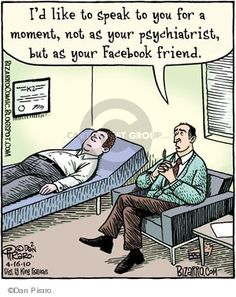
How about this situation: You’re seeing a client who is a writer. You, too, dabble in the written arts. The client mentions his blog during a session, and as soon as he leaves you Google his name, find his blog, and settle in to read it. Your curiosity piqued, you search for him on Facebook. Research, you tell yourself. What you find out will help you understand him better. The next time he comes in you say, “Great blog! I have one too. You should check it out. And if you have any feedback on my writing, I’d love to hear it.”

ethics cartoonWhat’s wrong here? Why not bond with a client over a shared passion? Maybe trade a few sessions for a critique of the novel you’ve been working on. After all, the writer doesn’t have a surplus of cash. It would be a win-win. Right?

No. To borrow a phrase from Cheryl Strayed’s book of quotes Brave Enough: “The short answer is No. The long answer is No.”

You are the therapist. He is the client. It is a one-way street. You must consider all the ways in which your actions could possibly harm the client. You are not friends, buddies, colleagues. You are the keeper of deep secrets, a confidant, a compassionate listener, a mirror. Just in asking, you’ve violated the trust implicit in the counseling relationship. And the client is paying you for a service. Asking for a personal favor, for feedback places an extra burden on the client, a burden he did not sign up for.

Okay. One more. How about this? You are seeing a client who struggles with self-esteem, with feeling heard and being seen. She shares with you some of the poetry she has written. You tell her it is beautiful and moving and wonderful. You email her a couple of poems from your favorite poets and hope they resonate with her the way the do with you. She sends you more of her poetry. It really is beautiful, full of amazing metaphors and gorgeous imagery. You tell her as much. She should be published, you say. She glows in your effusive praise.

What? Is there a problem?

The short answer is Yes. The long answer is Yes. Now the client is seen. Now the client is heard. But by you. Instead of helping her gather her inner resources and find her intrinsic value, you’ve taken a short cut. Basically, you have given her the needle and the spoon and pushed the plunger down, mainlining self-esteem. You are now her source, her dealer, her heroin. Congratulations, you’ve created an addict.boundary issues

There are so many other things to consider here as well. What is poetry? Who sends poems? Poetry is the language of love. People in love send poetry. Poetry is metaphor—a word can have a thousand meanings in a poem. What you read and what the client meant might be vastly different.

What would an ethical counselor do in any of these situations? And why? An ethical counselor must always consider the needs of the clients first. In some respects, a therapist has to see the future and ask herself, “How will my actions and words now impact my client down the road?” “Will I be helping or hurting my client by taking this action?” “What is my motivation?” “Am I getting my own needs met or am I meeting my client’s needs?”

Instead of praising a client’s poetry, ask them what writing poetry does for them? What do they get when they create? How do they feel when they are writing? What’s their process? Explore. Ask questions. Help the client find her own meaning in her work.

I could write for days on this topic. But the bottom line is this: There is a power differential in the therapeutic relationship. The ethical therapist uses her power for the good of the client. Never for herself.

And I’d love to hear your thoughts on the scenarios I’ve presented. What could possibly go wrong in each of these situations? Let me know what you think!

D is for Distal Contextual Affordances (ha ha, just kidding). D is for Diagnosis and DSM 5

Each quarter, as I take new classes and learn new material, I analyze and diagnose myself accordingly. I generally text a friend of mine who is a marriage and family therapist (MFT) during class. Our exchange goes something like this:

Me: OMG, I so have this.
MFT: what?
Me: I wasn’t properly attuned to as a baby. That’s why I’m so fucked up.
MFT: gawd
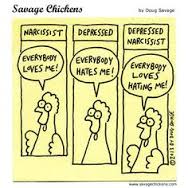
Me: well, it could be that or it could be that I experienced a trauma as an infant.narcissist chicken
MFT: maybe
Me: I was dropped on my head once.
MFT: well, that explains it.
Me: I know, right?
MFT: it’s just one lens, Pam. A theory.
Me: oh. Sorry for being so narcissistic.
MFT: You’re not a narcissist.
Me: borderline?
MFT: ugh.

And so it goes. Each quarter I learn new and fascinating ways to make sense of human behavior.

A few years ago, when I began working on my memoir, I asked my (by then former) psychologist if I could have access to my records. I wanted to reconstruct a timeline of events and double-check my memories. Since she had seen me through some of my darkest hours I figured I would find a good record of events that I had been too depressed and distraught to remember. And I did. But I also discovered how I had been diagnosed, and I found it all a bit unsettling to see the DSM codes next to the list of my symptoms.

If you read yesterday’s blog, Dear Reader, you know that I was depressed. So it came as no surprise when I decoded the DSM codes to find variations on that theme: major depressive disorder, recurrent episode; major depressive disorder, recurrent episode in partial remission; major depressive disorder, severe. And so on. I was fine with these diagnoses and also with the occasional Adjustment Disorder diagnosis that I found. I knew enough by then to know that when a mental health provider doesn’t know what else to use, when a client just needs to chat a bit to clear things up, they use the somewhat ambiguous 309.9 (Adjustment Disorder, Unspecified).

Diagnosing someone with an illness or disorder that appears in the DSM 5 is an art, not a hard science. This latest version of the Diagnostic and Statistical Manual is arranged quite differently from its predecessors with disorders arranged according to lifespan. So, disorders that affect children come first—neurodevelopmental disorders, followed by illnesses that appear in adolescence and early adulthood: schizophrenia and psychosis, depression, anxiety, OCD. These are followed by trauma related disorders, dissociative disorders, somatic (body disorders), feeding and eating disorders, elimination disorders, sexual dysfunctions, substance abuse issues, personality disorders, and paraphilia.

Gone are Axis I, II, III, IV, and V. Used to be that the most acute and familiar disorders—those requiring immediate attention fell under Axis I: schizophrenia, major depressive disorder, panic attacks; ongoing personality issues—narcissism, borderline personality disorder, intellectual disabilities, obsessive/compulsive disorder—fell under Axis II. Axis III was reserved for related medical conditions such as terminal cancer, which might contribute to a client’s depression. Axis IV diagnoses included life events: marriage, job loss, promotions, divorce, death of a parent or child, and Axis V is used for the Global Assessment of Functioning Scale, a 100 point questionnaire evaluating the client’s ability to function in daily life.

What we CMHC (clinical mental health counseling) students all learn early on in our clinical program is that diagnosis is a necessary evil if a mental health care provider wants to take insurance. Insurance companies will not pay if we don’t attach a diagnosis to our clients. At the same time we learn that our clients are much more than walking bundles of diagnoses.

The bottom line is that when a person presents in my office and tells me what’s going on in their life, how they are coping day-to-day, and want to pay for their sessions with insurance, I have to give them a diagnosis. One counselor I’ve talked to diagnoses everyone with PTSD. After all, she says, we have all had trauma in our lives. Others consult the DSM and match the client’s presentation with the best diagnosis.

Failure to attend to details? Difficulty sustaining attention with tasks? Often lose things? Easily distracted? Often forgetful? ADHD 314.

Heart palpitations? Sweating? Trembling and/or shaking? Shortness of breath? Nausea? Choking feelings? Fear of losing control? Fear of dying? Panic Disorder 300.01

Marked distress? Significant impairment in social, occupational or other areas but doesn’t meet the criteria for another mental disorder? Adjustment Disorder 309

When I left the psychologist and started seeing the counselor, I stopped feeling like a hopelessly troubled person and more like a person with some troubles that could be resolved. Instead of being treated for my “mental illness,” I was treated like a person and we looked together at why I might be feeling depressed or anxious or sad or worried. I began to see that my inability to come off my meds for depression had more to do with the fact that in my case, I had been treating the symptoms, but not the root of the issue.

Over time, I came to understand that my behaviors, moods, and thought patterns had more to do with how I had learned, over the course of the last few decades, to deal with the world. Starting in infancy we all learn how to get our needs met. Some of us learn to trust that we will be taken care of, that our needs are important, that our voices are valued. Others not so much.

There are many lenses through which to evaluate human behavior: family systems, attachment theory, behaviorism, post-modernism, Jungian. There are many schools of thought on how to best help people: cognitive behavior therapy, exposure therapy, psychoanalysis, narrative therapy, play therapy, art therapy, drama therapy.

There are a multitude of diagnoses I could apply to my future clients, but my clients deserve more than a label and to be compared against a checklist of criteria.

I must to remember Carl Rogers and not ask, ”How can I treat, or cure, or change this person?” But instead,“How can I provide a relationship which this person may use for [her] own personal growth?”