The F Word

On the days that writing a blog every day seems daunting—which truth be told is pretty much every day—I think about my dad and my grandfather who were journalists. Not only did they have to write every day, they had to write multiple articles that made sense from beginning to end every single day. Not only  made sense but had facts and accurate quotes. And they couldn’t call anyone names (except for once my grandfather wrote an op-ed column that said only this: Jane Fonda is an idiot. She had just gone to Hanoi to sit on the tank. I was very young at the time and had no opinion about this then).

I started my college career as a journalist—I started writing for the Western Front fall quarter of my freshman year, and for a while I found the whole experience exhilarating.  Journalism classes met in an old crickety house on the edge of campus and were taught by rumpled old men in questionable tweed jackets. One professor was the son of Lincoln Steffens, famous muckraker. There were not a lot of women in the program, not a single female professor in the time I was there (a good three years).

We only got two credits for a quarter’s stint on the campus paper, though the time commitment warranted far more than that. The paper came out twice a week and we met constantly it seemed—two nights a week to write headlines. I loved writing headlines—the section editors would give us the space and we had a formula for how many characters the headline could be. I excelled at writing headlines with active verbs and punchy nouns and that skill garnered me a little respect among the scruffy editors—male upperclassmen all. Everyone seemed to smoke and back then no one cared. Ashtrays overflowed with butts and the smoke hung low in the living-room turned newsroom.

Twice a week we had to show up at the print shop on the other end of campus to work on putting the paper together, literally. The section editors were responsible for pasting up their pages, but always needed help cutting and waxing the pages for paste up. I loved the waxing machine, and having grown up the daughter of a newspaper publisher, I knew my way around the layout tables. Exacto knives, blue pencils, the mockup sheets.

And of course we had to write stories. As much as I loved the atmosphere of the department and the headline writing and the paste up process, I wasn’t a big fan of writing the stories. I didn’t really like interviewing people. I was shy for one thing. And I didn’t really have a nose for news. I did great in classes where the local newspaper writer would give us the details and we’d pound out a story in class. I aced those, but I just didn’t seem to have a knack for sussing out the story, and I seriously lacked confidence when it came to calling people and asking for information.

I found my niche in the sports and op-ed pages, finally.  While I could give a damn about student fees and faculty senate stories, I did have a thing for the women’s basketball team (shocking, I know) and I knew my way around the gym. I made a small career out of covering the track and field team and putting together features on the women’s basketball players and coaches. Some dude had beat me out on covering the actual women’s games, a fact that chapped my ass to no end. The track coach once told me that he was impressed with my stories, surprised that I understood and wrote about the events as well as I did. I wasn’t exactly John Reed or Louise Bryant (the movie Reds came out my freshman year and I so wanted to be a journalist covering the Russian revolution), but I wrote good copy. I published humorous op-ed pieces, ala Dave Barry though not anywhere as funny (my mother often told me I’d be the next Erma Bombeck). Eventually, I became sports editor and one summer I was assistant editor. Lots of work for two credits. I suspected the real world wouldn’t treat us much better.

By the time my senior year rolled around, I was pretty sure I didn’t want to make a living as a journalist. My father had been out of the business for a few years by that time and my grandfather had died, though he had been successful as a writer, then editor and owner of a large suburban weekly. At one point I thought maybe if I could drink more and take up smoking, I’d be able to cut it in the newsroom, so I went out and bought a pack of Camel Unfiltereds and a bottle of Jim Beam. I sat on my little 8×8 foot apartment deck and smoked and drank like I’d seen the guys in the newsroom do. All I felt was sick and not long after on an election night it became clear to me when we were all (all of us Western Front reporters) were supposed to go downtown and cover the local, state, and federal elections. I just couldn’t see myself in that role—asking the pressing questions, taking notes, paying that close of attention. I froze at the thought. As much as I loved my name in the byline, I panicked under the pressure. So, I dropped that last 400 level reporting class the next day, just a few credits shy of completing my major and went to the Humanities building to switch to English, with an emphasis in writing.

 ****

            As I think back on this choice, I realize that I didn’t then have a really clear reason for leaving journalism, but it’s becoming clearer to me now. I didn’t have any role models. There wasn’t a single female reporter, professor, mentor, or local professional to whom I could point and say, “She’s who I want to be like.” I remember only one or two other young women in the program, one a photographer and one, slightly older than me who I didn’t ever get to know. I just didn’t ever see myself reflected back to me anywhere in that world. I couldn’t imagine a future there because I couldn’t see anyone like me. So, I joined the relatively cushy ranks of the English department to finish out my college career. I found enough mentors there that I continued on to graduate school and into teaching English composition. I could see myself as an English professor, as a novel writer, as a reader of great fiction and poetry and creative non-fiction. I had role models, finally.

I’m thinking about this all now because I just finished a paper on Karen Horney (pronounced Horn-eye), the founder of Feminine Psychology. She started out as a Freudian in the early part of the 20th century but soon broke ranks with Freud in part because of his limited view of what comprises human nature (sex and aggression and penis envy). As part of this paper writing adventure, I had to find a relevant online video to review and I ended up with this one: The Changing Face of Feminist Psychology. This video traces the struggles female psychologists faced as recently as the 1980s in getting jobs, being taken seriously, being admitted to graduate school. Even though Karen Horney published her work on Feminine Psychology as early as the 1930s, it took another 50 years for women to advance in the field. And then, even as they began to make inroads as part of feminism’s second wave, the 1980s rolled around and everyone declared feminism dead or over with or moot.

But feminism is not dead. As long as we have daughters, we need to keep making sure they know that they can be whatever they want to be, that they can choose whatever career they want, and they will only know those careers are available to them if we make sure our faces are there to reflect back to them. We need to make sure we are the ones writing the editorials explaining perhaps why Jane Fonda went to Hanoi to sit on that tank. That perhaps, as one half of the world’s population, we can have a voice as well whether in the papers, online, in the classroom, the boardroom. Our daughters must see us out there to know that our voices and theirs matter.


TechTherapy for Writers and Other Anxious Folk

I’ve come up with a name and a tag line for my new business supporting writers and technology:  Tech Therapy for Writers and Other Anxious Folk. I’m building a website, too, which is more challenging than I thought it would be. The good news is that by the time the website is up and running, I’ll be excellent at building websites.

That’s the beauty about learning something and practicing it—the more we do it, the better we get, and the better we get, the more whatever it is becomes second nature. And I don’t mean that only the end result becomes easier to achieve. I have discovered that the process becomes more meaningful and profound as well—so much so that the process or practice becomes the focal point of the activity, sometimes eclipsing the product.

I’ve found this to be true with writing—by making a commitment to a haiku a day, I’ve gotten really good at writing them and not just at creating a 5-7-5 syllable poem, but at the craft: choosing the words, noticing the cadence, enjoying the sort of transcendent experience that the process evokes—that little daydream along the way, and more importantly, the connection with another person.

The same thing has happened with the daily blogs. At first, I thought coming up with something to write about everyday would be the biggest challenge, but really, the hardest part is trusting myself once I sit down to write—trusting that what I have to say will somehow connect with at least one other person. Learning to still the voices that tell me no one could possibly care what I think and trusting that place in my gut that reminds me we are all connected and that if I care about something, there are others who do as well.

So more than having a series of blogs at the end of this month, I’ll have an experience of having connected and the practice of connection—of the exchange with readers, the building of a community. And having that community makes the writing easier the next time. Synergy.

So, too, hopefully, it will be with websites and building a business that supports synergy and connection. I have to think that by focusing not just on the end result but on the process, the learning, and the craft we will all come away energized and engaged. And that’s what TechTherapy should be about.

p.s. if you’re interested in techtherapy, drop me a line at pamela.s.helberg@gmail.com

Divine Intervention? Really?

390px-Plane_crash_into_Hudson_River_(crop)I worked for the Catholics when Captain Sully Sullenberger landed US Airways Flight 1549, an Airbus A320-214, in the middle of the Hudson River with such skill and aplomb and no loss of life. A few days later, a picture of the plane– the so-called Miracle on the Hudson–appeared in the staff lunch room, scotch-taped to the whiteboard. There was a drawing of the plane floating in the river and underneath and around the plane were a giant pair of hands. God’s hands as far as I could tell. gods_hands

I wondered that day as I stared at that picture on the whiteboard if Sully was angry that people were more willing (or at least as willing) to credit God and divine intervention than they were his skills as a pilot.

As I stood contemplating this bit of magical thinking, I couldn’t help but wonder about all of the other airplanes in the history of aeronautics that had crash landed with less fortunate outcomes. What pictures were we going to draw of these planes? I imagined the large God hands squeezing the planes and hurtling them like an angry Zeus and his lightning bolts, violently toward earth.

Is this what has happened to the missing Malaysian Airlines flight 370? Did God have some sort of score to settle with the 239 passengers? Where were His huge, cradling hands this time? Evidently God did want to save passenger Greg Candelaria (see this post on Patheos.com blog The Friendly Athiest). Mr. Candelaria credits the Big Guy with divinely intervening in his life, thereby saving him from whatever horrible fate the rest of the passengers succumbed to. This sort of thinking makes absolutely no sense. Somebody made an error and now the plane is gone. Period. Sully made a great save and no one died. Period. No magic.

What sort of arrogance is required to claim God singled you for salvation while condemning your colleague and 238 other people to death? The guy is still with us because he cancelled his trip. All of us who weren’t on that flight should also be able to claim divine intervention, yes?

We may never know what happened to Malaysian Airlines Flight 370. Maybe they got Raptured. Maybe God picked that plane right out of the sky and took it to heaven and we will never find it. Maybe, Mr. Candelaria missed out on that. Maybe god doesn’t want him right now. I wonder if he considered that possibility?

Writing, Always with the Writing

A week ago Sunday I returned from a lovely few days of basking in writerly goodness—a writing retreat to Lummi Island, two events featuring Cheryl Strayed in the ‘ham, and then four days at AWP in Seattle. Coming down over the past week has been a gentle process. I’ve been motivated to work. This blog a day thing is keeping me writing. The daily haikus, too. I’m also reading a lot about writing. I finished Theo Pauline Nestor’s Writing is My Drink—wonderful book, motivating, inspiring. I just bought Dani Shapiro’s Still Writing. I had the privilege of hearing her read a bit from it at AWP. Can’t wait to read it.

Currently I’m reading  Art and Fear: Observations on the Perils (and Rewards) of Artmaking by David Bayles and Ted Orland. The first edition of this book came out in 2001 and it’s currently in it’s 13th printing, so it’s done quite well for a slim volume on art.

I noticed on the end cap on the Memoir section at Village Books the other day—I’m always hovering around the Memoir section, hoping something will happen (irrational, I’m aware)—and there it was, speaking to me as so many of the books do. I passed it by twice before I finally gave in and bought it.

I’m not quite half way through as I type this—turns out it is one of those books best savored over a couple of weeks rather than inhaled overnight. Every night I pick it up and read a few pages. I toss it in my book bag as well and take it with me in case I have time to read something other than my iPhone during the day.

Here’s the first line from the first chapter:  “Making art is difficult.” I’m hooked. Go on. The book seeks to answer, I think, these questions:  If art is so damn hard, how does it even get done at all? What are the obstacles that artists must overcome to create?

I only have to get to page four to find this nugget:  “Making art provides uncomfortably accurate feedback about the gap that inevitably exists between what you intended to do and what you did.” Isn’t that the truth? How different is that paragraph I just wrote from the one that I thought I was going to write five minutes ago? The paragraph in my head practically danced off the page it was so lively, but now there’s this big brown poop pile of words that I actually typed and it bears absolutely no resemblance to what I intended to type. Why is that?

Bayles and Orland would argue that we need to type out many, many ugly piles of mediocre art in order to get to the one golden paragraph, the golden paragraph that shines the proverbial light in the inevitable darkness. Our job, the authors so helpfully point out, is to learn from our work. They say that “the function of the overwhelming majority of [our] artwork is to simply teach [us] how to make the small fraction of [our] artwork that soars.” We learn to work by doing our work.

Everyone has said this in every writing book I’ve read: Anne Lamott, Stephen King, Theo Nestor, Natalie Goldberg, Dani Shapiro are who pop into my  head at the moment. . . we have to put our butts in the chairs, we have to churn out shitty first drafts, we have to live in The Cave. We have to do the work. Cheryl Strayed said it last week when she was in town for Whatcom Reads. Multiple panelists at AWP said it last week. The book is not going to write itself, the painting won’t paint itself.

They also stress the importance of audience. Most people quit producing art when they lose their audience. For many folks, this time comes immediately after finishing school because our audience is suddenly gone. No more teachers, classmates, peers, student showings. It all vanishes and no one has taught us how to find our audience.

The authors make two recommendations. First, make friends with others who make art and share your work. Second, start to think less about showing your work in, say, MoMa, and more about showing it to those friends who make are.

I’m not sure what my point is here except to say that for me, there are two realities about writing—at least for me. The first is that no matter how much I think about writing something, nothing happens until I start actually writing. The second thing is that community is good. A writing community—being among so many writers, so many people with the same purpose, last week awakened the sleeping lazy writer in me. If all these people can write books, so can I. Because they are here to talk about it—they are here to help, to light the way, to pat me on the back, and to just sit across the table from me behind another laptop, working with me.

The Rapture, or Why I’m Afraid of Guillotines

Fun fact about me:  I have a fear of The Rapture. If ever I come home and find The Little Woman missing, her coat, keys, car, and shoes still in the house, I get a little wobbly. My first thought is that she’s been raptured, taken up into the sky by Jesus who has returned to claim the faithful. I, on the other hand, have been Left Behind. I don’t know why TLW would get to go and I would be left behind. After all, when it comes to being sinners, we are pretty much on a par, I think. But, logic has very little to do with The Rapture and my fear of being Left Behind. Generally, TLW is only at the neighbors’, but that doesn’t stop me from breaking into a cold sweat when I can’t find her.

When I was a kid, between the ages of five and 18, my family attended a series churches that, over time, became increasingly Pentecostal. My parents, one a lapsed Catholic, the other an indifferent Lutheran, seemed an unlikely pair for conversion. But, at some point near my fourth birthday, my father got a wild hair that he wanted to live on a farm in the country, and he moved us from an affluent Seattle suburb to a tiny mountain logging town that straddled a state highway. Not long after arriving we began attending a Southern Baptist church, the result of my parents being swept up in the Jesus Freak movement (they could have just become hippies, but noooo).

Eventually my parents became Born Again, baptized (their previous infant sprinklings were deemed insufficient—these were the Baptists after all), and saved for all eternity from the eventual hellfire and brimstone that would one day rain down on earth. When I was ten, I too walked up the aisle at the church during the altar call hymn after the sermon to ask Jesus to be my personal Lord and Savior. My salvation had more to do with the fact that my best friend had gone forward that day at church than with any inner desire on my part to invite Christ into my heart. Nonetheless, I too was baptized, in the Wallace River, on a sunny September afternoon by Pastor John, the Baptist minister.

Not long after my immersion (during which I fully expected a dove to land on my head though this did not happen), the Baptists and my parents parted ways. Details are lost to history, but if my child-memories can be trusted, I think the separation had something to do with theological differences. I remember loud conversations when my parents came home after church business meetings, angry phone calls, and extracurricular activities, like trips to evangelical meetings where devotees waved their arms in the air, spoke in strange languages, and regularly fell out of their chairs. Even as a child, I could sense that the Baptists disapproved of such behavior. My parents on the other hand began adopting these behaviors and sought out a likeminded worship community.

That is how we ended up in the windowless cinderblock building on Sunday mornings, listening to a twitchy pastor in a cheap suit who had only recently left the streets himself. We kids perched impatiently on the cold metal folding chairs and let our minds wander.  As the adults sought redemption, my eyes searched the empty walls, tracing patterns in the bricks, looking for some sign that life might again make sense. The hours wore on and the grown ups babbled and writhed, speaking in tongues and dancing this new and strange dance in the aisles. It seemed dangerous.

Church wasn’t just confined to Sundays. On Wednesdays we again congregated in the soulless room on our folding chairs for Family Night. I know we attended many Family Nights, but only a handful stand out—the movie nights. Someone found a way to tack a once-white sheet to the cinderblock walls and someone else started the Super 8 movie projector. My nightmares began with the threading of that projector. They’ve continued for most of my life.

When we hung out with the Baptists, the adults socialized around Sanka in the kitchen while we kids scrunched all cozy and sweaty-happy into the family room where we watched The Wizard of Oz or Chitty Chitty Bang Bang, happy fun family movies. That all changed when we left the Baptists. In the cinderblock church, movie night wasn’t about cartoons or Disney or anything quite so benign. Instead we were treated to movies designed to literally scare the hell out of us.

The Thief in the Night series of films came along in the mid-1970s and followed the story of Patty, a young married woman who somehow forgot to accept Christ as her personal lord and savior. One morning she wakes up to the sound of an electric razor rattling around in the bathroom sink, her husband gone. We can hear sirens in the background and on the clock radio in her bedroom we hear the frantic announcer describe chaos around the world—people are missing everywhere. Drivers have vanished from cars, children from families, teachers from classrooms, doctors from operating rooms. (We had a bumper sticker on our camper that read “Warning:  In case of the rapture this vehicle will be unmanned”).

As the movie progresses, we learn that the rapture, the second coming of Christ has occurred and soon evil government forces led by the anti-Christ (interesting side note, when I was a kid, I heard much speculation that Henry Kissinger was the anti-Christ) are forcing those unfortunate enough to be Left Behind to take the Mark of the Beast. This mark enables people to conduct basic transactions such as buying food and gasoline. At least at first. Eventually, as the movies (there are four total) progress, the mark is required. Period. (Interesting side note, I remember my grandparents thinking that debit cards were akin to the Mark of the Beast–this thought still occurs to me whenever I use an ATM).

To refuse the Mark of the Beast is to invite certain and unpleasant death. This theme is the gist of the fourth and final movie in the series. We have followed Patty through the first three movies as she wrestles with her new reality and tries to decide if she will accept Christ as her savior or accept the mark and the ease it offers those who take it. Once those Left Behind take the mark of the beast, they will not be allowed into heaven. To take the mark means eternal death and damnation—hellfire and brimstone. Literally living for all of eternity in unimaginable agony. To escape this end, Patty and her friends will have to withstand the period of time known as The Tribulation and await a third coming of Christ—when he returns to collect those who have remained faithful in the face of great pain and suffering.

In short, Patty must decide if she will suffer for a short time on earth in exchange for an eternity in heaven. She finally decides to accept Christ into her heart, to eschew the Mark of the Beast and to accept whatever suffering the Anti-Christ and his henchman have to mete out. Patty is herded along with the others into a church sanctuary. We can hear screams coming from outside the church and the faithful are given one last opportunity to avoid whatever awfulness awaits them beyond the sanctuary door. They can take the mark and live out their remaining days on earth in peace, free from pain and suffering.

As Patty waits in line the screams intensify and a few weak souls ahead of her change their minds, hold out their hands and get the mark tattooed onto their wrists. Their relief is palpable as they walk away. Patty remains stalwart in her decision and the door to her fate draws closer—the faithful faint and are carried out the door. When Patty crosses the threshold, we see what awaits her: a guillotine. Those who have refused to take the Mark of the Beast, those who have remained faithful to Christ and have chosen great agony now in exchange for eternal life, are being beheaded. And they are strapped to the guillotine face up.

You can bet your communion wafers that I toed the line in church after watching those movies. And it’s no wonder I have an unnatural fear of guillotines and a slight issue with anyone touching my neck. I do not want to be Left Behind. Even if we are only going to see the neighbors. Take me along or at least leave me a note.

Gender, George Kelly, and the Coming Revolution

A number of years ago, when my nephew was four we were at the community pool near his home in a very upwardly mobile suburban enclave in the Pacific Northwest. I was wearing my one-piece speedo swimsuit and a pair of cargo shorts, sitting on the edge of the hot tub where he was enjoying a soak and roughhousing with a couple of friends. He looked up at me as I dangled my legs in the bubbling water.

“Auntie Pammie,” he said, “are you a boy or a girl?”

I looked back at his wide open and innocent face, and I could tell immediately that he was genuinely puzzled, that his four-year-old awareness of what made a boy a boy and a girl a girl was in direct conflict with what he saw represented in me. In his world, girls did not have short hair and wear cargo shorts. In his world there was one way to be a girl and another to be a boy and he could not figure out where to put me.

“It must be confusing,” I said to him. “You don’t usually see girls with such short hair or wearing clothes like I wear. But, I’m here to tell you, I am a girl, buddy. I’m definitely a girl.” I smiled at him and thought about all of the ways I could identify myself as a female. I had big boobs for one thing but I wasn’t going to go there with a four year old. I wore diamond earrings, but that didn’t make me a girl anymore, not like it did 25 years ago. I shaved my legs. I was, in fact Auntie Pammie, not Uncle.  I tried to think of how else I could convince him that I was a girl, beyond the obvious. My genitals were not up for discussion. Not poolside, not without his parents’ permission. Probably not ever.

“Okay,” he smiled and went back to playing with his friends in the water.

I breathed a sigh of relief, and his question has become a bit of family folklore. Also, it has jangled in the back of my mind since that day. I was not like his mother and the other mothers in the neighborhood. I didn’t wear make up, heels, ruffles, dresses or skirts. I didn’t even wear girl jeans or shorts. I wore t-shirts and shorts—I dressed more like his dad, my brother. I drank beer with his dad when I visited. I did not sip wine with his mother. I worked with computers for a living. I drove a Jeep.  My brother and sister-in-law were slightly mortified when I relayed the question to them later, but once I started explaining his confusion, they began to understand. He wasn’t being impolite. He had no social construct for me. (if  you haven’t seen Ash Beckham or iO Tillet Wright’s TED talks on gender, check them out here).

I have to write a paper by tomorrow on one George Kelly, one of a dozen or so theorists of the last 100 years or so who have impacted the field of psychology. In one of the classes I’m taking, our weekly papers go along the same lines each week—choose one of the theorists concepts (our favorite concept) and write up a paragraph on it, summarizing it. Then we write another paragraph in which we analyze another source on the same concept.

I started the quarter loving this assignment—first of all it was pretty easy initially to pick and choose concepts that intrigued me from among the early theorists. For Freud, I chose to analyze his theory that anatomy is destiny. I took him to task on that. I had no trouble finding other sources out there on the world wide web to support me in my analysis of his so-called theory. I ran across a TED Talk by Alice Dreger entitled Is Anatomy Destiny which nicely expanded Freud’s discussion on the matter.

In her talk, Dreger, an anatomy historian and advocate for patients whose body types challenge social norms (i.e. conjoined twins, dwarves, intersex folks) refutes Freud’s “anatomy is destiny” assertion. Dreger posits that there is “no such thing as stable anatomical categories that map  . . . simply to stable identity categories.” She goes on to describe how science is now revealing that gender and sex categories are overly simplistic.” For example, Dreger describes a patient who presents as male: looks like a man, acts like a man, has apparent anatomy that is typically male but who has a uterus and ovaries due to androgyne insensitivity syndrome. Dreger has patients whom surgeons want to “normalize” in her words, “not because [the surgery] leave them better off in terms of physical health” but because “they (the anatomically atypical patients) threaten our social categories.” In other words, our cultural, like Freud (and maybe partly because of him) doesn’t know what to do with people whom we don’t understand.

Which brings us nicely back to George Kelly, who in spite of not having written very much, basically established the entire concept of social cognition. Social cognition is, according to our text (Feist’s Theories of Personality) the examination of “the cognitive and attitudinal bases of person perception, including schemas, biases, stereotypes, and prejudiced behavior.”  In other words, people make judgments and base their opinions on what they believe to be true—they form their opinions based on their experiences, how they were raised, their backgrounds, their way of being in the world. They form a social construct.

When Kelly’s theories were used to measure how people viewed gender, it turned out that most people use gender as a means of categorizing other people. Among those who do have biases about gender were more likely to apply gender stereotypes to strangers in social situations. And finally, the study concluded that those who stereotype strangers are more likely to ascribe stereotypical gender behavior to family members, friends, and acquaintances.

What’s the issue, you may wonder? The problem is that gender isn’t binary. According to Dreger and other researchers, gender occurs along a continuum. We might like to neatly categorize people as male or female and attribute behaviors thusly, but I would posit that gender behavior is a social construct foisted upon us by a culture interested in easy answers and quick categorizations. When we judge people according to our own narrow beliefs, we limit them and ourselves. When we believe our dreams are not valid because they fall outside of the gender norms, we cannot reach our full potential.

We are really touchy about gender. Nothing makes us more uncomfortable than not being able to place someone as either male or female. Even me, a lesbian, who despite being of a certain age, has a wide-open mind and tries not to stereotype anyone, still squirms a bit when I am faced with gender ambiguity. Even me, who spent a large portion of my 20s and 30s being called sir (I attribute the confusion to my then narrow hips).

But, the next revolution might be in the offing as transgender rights begin to take center stage. A new discussion and awareness is beginning and I am looking forward to a new unpacking of gender stereotypes and some talk about what it means to be male and female. Imagine doing away with our social constructs around gender—imagine a world in which a four year old doesn’t care if his Auntie Pammie is a boy or a girl, or have to worry about if he likes “girl things” or “boy things.” Imagine a world in which we truly are not judged by the sort of women or men we are, but on our humanity and on the ways in which we treat one another regardless of differences. Freud might be rolling in his grave, but I think George Kelly will be proud.

Scary Ass Hotel

So, please forgive me in advance for what may be a shitty post but I’m without a wifi connection and am desperate to remain committed to my daily blog post. So I’m doing it from my iPhone.

The Little Woman and I traveled to Port Townsend today in order to cheer on our friend Tele who read tonight as part of She Tells Sea Tales, a fundraiser for The Girls Boatbuilding Project. We thought we would work a little romantic getaway into the weekend since the last ferry leaves Port Townsend at 830 and we would therefore have to spend the night. TLW got on the internets at home last night and booked us a hotel room–she found one that wasn’t too pricey in the heart of downtown PT for about $80. She made ferry reservations as well–we figured we would catch an early afternoon sailing and spend the day wandering the shops and uhm having a romantic afternoon in our centrally located hotel room.

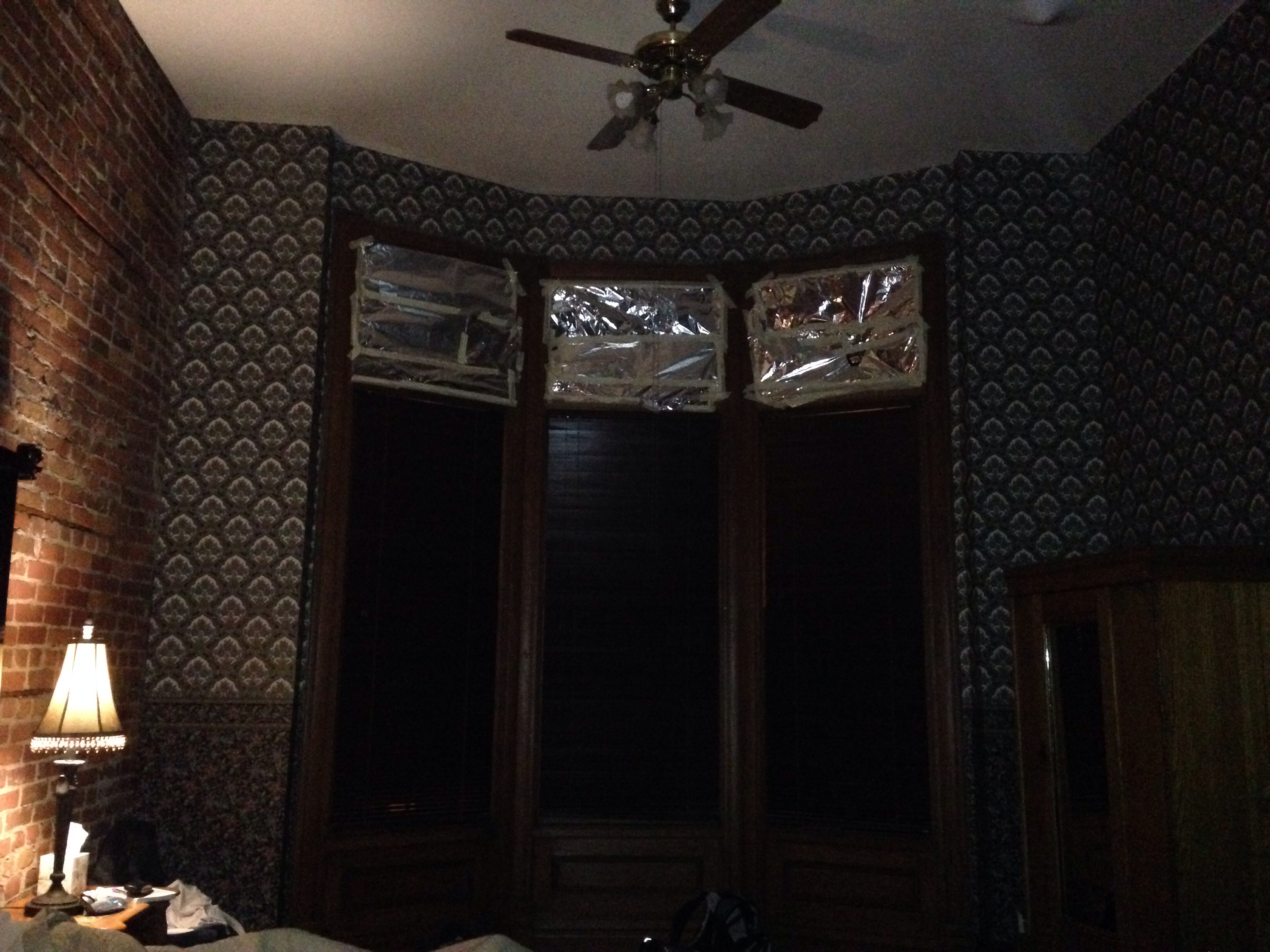
Imagine our surprise then when we arrived to find this: image

And this:
image

We basically dropped our bags and left the room to wander in the rain. Any shop would do thank you so long as we didn’t have to spend any time in this room. The carpets may have been lovely in 1957 but today the are nasty and smell. The hotel may have been grand in say 1878 but today not so much.

Now we are in bed and I am refusing to turn out the light. I can hear the people on the street below as if there are no walls or windows between us. TLW has in her earplugs and is wearing her eye shades and has drifted off to sleep while I peck out this blog on my iPhone and wait for something to crawl out of the large hole in the ceiling above my side of the bed.

If something untoward happens in the middle of the night, at least I will have kept my commitment to this blog. At least I have submitted my haiku for today and gone for a run. I have heard my good friend and writing buddy read for a good cause.

If we make it out the other side., I will never again let TLW book our accommodations.

Thanks for reading and if there are strange phrases or words in this post it’s because I did the whole damn thing on my phone. Because I’m dedicated. Because I don’t want to close my eyes in this scary ass hotel room.

Goodnight. Gulp.

Haiku Love

I continue to write a daily haiku for the Haiku Room—there’s something healing, freeing, magical about writing poetry. I ‘ve never, ever, seen myself as a poet. Even as an angst-ridden teenager who wrote the occasional angst-ridden poem, I knew better than to call myself a poet. But this haiku thing—it’s grabbed hold of me and won’t let go. I look forward to reading the new haikus everyone will post each day—I look forward to the ones I will write. I am loving the challenge of distilling whatever is going on with me down to a mere 17 syllables and I revel in the diversity of postings from the 175 members.

Work frustrations, chemo treatments, children, spouses, parents, nature . . . the topics are varied and the haikus raw, refined, polished, tentative. Each day brings a fresh take on life and love. Some of the writers are actual poets, some with published books. Many writers are also teachers, mothers, wives.  There are a smattering of men.

There is a generosity in the Haiku Room, an expansive and welcoming spirit among a group of disparate folks most of whom have never met one another.  I feel so privileged to be among them and each day welcome the glimpses into these other lives.

Here’s a sampling of my submissions for the past month:

I attend haiku church
Words and syllables offered,
Received. Communion.

Fragile, frangible
My heart’s porcelain terrain
Travel gently here

Words fall from my tongue–
Spilt, dance upon this altar
Freely sacrificed

I am astonished–
What lies beneath the surface?
Ask. Answers astound.

Peel words from my tongue
Thoughts stuck in my throat, silence
Masquerades as truth

Last night we poets
Gathered in my dreams, sacred
Space with food and wine

Who lays hands on you
When the world becomes too much?
What eases your aches?

If I run without
My Nike app or Fitbit
Will the miles still count?

Start with I don’t know
Then turn, face those deep kid fears
Pain embraced can heal

What country would you
Find if you traveled through the
Atlas of my heart?

A ribbon of words
Unfurls and I have written
The way to my heart

Feedback hits my veins
Smack for my ego, mainlined
I close my eyes, sigh

If I exhale words
Will you breathe deeply, and find
Tattoos on your heart?

Words spark and ignite
Tender tinder, dry fuel
Strike a careful match

If my choices are
Deadly darkness or white light
I prefer to burn

Poetry becomes
A complicated riddle
Seek simplicity

Words live on my tongue
Like communion, and sweet wine
Come closer, receive

I am amazed, daily, at what the haiku—a mere 17 syllables—brings to my life. Gratitude abounds.

Shameless Self Promotion

As I embark upon this new adventure, I’ve been pondering ways to integrate my past experience with all things technological with my writing life and my new life as a therapist—how to intertwine computer support, writing, and therapy? I believe I’ve hit upon a solution and am launching a computer support service for writers.

As any writer who has been to a workshop knows, these days it’s all about platform. Platform. Platform. Platform. Marsha. Marsha. Marsha. (Sorry.) Not everyone who writes wants to promote themselves. Some of us just want to write. But the hard truth of the matter is that regardless of what you write or who ends up publishing your writing, you are going to need a platform. For the uninitiated (and sorry if this sounds preachy or redundant, but I’m guessing there are some out there who don’t know), platform is the means by which you promote yourself and your writing and starts with the basics: A Facebook page, a Twitter account, a website. I’m sure, just by virtue of my age, that I’m unaware of the latest social networking tools, but I’m according to this website, FB and Twitter are in the top few still. If you want to sell a book, you need to have an audience and an online presence. This summer at the PNWA conference, one agent said that if we even wanted a publisher to look at our work we needed a minimum of 10,000 Twitter followers. At the time, I had fewer than 80.

I’ve managed to build my Twitter following to nearly 600, but this endeavor is time-consuming. Enter me—budding therapist, aspiring writer, retired technology guru. I can help you build your Twitter following. I can put that Twitter button on your WordPress site for you. I can show you how to create lists and give you tips on generating a following. If you don’t have a Facebook page or if you have a FB page but just one for family and friends, I can help. I can show you how to create an author page and generate followers. If you want a website but aren’t sure if you should go with WordPress, Blogger, or SquareSpace, I can help you decide and walk you through the fine points.

For eight years I worked at a Catholic elementary school helping teachers integrate technology into their classroom. Before that, I taught computer repair skills to adult learners, and prior to that I taught freshman composition to community college students. I’ve taught some of the most difficult subjects to the most challenging students (come on, have YOU ever taught a room full of teachers or displaced workers?) I can certainly help you build your platform. If I can talk Mrs. Koreski into having an interactive whiteboard in her classroom AND teach her to use it, I can help even the most tech-phobic and recalcitrant writer build her platform. I’m even willing to manage said platform (for the right price).

So, lock yourself away in your writing garret if you must, but if you want to sell that shit, you’re going to need a platform. I can help. Drop me a line: pamela.s.helberg@gmail.com

My Surprisingly Not So Dubious Work History

I’ve long held the apparently erroneous belief that aside from being a writer, I am otherwise unemployable, but when I take an objective look at my work history, that just isn’t the case. Now, given the fact that I quit my last job over six months ago and have developed an online presence as a lesbian, feminist, atheist author, I may in fact never get another job, but up until last August, I did a pretty fair job of bringing home the bacon. I guess my belief about my employability stems more from my longtime desire to be a writer than from my willingness to do whatever it took to stay afloat. I’ve even managed to put together a couple of careers amid what seems to be a mishmash of jobs.

I’ve been a college English instructor, a college Computer Information Systems instructor, the technology director for a Catholic elementary school, and a systems analyst for an oil refinery. I’ve owned my own bookstore and managed the bookstore at a technical college. I’ve worked at our local independent bookstore in town a few times over the years, as well as at a national bookstore chain (and for a while I worked both places at once). Not long after I graduated from college I managed to get a job at the local university as a Secretary 3 by lying about my knowledge of filing systems, but my shorthand skills were not what they should have been and I didn’t take orders very well.

During high school I worked at Kentucky Fried Chicken and while in college I dropped out for a quarter and took a gig at Arby’s, but I’ve never waited tables. During the summers while I was in college I worked as a forest fire fighter, first for the department of natural resources and then one summer for the National Park Service. I spent the summer between my junior and senior years of high school in the Youth Conservation Corps on the Olympic Peninsula. Once, I had a job in a television tower putting on local commercials in place of the national ads. I don’t remember much about that job except that I drove miles and miles up a gravel road to this boxlike structure where I climbed a ladder, locked myself in, and watched a lot of tv.  And I did a stint during high school at a print shop where I learned to make silk screens and plates for printing presses, skills I wish I still had today.

Currently I am not working. Ostensibly I quit my job last August in order to pursue my career as a writer, but that’s not really going very well. I’ve discovered something new about myself:  I don’t like to work in isolation. That thing that Robert DeNiro said at the Academy Awards the other night about writers—was so accurate. The mind of a writer IS a terrifying thing—the isolation, the neurosis, the procrastination, panic, self-loathing, it’s all true.  I couldn’t hack it. So, I decided to go back to school. To get my masters degree in mental health counseling. So I can help writers battle the isolation, neuroticism, self-loathing, panic, and procrastination. I mean who better than I to provide this service? I am not planning on giving up on being a writer, but I am going to add “therapist to the worried writer” to my resume. Naturally, I plan to write about this adventure as it unfolds.

Starting a new career at the age of 50 is frightening. Taking on student loans terrifies me (though I do my best not to let on to The Little Woman), but I look at it like this—I have one life, one shot to get it right, one chance to find out really what I was meant to do. I don’t think I’ve figured it out yet, and I’d really like to before all of this comes to an end.