The End

And so ends a month of blogging (nearly) every day. Technically, according to the rules of the NaBloPoMo site we weren’t supposed to blog on the weekends, so considering that, I succeeded, I think in my commitment to blog every day this month.

Tomorrow begins a new challenge–blogging according to the alphabet, starting with a topic beginning with the letter A on April 1 and ending with a topic beginning with Z on the last day of the month (excluding Sundays). I’m still taking suggestions for topics . . . all will be considered.

Thanks for reading this month–looking forward to more anon.


Cher—-Dressed to Kill Tour

I’ve been trying to decide what to write about the Cher concert on Saturday night–I don’t know how to even describe how amazing it was, but then I ran across an article on billboard.com and realized I don’t have to write a damn thing. It’s all here–I completely agree with this assessment. It was wonderful, a little rough in places (it was opening night after all–and she’s not been on tour in 11 years!) but easily forgiven.

Cher is a force of nature–truly, and she also strikes me as a woman who not only knows who she is, but where she came from. She is humble and sincere and honest.  I was particularly struck by something she said in one of the many montages between set changes (the sets were fucking amazing–mind blowing). During a montage about her film career and her Oscar win, she said that she had never felt that she belonged in either the film industry or in the music industry and that winning the Oscar didn’t mean that she was suddenly somebody but that she was most certainly on her way.

It was clear listening to her talk between songs on Saturday night that she still has that sense, that she still, like all of us, is plagued with insecurities and doubts. She wondered out loud that she was surprised anyone was even in the audience. I find it comforting to know that Cher has the same nagging fears as I do, to know that as much as we cast about looking for the magic bullet that will finally allay our insecurities, we aren’t going to find it. We just, again, have to show up and do the work and trust that our audience will come.

And come they did. the place was packed full of people of all ages. I’m so grateful that we were fortunate enough to get tickets, that we have friends in the area who were willing to put up with us for a few days (thanks Paul and Jan!), and that going to the concert came with the added benefit of spending a few days in the sun and warmth.

Life is good–music makes it better. The wigs, outrageous costumes and mind-blowing sets, well they are all merely icing.


Writing is Writing, Right? Write. On Feminine Psychology and Introverts. A Few Words.

I’ve pondered posting the two papers I’ve written this week for my pscyh classes. I mean, it’s not like I haven’t been writing, I just haven’t been writing anything bloggish. I finished up a final paper on Karen Horney (Horn-EYE people, not horn-ee), widely regarded as the mother of Feminine Psychology. Turns out that about 50 years lapsed between the time she took old Freud to task on his penis envy nonsense and women making any inroads into psychology. I found a fascinating video on women in the field as there just wasn’t much out there on Karen H. herself, but quite a lot about on feminine or feminist psychology.  The Changing Face of Feminist Psychology was an excellent historical document.

At one point in this video, one of the women mentions the publication of Our Bodies, Ourselves, the manual on women’s health published by the Boston Women’s Health Collective in 1974 and how that single publication dramatically changed things for women. I remember my best friend (and first ever girlfriend) in high school had that book and how scandalized and tantalized I was by it at the time. I’ve since given it as a gift to many young women in my life, my daughters included. It’s really hard to believe sometimes how huge the strides are that have been made in my lifetime. And then not. As Jane Yoder points out in this video, she watched as her 22 year old daughter graduated from college and went to work in a world where not much had changed at all for women in the past 30 years. And how the university for which she works still has a bare bones maternity policy. Steps forward. Steps backward. We stand still sometimes.

I finished this paper thankful for women like Karen Horney, women who stuck their necks out and challenged the status quo, spoke up when things seemed weird and one-sided, like penis envy. Really? Was it such a stretch that the good old boys couldn’t figure out that it wasn’t the penis women envied but the power conferred upon those who had one? I mean, really, guys.

I then tackled a shorter assignment on the 5 Personality Traits. The assignment was to do a report on our “favorite trait.” Well, that seemed a little odd, given that we all have these traits, allegedly. Hard to choose a favorite. Not like ice cream or a sports team, exactly. Here are the traits, the five traits that modern personality theorists claim we all have (and upon which we each claim a place on the spectrum, more or less): Extraversion, Neuroticism, Openness, Agreeableness, and Conscientiousness.

In hindsight, I probably should have chosen Neuroticism (that, along with Feminine Psychology) is the thing Karen Horney is known for, after all (and, you know, it takes one to know one), but instead I decided to focus on Introversion (yeah, it’s not on the list, right?). Because as an introvert I was so insulted by the way the theorists demeaned us introverts–monotonous they said, boring, passive, meek, not open to new experiences. Come on! Just because I don’t like to make small talk at a cocktail party doesn’t mean I don’t value new experiences, don’t like a thrill, don’t like to leave the house fer chrissake.

A few months ago, maybe a year ago, I read Susan Cain’s excellent book Quiet: The Power of Introverts in a World that Just Can’t Stop Talking. She also has an excellent TED talk, The Power of Introverts in which she takes our culture to task on the devaluation of quiet, of solitude, and the space and time to dream. She’s so right in her assessment of schools and businesses focusing on the group at the expense of the individual. We are sacrificing the thinkers and the dreamers and turning our future over to the people who talk the loudest.

As Cain points out, there is ZERO correlation between being the best talker and having the best ideas. She says that we have given in to a new group think—that all creativity comes from a gregarious place. But, she says, quite correctly, most creative people have a serious streak of introversion because creativity needs long flights of fancy. Kids in school don’t get any time to pursue individual thoughts as they are all involved in group work, even when it comes to creative writing, and if you’ve been in a modern office building lately, you’ll see that the open concept is all the rage. No one gets an office where they can close the door on the noise–now they sit together so they can share ideas. I don’t even know how anything gets accomplished. The Little Woman works in such a space–and frankly I don’t know how she does it. But, she’s an extravert. I’m an introvert.

Hey look–I had a blog post after all. Feminists. Introverts. My people.

Nothing to See Here

I’ve got nothing. I am tapped out. Studying for finals. Getting ready to go on a short vacation. Have orientation for grad school on Wednesday. Running. Working on my shit.

Hopefully I’ll have something useful to say tomorrow, but I figure it’s better not to say much at all than to blather on about nonsense.

Happy St. Paddy’s Day.

xo

P

Sidelined

I was a pretty good baseball player when I was a kid. I could hit and catch and run. For my 9th birthday, I got a genuine leather mitt, one like the big league players used. My dad and I rubbed that mitt with oil and wrapped it up with a ball in the pocket. I sat in my bedroom, in my lime green beanbag chair and spent hours tossing the regulation hardball into the mitt’s pocket. I loved the solid thwap it made when it hit the webbing.

We lived in the boondocks, so there wasn’t really anyone to play catch with, but I threw that ball in the air as high as I could so I could catch it. I tried valiantly and in vain to teach my little brother how to throw. Poor kid—he was only five when he had to endure my berating his terrible arm and aim. Somehow the two of us and the occasional neighbor kid (I use the term neighbor loosely as no one lived within a mile of us) spent hours in the field behind the house playing the best version of the game we could muster amongst ourselves. Mostly our time consisted of shagging overthrown or underthrown balls or wild pitches.

I don’t know where I even learned about the game—we didn’t have television when I was growing up and neither of my parents was much for sports. I have vague recollections of watching the occasional baseball game on tv when I’d visit my grandparents, but the overarching memory there is one of sheer boredom. Nothing seemed to move more slowly than a baseball game on tv. I don’t remember anyone schooling me on the fine points of the game until I was well into my 20s, but somehow I knew the rules.

We played during recess at school. Once our 7th grade teacher let us all out to play on a beautiful spring day. I remember because  I made a miraculous diving catch, snagging a rocketed line drive and my teacher Ms. Allen lavished me with praise, a moment that crystallized in my memory and probably contributed to my lifelong affinity for the game. I adored Ms. Allen and would have gone to the ends of the earth to recreate that moment in time (this proclivity has created all sorts of issues for me, but that’s another blog).

I only tried out once for a baseball team though, in spite of my deep desire to play. Back in the day (way back, people, before Title IX), we had only Little League, and everyone knew that only boys got to play Little League baseball. But I had no alternatives. There were no other places to play, at least not in our little logging town—no girls’ softball through parks and rec and certainly no girls’ sports at the local junior high school I attended.

I didn’t know of any other girls who wanted to try out for Little League, but Billie Jean King had recently defeated Bobby Riggs in The Battle of the Sexes and obviously a seed had been planted in me. Remember try-outs? Remember the days when not everyone who showed up got a ribbon and a place on the team? I showed up for Little League try-outs in Sultan, Washington in 1975. I ran bases with the boys. I fielded grounders and caught fly balls. And I hit line drives out of the infield.

I still remember the ping of the ball flying off the bat the first time I took a swing in the batter’s box, but more than the ping, I remember the collective intake of breath from the onlookers. The shock that a girl could actually hit a pitch, a hard ball, a boys’ baseball, not some looping fat softball pitch (not to disparage my lesbian sisters who played softball). I made it to first.

I made it to first, but I didn’t make the team because an obstacle larger and more unbeatable than Bobby Riggs stood between me and my baseball dreams: Larry Stucker.  Larry Stucker was the stuff of legends in our little town, known to all of the kids anyway as Stucker the Trucker, the Mean Old Fucker.  He drove his own logging truck and his wife was the nicest, meekest woman who taught Sunday school at our church. I was in class with his kid, Shawn, a scrawny, big-nosed, big-eared kid who looked just like his old man and couldn’t play baseball worth a damn. Larry Stucker coached the Little League team I would have been on had he taken me on my merits but Stucker the Trucker wasn’t about to have any girls on his team.

I still have my mitt—and I still use it when I have occasion to play catch or a pick up game of softball. When Taylor was in elementary school, she had a great sense for the game, and we played often in the back yard. I bought her a mitt, and a bat, and a ball, but sports never really interested her the way that they pulled at me when I was that age. Sometimes I wonder if we just always want most the things that we can’t have.

baseballmitt2

The F Word

On the days that writing a blog every day seems daunting—which truth be told is pretty much every day—I think about my dad and my grandfather who were journalists. Not only did they have to write every day, they had to write multiple articles that made sense from beginning to end every single day. Not only  made sense but had facts and accurate quotes. And they couldn’t call anyone names (except for once my grandfather wrote an op-ed column that said only this: Jane Fonda is an idiot. She had just gone to Hanoi to sit on the tank. I was very young at the time and had no opinion about this then).

I started my college career as a journalist—I started writing for the Western Front fall quarter of my freshman year, and for a while I found the whole experience exhilarating.  Journalism classes met in an old crickety house on the edge of campus and were taught by rumpled old men in questionable tweed jackets. One professor was the son of Lincoln Steffens, famous muckraker. There were not a lot of women in the program, not a single female professor in the time I was there (a good three years).

We only got two credits for a quarter’s stint on the campus paper, though the time commitment warranted far more than that. The paper came out twice a week and we met constantly it seemed—two nights a week to write headlines. I loved writing headlines—the section editors would give us the space and we had a formula for how many characters the headline could be. I excelled at writing headlines with active verbs and punchy nouns and that skill garnered me a little respect among the scruffy editors—male upperclassmen all. Everyone seemed to smoke and back then no one cared. Ashtrays overflowed with butts and the smoke hung low in the living-room turned newsroom.

Twice a week we had to show up at the print shop on the other end of campus to work on putting the paper together, literally. The section editors were responsible for pasting up their pages, but always needed help cutting and waxing the pages for paste up. I loved the waxing machine, and having grown up the daughter of a newspaper publisher, I knew my way around the layout tables. Exacto knives, blue pencils, the mockup sheets.

And of course we had to write stories. As much as I loved the atmosphere of the department and the headline writing and the paste up process, I wasn’t a big fan of writing the stories. I didn’t really like interviewing people. I was shy for one thing. And I didn’t really have a nose for news. I did great in classes where the local newspaper writer would give us the details and we’d pound out a story in class. I aced those, but I just didn’t seem to have a knack for sussing out the story, and I seriously lacked confidence when it came to calling people and asking for information.

I found my niche in the sports and op-ed pages, finally.  While I could give a damn about student fees and faculty senate stories, I did have a thing for the women’s basketball team (shocking, I know) and I knew my way around the gym. I made a small career out of covering the track and field team and putting together features on the women’s basketball players and coaches. Some dude had beat me out on covering the actual women’s games, a fact that chapped my ass to no end. The track coach once told me that he was impressed with my stories, surprised that I understood and wrote about the events as well as I did. I wasn’t exactly John Reed or Louise Bryant (the movie Reds came out my freshman year and I so wanted to be a journalist covering the Russian revolution), but I wrote good copy. I published humorous op-ed pieces, ala Dave Barry though not anywhere as funny (my mother often told me I’d be the next Erma Bombeck). Eventually, I became sports editor and one summer I was assistant editor. Lots of work for two credits. I suspected the real world wouldn’t treat us much better.

By the time my senior year rolled around, I was pretty sure I didn’t want to make a living as a journalist. My father had been out of the business for a few years by that time and my grandfather had died, though he had been successful as a writer, then editor and owner of a large suburban weekly. At one point I thought maybe if I could drink more and take up smoking, I’d be able to cut it in the newsroom, so I went out and bought a pack of Camel Unfiltereds and a bottle of Jim Beam. I sat on my little 8×8 foot apartment deck and smoked and drank like I’d seen the guys in the newsroom do. All I felt was sick and not long after on an election night it became clear to me when we were all (all of us Western Front reporters) were supposed to go downtown and cover the local, state, and federal elections. I just couldn’t see myself in that role—asking the pressing questions, taking notes, paying that close of attention. I froze at the thought. As much as I loved my name in the byline, I panicked under the pressure. So, I dropped that last 400 level reporting class the next day, just a few credits shy of completing my major and went to the Humanities building to switch to English, with an emphasis in writing.

 ****

            As I think back on this choice, I realize that I didn’t then have a really clear reason for leaving journalism, but it’s becoming clearer to me now. I didn’t have any role models. There wasn’t a single female reporter, professor, mentor, or local professional to whom I could point and say, “She’s who I want to be like.” I remember only one or two other young women in the program, one a photographer and one, slightly older than me who I didn’t ever get to know. I just didn’t ever see myself reflected back to me anywhere in that world. I couldn’t imagine a future there because I couldn’t see anyone like me. So, I joined the relatively cushy ranks of the English department to finish out my college career. I found enough mentors there that I continued on to graduate school and into teaching English composition. I could see myself as an English professor, as a novel writer, as a reader of great fiction and poetry and creative non-fiction. I had role models, finally.

I’m thinking about this all now because I just finished a paper on Karen Horney (pronounced Horn-eye), the founder of Feminine Psychology. She started out as a Freudian in the early part of the 20th century but soon broke ranks with Freud in part because of his limited view of what comprises human nature (sex and aggression and penis envy). As part of this paper writing adventure, I had to find a relevant online video to review and I ended up with this one: The Changing Face of Feminist Psychology. This video traces the struggles female psychologists faced as recently as the 1980s in getting jobs, being taken seriously, being admitted to graduate school. Even though Karen Horney published her work on Feminine Psychology as early as the 1930s, it took another 50 years for women to advance in the field. And then, even as they began to make inroads as part of feminism’s second wave, the 1980s rolled around and everyone declared feminism dead or over with or moot.

But feminism is not dead. As long as we have daughters, we need to keep making sure they know that they can be whatever they want to be, that they can choose whatever career they want, and they will only know those careers are available to them if we make sure our faces are there to reflect back to them. We need to make sure we are the ones writing the editorials explaining perhaps why Jane Fonda went to Hanoi to sit on that tank. That perhaps, as one half of the world’s population, we can have a voice as well whether in the papers, online, in the classroom, the boardroom. Our daughters must see us out there to know that our voices and theirs matter.

The Rapture, or Why I’m Afraid of Guillotines

Fun fact about me:  I have a fear of The Rapture. If ever I come home and find The Little Woman missing, her coat, keys, car, and shoes still in the house, I get a little wobbly. My first thought is that she’s been raptured, taken up into the sky by Jesus who has returned to claim the faithful. I, on the other hand, have been Left Behind. I don’t know why TLW would get to go and I would be left behind. After all, when it comes to being sinners, we are pretty much on a par, I think. But, logic has very little to do with The Rapture and my fear of being Left Behind. Generally, TLW is only at the neighbors’, but that doesn’t stop me from breaking into a cold sweat when I can’t find her.

When I was a kid, between the ages of five and 18, my family attended a series churches that, over time, became increasingly Pentecostal. My parents, one a lapsed Catholic, the other an indifferent Lutheran, seemed an unlikely pair for conversion. But, at some point near my fourth birthday, my father got a wild hair that he wanted to live on a farm in the country, and he moved us from an affluent Seattle suburb to a tiny mountain logging town that straddled a state highway. Not long after arriving we began attending a Southern Baptist church, the result of my parents being swept up in the Jesus Freak movement (they could have just become hippies, but noooo).

Eventually my parents became Born Again, baptized (their previous infant sprinklings were deemed insufficient—these were the Baptists after all), and saved for all eternity from the eventual hellfire and brimstone that would one day rain down on earth. When I was ten, I too walked up the aisle at the church during the altar call hymn after the sermon to ask Jesus to be my personal Lord and Savior. My salvation had more to do with the fact that my best friend had gone forward that day at church than with any inner desire on my part to invite Christ into my heart. Nonetheless, I too was baptized, in the Wallace River, on a sunny September afternoon by Pastor John, the Baptist minister.

Not long after my immersion (during which I fully expected a dove to land on my head though this did not happen), the Baptists and my parents parted ways. Details are lost to history, but if my child-memories can be trusted, I think the separation had something to do with theological differences. I remember loud conversations when my parents came home after church business meetings, angry phone calls, and extracurricular activities, like trips to evangelical meetings where devotees waved their arms in the air, spoke in strange languages, and regularly fell out of their chairs. Even as a child, I could sense that the Baptists disapproved of such behavior. My parents on the other hand began adopting these behaviors and sought out a likeminded worship community.

That is how we ended up in the windowless cinderblock building on Sunday mornings, listening to a twitchy pastor in a cheap suit who had only recently left the streets himself. We kids perched impatiently on the cold metal folding chairs and let our minds wander.  As the adults sought redemption, my eyes searched the empty walls, tracing patterns in the bricks, looking for some sign that life might again make sense. The hours wore on and the grown ups babbled and writhed, speaking in tongues and dancing this new and strange dance in the aisles. It seemed dangerous.

Church wasn’t just confined to Sundays. On Wednesdays we again congregated in the soulless room on our folding chairs for Family Night. I know we attended many Family Nights, but only a handful stand out—the movie nights. Someone found a way to tack a once-white sheet to the cinderblock walls and someone else started the Super 8 movie projector. My nightmares began with the threading of that projector. They’ve continued for most of my life.

When we hung out with the Baptists, the adults socialized around Sanka in the kitchen while we kids scrunched all cozy and sweaty-happy into the family room where we watched The Wizard of Oz or Chitty Chitty Bang Bang, happy fun family movies. That all changed when we left the Baptists. In the cinderblock church, movie night wasn’t about cartoons or Disney or anything quite so benign. Instead we were treated to movies designed to literally scare the hell out of us.

The Thief in the Night series of films came along in the mid-1970s and followed the story of Patty, a young married woman who somehow forgot to accept Christ as her personal lord and savior. One morning she wakes up to the sound of an electric razor rattling around in the bathroom sink, her husband gone. We can hear sirens in the background and on the clock radio in her bedroom we hear the frantic announcer describe chaos around the world—people are missing everywhere. Drivers have vanished from cars, children from families, teachers from classrooms, doctors from operating rooms. (We had a bumper sticker on our camper that read “Warning:  In case of the rapture this vehicle will be unmanned”).

As the movie progresses, we learn that the rapture, the second coming of Christ has occurred and soon evil government forces led by the anti-Christ (interesting side note, when I was a kid, I heard much speculation that Henry Kissinger was the anti-Christ) are forcing those unfortunate enough to be Left Behind to take the Mark of the Beast. This mark enables people to conduct basic transactions such as buying food and gasoline. At least at first. Eventually, as the movies (there are four total) progress, the mark is required. Period. (Interesting side note, I remember my grandparents thinking that debit cards were akin to the Mark of the Beast–this thought still occurs to me whenever I use an ATM).

To refuse the Mark of the Beast is to invite certain and unpleasant death. This theme is the gist of the fourth and final movie in the series. We have followed Patty through the first three movies as she wrestles with her new reality and tries to decide if she will accept Christ as her savior or accept the mark and the ease it offers those who take it. Once those Left Behind take the mark of the beast, they will not be allowed into heaven. To take the mark means eternal death and damnation—hellfire and brimstone. Literally living for all of eternity in unimaginable agony. To escape this end, Patty and her friends will have to withstand the period of time known as The Tribulation and await a third coming of Christ—when he returns to collect those who have remained faithful in the face of great pain and suffering.

In short, Patty must decide if she will suffer for a short time on earth in exchange for an eternity in heaven. She finally decides to accept Christ into her heart, to eschew the Mark of the Beast and to accept whatever suffering the Anti-Christ and his henchman have to mete out. Patty is herded along with the others into a church sanctuary. We can hear screams coming from outside the church and the faithful are given one last opportunity to avoid whatever awfulness awaits them beyond the sanctuary door. They can take the mark and live out their remaining days on earth in peace, free from pain and suffering.

As Patty waits in line the screams intensify and a few weak souls ahead of her change their minds, hold out their hands and get the mark tattooed onto their wrists. Their relief is palpable as they walk away. Patty remains stalwart in her decision and the door to her fate draws closer—the faithful faint and are carried out the door. When Patty crosses the threshold, we see what awaits her: a guillotine. Those who have refused to take the Mark of the Beast, those who have remained faithful to Christ and have chosen great agony now in exchange for eternal life, are being beheaded. And they are strapped to the guillotine face up.

You can bet your communion wafers that I toed the line in church after watching those movies. And it’s no wonder I have an unnatural fear of guillotines and a slight issue with anyone touching my neck. I do not want to be Left Behind. Even if we are only going to see the neighbors. Take me along or at least leave me a note.

Gender, George Kelly, and the Coming Revolution

A number of years ago, when my nephew was four we were at the community pool near his home in a very upwardly mobile suburban enclave in the Pacific Northwest. I was wearing my one-piece speedo swimsuit and a pair of cargo shorts, sitting on the edge of the hot tub where he was enjoying a soak and roughhousing with a couple of friends. He looked up at me as I dangled my legs in the bubbling water.

“Auntie Pammie,” he said, “are you a boy or a girl?”

I looked back at his wide open and innocent face, and I could tell immediately that he was genuinely puzzled, that his four-year-old awareness of what made a boy a boy and a girl a girl was in direct conflict with what he saw represented in me. In his world, girls did not have short hair and wear cargo shorts. In his world there was one way to be a girl and another to be a boy and he could not figure out where to put me.

“It must be confusing,” I said to him. “You don’t usually see girls with such short hair or wearing clothes like I wear. But, I’m here to tell you, I am a girl, buddy. I’m definitely a girl.” I smiled at him and thought about all of the ways I could identify myself as a female. I had big boobs for one thing but I wasn’t going to go there with a four year old. I wore diamond earrings, but that didn’t make me a girl anymore, not like it did 25 years ago. I shaved my legs. I was, in fact Auntie Pammie, not Uncle.  I tried to think of how else I could convince him that I was a girl, beyond the obvious. My genitals were not up for discussion. Not poolside, not without his parents’ permission. Probably not ever.

“Okay,” he smiled and went back to playing with his friends in the water.

I breathed a sigh of relief, and his question has become a bit of family folklore. Also, it has jangled in the back of my mind since that day. I was not like his mother and the other mothers in the neighborhood. I didn’t wear make up, heels, ruffles, dresses or skirts. I didn’t even wear girl jeans or shorts. I wore t-shirts and shorts—I dressed more like his dad, my brother. I drank beer with his dad when I visited. I did not sip wine with his mother. I worked with computers for a living. I drove a Jeep.  My brother and sister-in-law were slightly mortified when I relayed the question to them later, but once I started explaining his confusion, they began to understand. He wasn’t being impolite. He had no social construct for me. (if  you haven’t seen Ash Beckham or iO Tillet Wright’s TED talks on gender, check them out here).

I have to write a paper by tomorrow on one George Kelly, one of a dozen or so theorists of the last 100 years or so who have impacted the field of psychology. In one of the classes I’m taking, our weekly papers go along the same lines each week—choose one of the theorists concepts (our favorite concept) and write up a paragraph on it, summarizing it. Then we write another paragraph in which we analyze another source on the same concept.

I started the quarter loving this assignment—first of all it was pretty easy initially to pick and choose concepts that intrigued me from among the early theorists. For Freud, I chose to analyze his theory that anatomy is destiny. I took him to task on that. I had no trouble finding other sources out there on the world wide web to support me in my analysis of his so-called theory. I ran across a TED Talk by Alice Dreger entitled Is Anatomy Destiny which nicely expanded Freud’s discussion on the matter.

In her talk, Dreger, an anatomy historian and advocate for patients whose body types challenge social norms (i.e. conjoined twins, dwarves, intersex folks) refutes Freud’s “anatomy is destiny” assertion. Dreger posits that there is “no such thing as stable anatomical categories that map  . . . simply to stable identity categories.” She goes on to describe how science is now revealing that gender and sex categories are overly simplistic.” For example, Dreger describes a patient who presents as male: looks like a man, acts like a man, has apparent anatomy that is typically male but who has a uterus and ovaries due to androgyne insensitivity syndrome. Dreger has patients whom surgeons want to “normalize” in her words, “not because [the surgery] leave them better off in terms of physical health” but because “they (the anatomically atypical patients) threaten our social categories.” In other words, our cultural, like Freud (and maybe partly because of him) doesn’t know what to do with people whom we don’t understand.

Which brings us nicely back to George Kelly, who in spite of not having written very much, basically established the entire concept of social cognition. Social cognition is, according to our text (Feist’s Theories of Personality) the examination of “the cognitive and attitudinal bases of person perception, including schemas, biases, stereotypes, and prejudiced behavior.”  In other words, people make judgments and base their opinions on what they believe to be true—they form their opinions based on their experiences, how they were raised, their backgrounds, their way of being in the world. They form a social construct.

When Kelly’s theories were used to measure how people viewed gender, it turned out that most people use gender as a means of categorizing other people. Among those who do have biases about gender were more likely to apply gender stereotypes to strangers in social situations. And finally, the study concluded that those who stereotype strangers are more likely to ascribe stereotypical gender behavior to family members, friends, and acquaintances.

What’s the issue, you may wonder? The problem is that gender isn’t binary. According to Dreger and other researchers, gender occurs along a continuum. We might like to neatly categorize people as male or female and attribute behaviors thusly, but I would posit that gender behavior is a social construct foisted upon us by a culture interested in easy answers and quick categorizations. When we judge people according to our own narrow beliefs, we limit them and ourselves. When we believe our dreams are not valid because they fall outside of the gender norms, we cannot reach our full potential.

We are really touchy about gender. Nothing makes us more uncomfortable than not being able to place someone as either male or female. Even me, a lesbian, who despite being of a certain age, has a wide-open mind and tries not to stereotype anyone, still squirms a bit when I am faced with gender ambiguity. Even me, who spent a large portion of my 20s and 30s being called sir (I attribute the confusion to my then narrow hips).

But, the next revolution might be in the offing as transgender rights begin to take center stage. A new discussion and awareness is beginning and I am looking forward to a new unpacking of gender stereotypes and some talk about what it means to be male and female. Imagine doing away with our social constructs around gender—imagine a world in which a four year old doesn’t care if his Auntie Pammie is a boy or a girl, or have to worry about if he likes “girl things” or “boy things.” Imagine a world in which we truly are not judged by the sort of women or men we are, but on our humanity and on the ways in which we treat one another regardless of differences. Freud might be rolling in his grave, but I think George Kelly will be proud.

Scary Ass Hotel

So, please forgive me in advance for what may be a shitty post but I’m without a wifi connection and am desperate to remain committed to my daily blog post. So I’m doing it from my iPhone.

The Little Woman and I traveled to Port Townsend today in order to cheer on our friend Tele who read tonight as part of She Tells Sea Tales, a fundraiser for The Girls Boatbuilding Project. We thought we would work a little romantic getaway into the weekend since the last ferry leaves Port Townsend at 830 and we would therefore have to spend the night. TLW got on the internets at home last night and booked us a hotel room–she found one that wasn’t too pricey in the heart of downtown PT for about $80. She made ferry reservations as well–we figured we would catch an early afternoon sailing and spend the day wandering the shops and uhm having a romantic afternoon in our centrally located hotel room.

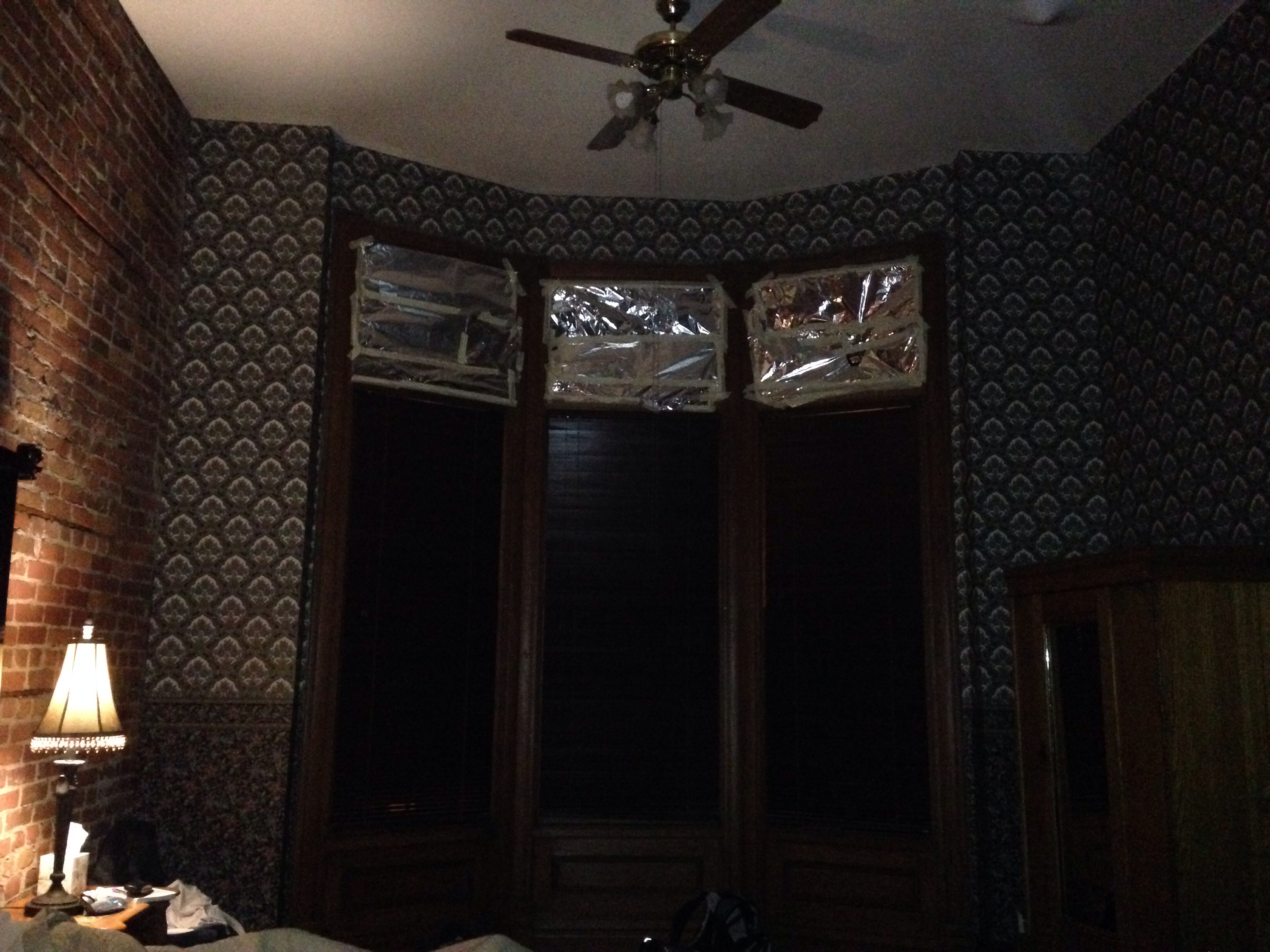
Imagine our surprise then when we arrived to find this: image

And this:
image

We basically dropped our bags and left the room to wander in the rain. Any shop would do thank you so long as we didn’t have to spend any time in this room. The carpets may have been lovely in 1957 but today the are nasty and smell. The hotel may have been grand in say 1878 but today not so much.

Now we are in bed and I am refusing to turn out the light. I can hear the people on the street below as if there are no walls or windows between us. TLW has in her earplugs and is wearing her eye shades and has drifted off to sleep while I peck out this blog on my iPhone and wait for something to crawl out of the large hole in the ceiling above my side of the bed.

If something untoward happens in the middle of the night, at least I will have kept my commitment to this blog. At least I have submitted my haiku for today and gone for a run. I have heard my good friend and writing buddy read for a good cause.

If we make it out the other side., I will never again let TLW book our accommodations.

Thanks for reading and if there are strange phrases or words in this post it’s because I did the whole damn thing on my phone. Because I’m dedicated. Because I don’t want to close my eyes in this scary ass hotel room.

Goodnight. Gulp.

Haiku Love

I continue to write a daily haiku for the Haiku Room—there’s something healing, freeing, magical about writing poetry. I ‘ve never, ever, seen myself as a poet. Even as an angst-ridden teenager who wrote the occasional angst-ridden poem, I knew better than to call myself a poet. But this haiku thing—it’s grabbed hold of me and won’t let go. I look forward to reading the new haikus everyone will post each day—I look forward to the ones I will write. I am loving the challenge of distilling whatever is going on with me down to a mere 17 syllables and I revel in the diversity of postings from the 175 members.

Work frustrations, chemo treatments, children, spouses, parents, nature . . . the topics are varied and the haikus raw, refined, polished, tentative. Each day brings a fresh take on life and love. Some of the writers are actual poets, some with published books. Many writers are also teachers, mothers, wives.  There are a smattering of men.

There is a generosity in the Haiku Room, an expansive and welcoming spirit among a group of disparate folks most of whom have never met one another.  I feel so privileged to be among them and each day welcome the glimpses into these other lives.

Here’s a sampling of my submissions for the past month:

I attend haiku church
Words and syllables offered,
Received. Communion.

Fragile, frangible
My heart’s porcelain terrain
Travel gently here

Words fall from my tongue–
Spilt, dance upon this altar
Freely sacrificed

I am astonished–
What lies beneath the surface?
Ask. Answers astound.

Peel words from my tongue
Thoughts stuck in my throat, silence
Masquerades as truth

Last night we poets
Gathered in my dreams, sacred
Space with food and wine

Who lays hands on you
When the world becomes too much?
What eases your aches?

If I run without
My Nike app or Fitbit
Will the miles still count?

Start with I don’t know
Then turn, face those deep kid fears
Pain embraced can heal

What country would you
Find if you traveled through the
Atlas of my heart?

A ribbon of words
Unfurls and I have written
The way to my heart

Feedback hits my veins
Smack for my ego, mainlined
I close my eyes, sigh

If I exhale words
Will you breathe deeply, and find
Tattoos on your heart?

Words spark and ignite
Tender tinder, dry fuel
Strike a careful match

If my choices are
Deadly darkness or white light
I prefer to burn

Poetry becomes
A complicated riddle
Seek simplicity

Words live on my tongue
Like communion, and sweet wine
Come closer, receive

I am amazed, daily, at what the haiku—a mere 17 syllables—brings to my life. Gratitude abounds.