N is for Names or What Am I?

NLast week in my counseling and professional identity class, a class I should have taken four quarters ago, we spent a good hour and a half debating what we should call ourselves: counselors or therapists? I like therapist, personally, and was more than a bit frustrated that we’d spent so much time splitting hairs, focused on semantics rather than content. At my current tuition rate, this inane conversation cost me approximately $150. Yes, we are studying in the Clinical Mental Health Counseling program. And yes, as a group, we are referred to as counselors. But on a daily basis, in my practice, I will call myself a therapist.

Evidently, in the fine state of California, the marriage and family therapist lobby has legally taken the name of therapist for themselves. No one can call themselves a therapist if they are not, in fact, a licensed MFT. But I do not live and practice in California. Nor do I plan to.keep-calm-the-therapist-is-here-9

Some of my classmates (well, one in particular) thought that therapist reeked of white, upper class privilege. She actually looked across the classroom at me and said something to the effect of “therapy implies rich housewives going to whine about their lives once a week.” Others in the class thought therapist has a negative, destructive connotation, as in electroshock therapy and reparative therapy.

I tried not to take these opinions personally, but I do use the term therapy when I go to see my Licensed Mental Health Counselor once a week. I do not go to whine about my life, however. I go seeking healing and strategies for making my life richer and more meaningful. I go to get help making sense of my history, to learn how it impacts me now. I go to figure out how I can be happier, more fulfilled, less stressed. In short, I seek therapy in order to heal and live better.

In fact, the root of the word, thera, traced back to its origins means “forward” “progress” and “healing,” all of which make me want to be a therapist, to call myself a therapist, even more. To be someone who helps others move forward, to progress, and to heal? Sign me up.

BLOG-counselor-inundatedCounselor, on the other hand, to my ear sounds like someone who gives advice, and, in particular, legal advice. Or, like a school counselor–someone who talks to children who have misbehaved. If there’s one thing I don’t want to do it’s work with children. And, if there’s one thing I’ve learned in my five quarters of school, it’s that we counselors/therapists are not to dispense advice. We are to listen, to guide, to inquire, to reflect, to mirror, to ask questions, but we are not to give advice or tell our clients what they should or should not do.

The American Counselors Association (ACA) Code of Ethics tells us that we are to avoid imposing our values on clients (Section A.4.b.) What is advice if not an imposition of values?

The bottom line is that it doesn’t matter what I call myself if I practice in Washington State. I can get my degree in mental health counseling and call myself a therapist or I can call myself a counselor. I can see upper middle class white housewives or I can see lower socioeconomic white people. I can see whoever wants to come and sit across from me and tell me their struggles. I can offer them a chance to heal, a way forward, a path of progress. I can give them therapy.

Running Happy

Happy Before Pic
Happy Before Pic

Tomorrow morning at 8:30, I am running my first ever half marathon (my friend Cami puts on The Windhorse Half Marathon each year–read about it here). I’ve never run more than 11 miles, so this is a new adventure, one that I’ve been working up to for the past few months (though not really on purpose). Since January, I’ve logged nearly 700 running miles, and last Saturday I completed the Chuckanut Foot Race which is a little more than half of the run I’ll be doing tomorrow—the same basic route, only tomorrow I’ll have to run back.

chuckanutfootrace pic face
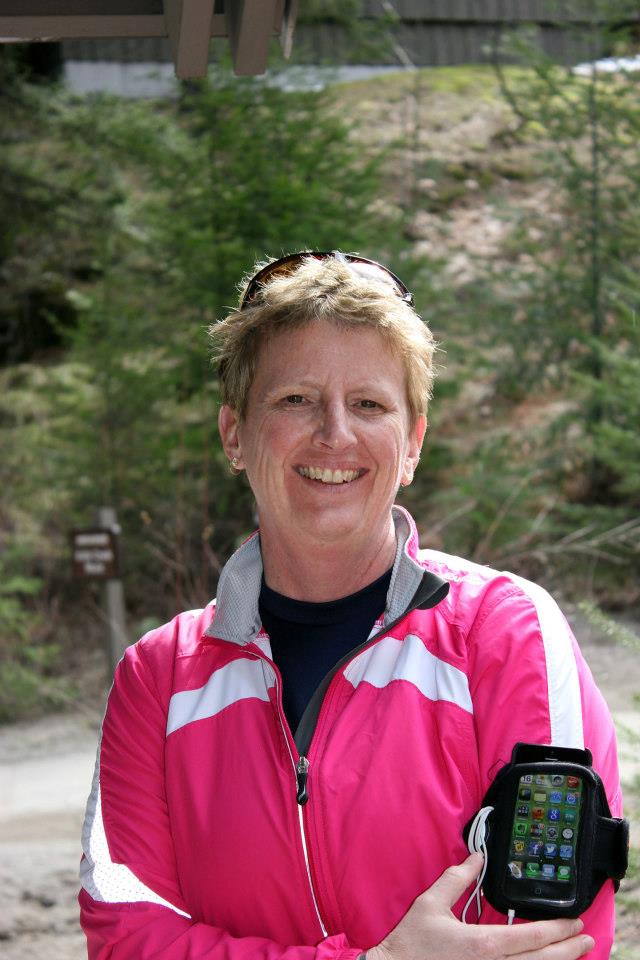
Really, I’m happy!

My running buddy and friend April has a sticker on the back of her car that says Run Happy. I love this sticker because running makes me happy. Not that anyone who sees my Chuckanut Footrace race photo would know this fact. In fact, if I do a quick review of recent race photos, I don’t look happy at all. Not while I’m running. I look happy before and after, but the pictures of me actually running definitely paint a more dire picture. I look like I’m expecting the world to end. No one would have any idea that my mind has been occupying a very happy place as the miles unfurl beneath my winged feet.

A few months ago, an acquaintance saw me running at my usual morning running spot. I grunted in her general direction as I ran past, maybe managed to give her a little wave, and continued on my way, focused on the task at hand, i.e. running. When I saw her later in the week, she asked me if I’d been running under a little black cloud that morning because I seemed “dark” when she saw me. I thought about that comment for a moment. “Yeah, I guess,” I said, “some days I feel like the windshield, some days like the bug. Today, I was the bug.” I shrugged and forgot about our conversation. Until I saw her on the trail again a couple of weeks later—then I made a concerted effort to smile. I didn’t want her to think I ran under a dark cloud. I love running—it makes me happy even though it sometimes hurts.

Happy?
Happy?

One of the things I love about my favorite running trail is that for the most part, the regulars are a friendly bunch. Most of the folks I see regularly smile and wave. Some say good morning. I smile and wave back. I try to remember to smile and make eye contact when someone comes my way. One of the reasons I run the trail clockwise is because most people run counter clockwise—I can see more people this way, and fewer people run past me. I startle easily when other, faster, runners pass me from behind. I’ve run other trails, but have yet to encounter such a consistently cheerful bunch of morning exercisers.

Just this morning as I was walking around the lake (I couldn’t stay away—my morning routine has become, well, my morning routine. I didn’t run though—being in taper mode—I just walked one time around), one of the regulars stopped me to tell me how she had noticed how much weight I’d lost in the past few months. Wow. I was touched, amazed actually, that she would reach out like that, but that’s what running has become for me—connection: with strangers, with friendly faces, with a community.

Running makes me happy—happy enough that I’m going to lace up my shoes and run 13.1 miles tomorrow.

Happy!
Happy!


On Failing Better

It’s been a tough week, wrapping up with finals, keeping up with my wifely duties (mostly being door person to the cats), and contemplating a new direction in life in the form of grad school (starting in the Clinical Mental Health Counseling program at Antioch University in April). Yesterday I attended orientation–and I’m excited to get going. That said, I’ve been wrestling with my writing too–what it means, how I do it, what will happen to it once I start school. I’m thinking there will be an intersection for me, a sweet spot between counseling and writing. Not sure yet what it will look like, but I suspect I will find it.

Mostly though I’ve been thinking about what it means to write, to be a writer. How I relate to the world via the written word.  Starting this blog a day commitment almost three weeks ago has reinforced much of what I already know–that nothing works quite so well as putting my butt in the chair–that usually even if I don’t think I have anything to say, if I just sit down and start writing, something will manifest. Not everything will be deep or terribly meaningful, but every now and then I hit on something I can work with, mold into more meaning. I’m turning out some shitty first and final drafts because oftentimes they are one and the same.

The blog isn’t a great format for me for in-depth explorations as I haven’t been devoting enough time to it. I write a piece and then spend the next few hours or days after posting thinking I should take it down, thinking “oh man, I should have said x and done more research so I could have said y” and generally wishing I was smarter or more thoughtful with more time and a deeper commitment. So many times I find blogs and articles on exactly my point that are far more articulate, funnier, and published in actual publications. And I berate myself further.

I started reading Dani Shapiro’s lovely new book Still Writing today on the plane today. I’ve been toting it around with me for several days now, waiting for the right moment to break into it. Today I needed to read what she had written. She writes about the inner censor, the one that sits on the writer’s left shoulder and says things like “that’s stupid” and “how boring” and “you’re wasting your time.”  Anyone who creates anything knows this voice intimately. We know to get any work done we have to ignore her, silence her, wrestle her to the ground and say “look bitch, I’m going to fucking write so just fucking fuck off.” She will sometimes slink away for a bit.

I’ve noticed the Censor doesn’t come around so much when I’m writing haikus. Ironically (is that the right use of this word Kari Neumeyer?), the daily haiku practice, of which I’ve written about  twice now (here and here), has actually been good for my writer’s ego. I get more bang for my syllabic buck with the haiku. For one thing, I have a venue in which I post and in that venue, a closed Facebook group, I’ve found a thriving community full of cheerful support and thoughtful feedback.

I’ve shared some of my haikus with other folks as well, people I know in real life, offline as it were (email is so luddite, it practically counts as being offline, don’t you think?). My commitment to writing a haiku a day has inspired others to do the same. Some people have shared theirs with me–a haiku exchange. I’ve found kindred spirits–it’s not everyone who understands what it means to distill an experience or a feeling or a sensation down to 17 intentional syllables. Even fewer people get excited about the process. Here it is less about ego and more about connection. There’s something holy there, sacred. A communion:

I attend haiku church
Words and syllables offered,
Received. Communion.

Words live on my tongue
Like communion, and sweet wine
Come closer, receive

(I love that I can use all of that religious imagery from my childhood to illuminate my love of writing and poetry. Finally.)

I love too that poetry is mystery–the making of it is a strange alchemy, and even when words are so intentionally selected, the meanings from person to person vary wildly. Poetry engages the imagination in a way that prose doesn’t. I know this may not be news to most of you, but I’m late to the poetry lovefest. I didn’t ever think I could enjoy poetry, let alone write it until recently someone put it in front of me and said read, this is great, expansive, mind blowing stuff. It is.

Writing is powerful, transformative medicine–for the reader and for the writer. As Dani Shapiro says

“the page is your mirror. What happens inside you is reflected back. You come face to face with your own resistance, lack of balance, self-loathing, and insatiable ego–and also with your singular vision, guts, and attitude . . . life is usually right out there, ready to knock us over when we get too sure of ourselves. Fortunately if we have learned the lessons that years of practice have taught us, when this happens, we endure. We fail better. We sit up and dust ourselves off, and begin again.”

This place, I think, in the failing, the sitting up, the beginning again, is where my career in counseling will intersect with what I know and love about writing.

The F Word

On the days that writing a blog every day seems daunting—which truth be told is pretty much every day—I think about my dad and my grandfather who were journalists. Not only did they have to write every day, they had to write multiple articles that made sense from beginning to end every single day. Not only  made sense but had facts and accurate quotes. And they couldn’t call anyone names (except for once my grandfather wrote an op-ed column that said only this: Jane Fonda is an idiot. She had just gone to Hanoi to sit on the tank. I was very young at the time and had no opinion about this then).

I started my college career as a journalist—I started writing for the Western Front fall quarter of my freshman year, and for a while I found the whole experience exhilarating.  Journalism classes met in an old crickety house on the edge of campus and were taught by rumpled old men in questionable tweed jackets. One professor was the son of Lincoln Steffens, famous muckraker. There were not a lot of women in the program, not a single female professor in the time I was there (a good three years).

We only got two credits for a quarter’s stint on the campus paper, though the time commitment warranted far more than that. The paper came out twice a week and we met constantly it seemed—two nights a week to write headlines. I loved writing headlines—the section editors would give us the space and we had a formula for how many characters the headline could be. I excelled at writing headlines with active verbs and punchy nouns and that skill garnered me a little respect among the scruffy editors—male upperclassmen all. Everyone seemed to smoke and back then no one cared. Ashtrays overflowed with butts and the smoke hung low in the living-room turned newsroom.

Twice a week we had to show up at the print shop on the other end of campus to work on putting the paper together, literally. The section editors were responsible for pasting up their pages, but always needed help cutting and waxing the pages for paste up. I loved the waxing machine, and having grown up the daughter of a newspaper publisher, I knew my way around the layout tables. Exacto knives, blue pencils, the mockup sheets.

And of course we had to write stories. As much as I loved the atmosphere of the department and the headline writing and the paste up process, I wasn’t a big fan of writing the stories. I didn’t really like interviewing people. I was shy for one thing. And I didn’t really have a nose for news. I did great in classes where the local newspaper writer would give us the details and we’d pound out a story in class. I aced those, but I just didn’t seem to have a knack for sussing out the story, and I seriously lacked confidence when it came to calling people and asking for information.

I found my niche in the sports and op-ed pages, finally.  While I could give a damn about student fees and faculty senate stories, I did have a thing for the women’s basketball team (shocking, I know) and I knew my way around the gym. I made a small career out of covering the track and field team and putting together features on the women’s basketball players and coaches. Some dude had beat me out on covering the actual women’s games, a fact that chapped my ass to no end. The track coach once told me that he was impressed with my stories, surprised that I understood and wrote about the events as well as I did. I wasn’t exactly John Reed or Louise Bryant (the movie Reds came out my freshman year and I so wanted to be a journalist covering the Russian revolution), but I wrote good copy. I published humorous op-ed pieces, ala Dave Barry though not anywhere as funny (my mother often told me I’d be the next Erma Bombeck). Eventually, I became sports editor and one summer I was assistant editor. Lots of work for two credits. I suspected the real world wouldn’t treat us much better.

By the time my senior year rolled around, I was pretty sure I didn’t want to make a living as a journalist. My father had been out of the business for a few years by that time and my grandfather had died, though he had been successful as a writer, then editor and owner of a large suburban weekly. At one point I thought maybe if I could drink more and take up smoking, I’d be able to cut it in the newsroom, so I went out and bought a pack of Camel Unfiltereds and a bottle of Jim Beam. I sat on my little 8×8 foot apartment deck and smoked and drank like I’d seen the guys in the newsroom do. All I felt was sick and not long after on an election night it became clear to me when we were all (all of us Western Front reporters) were supposed to go downtown and cover the local, state, and federal elections. I just couldn’t see myself in that role—asking the pressing questions, taking notes, paying that close of attention. I froze at the thought. As much as I loved my name in the byline, I panicked under the pressure. So, I dropped that last 400 level reporting class the next day, just a few credits shy of completing my major and went to the Humanities building to switch to English, with an emphasis in writing.

 ****

            As I think back on this choice, I realize that I didn’t then have a really clear reason for leaving journalism, but it’s becoming clearer to me now. I didn’t have any role models. There wasn’t a single female reporter, professor, mentor, or local professional to whom I could point and say, “She’s who I want to be like.” I remember only one or two other young women in the program, one a photographer and one, slightly older than me who I didn’t ever get to know. I just didn’t ever see myself reflected back to me anywhere in that world. I couldn’t imagine a future there because I couldn’t see anyone like me. So, I joined the relatively cushy ranks of the English department to finish out my college career. I found enough mentors there that I continued on to graduate school and into teaching English composition. I could see myself as an English professor, as a novel writer, as a reader of great fiction and poetry and creative non-fiction. I had role models, finally.

I’m thinking about this all now because I just finished a paper on Karen Horney (pronounced Horn-eye), the founder of Feminine Psychology. She started out as a Freudian in the early part of the 20th century but soon broke ranks with Freud in part because of his limited view of what comprises human nature (sex and aggression and penis envy). As part of this paper writing adventure, I had to find a relevant online video to review and I ended up with this one: The Changing Face of Feminist Psychology. This video traces the struggles female psychologists faced as recently as the 1980s in getting jobs, being taken seriously, being admitted to graduate school. Even though Karen Horney published her work on Feminine Psychology as early as the 1930s, it took another 50 years for women to advance in the field. And then, even as they began to make inroads as part of feminism’s second wave, the 1980s rolled around and everyone declared feminism dead or over with or moot.

But feminism is not dead. As long as we have daughters, we need to keep making sure they know that they can be whatever they want to be, that they can choose whatever career they want, and they will only know those careers are available to them if we make sure our faces are there to reflect back to them. We need to make sure we are the ones writing the editorials explaining perhaps why Jane Fonda went to Hanoi to sit on that tank. That perhaps, as one half of the world’s population, we can have a voice as well whether in the papers, online, in the classroom, the boardroom. Our daughters must see us out there to know that our voices and theirs matter.

My Surprisingly Not So Dubious Work History

I’ve long held the apparently erroneous belief that aside from being a writer, I am otherwise unemployable, but when I take an objective look at my work history, that just isn’t the case. Now, given the fact that I quit my last job over six months ago and have developed an online presence as a lesbian, feminist, atheist author, I may in fact never get another job, but up until last August, I did a pretty fair job of bringing home the bacon. I guess my belief about my employability stems more from my longtime desire to be a writer than from my willingness to do whatever it took to stay afloat. I’ve even managed to put together a couple of careers amid what seems to be a mishmash of jobs.

I’ve been a college English instructor, a college Computer Information Systems instructor, the technology director for a Catholic elementary school, and a systems analyst for an oil refinery. I’ve owned my own bookstore and managed the bookstore at a technical college. I’ve worked at our local independent bookstore in town a few times over the years, as well as at a national bookstore chain (and for a while I worked both places at once). Not long after I graduated from college I managed to get a job at the local university as a Secretary 3 by lying about my knowledge of filing systems, but my shorthand skills were not what they should have been and I didn’t take orders very well.

During high school I worked at Kentucky Fried Chicken and while in college I dropped out for a quarter and took a gig at Arby’s, but I’ve never waited tables. During the summers while I was in college I worked as a forest fire fighter, first for the department of natural resources and then one summer for the National Park Service. I spent the summer between my junior and senior years of high school in the Youth Conservation Corps on the Olympic Peninsula. Once, I had a job in a television tower putting on local commercials in place of the national ads. I don’t remember much about that job except that I drove miles and miles up a gravel road to this boxlike structure where I climbed a ladder, locked myself in, and watched a lot of tv.  And I did a stint during high school at a print shop where I learned to make silk screens and plates for printing presses, skills I wish I still had today.

Currently I am not working. Ostensibly I quit my job last August in order to pursue my career as a writer, but that’s not really going very well. I’ve discovered something new about myself:  I don’t like to work in isolation. That thing that Robert DeNiro said at the Academy Awards the other night about writers—was so accurate. The mind of a writer IS a terrifying thing—the isolation, the neurosis, the procrastination, panic, self-loathing, it’s all true.  I couldn’t hack it. So, I decided to go back to school. To get my masters degree in mental health counseling. So I can help writers battle the isolation, neuroticism, self-loathing, panic, and procrastination. I mean who better than I to provide this service? I am not planning on giving up on being a writer, but I am going to add “therapist to the worried writer” to my resume. Naturally, I plan to write about this adventure as it unfolds.

Starting a new career at the age of 50 is frightening. Taking on student loans terrifies me (though I do my best not to let on to The Little Woman), but I look at it like this—I have one life, one shot to get it right, one chance to find out really what I was meant to do. I don’t think I’ve figured it out yet, and I’d really like to before all of this comes to an end.

Coming Out. Again and again and again

It’s fitting that National Coming Out Day should fall during Mental Health Awareness Week. The two are inextricably linked.

We wore our cowgirl outfits to the wedding, after all the invitation had said country chic and it was being held outdoors in Jackson Hole, Wyoming with the reception to follow in a barn. Me: black cowgirl hat, pointy-toed boots, Western shirt with pearl snaps, bedazzled cowgirl jeans. The Little Woman: ruffled skirt, black cowgirl boots, black Western shirt with longhorns on the shoulders, pearl snaps. We had road-tripped down in our Jeep, all 1600 miles or so, through eastern Washington, eastern Oregon, Idaho, Wyoming. We were excited to see the family, to celebrate with my cousin Brad and his soon-to-be wife Megan.

TLW grabbed my hand when we got out of the Jeep and waited for my brother and his family and my father and his wife to debark from their vehicles and join us as we walked to the front of the (very upscale) barn. I let Nancy hold my hand then, but I could feel that familiar uneasiness creeping in the closer we got to the venue, and when I didn’t immediately see anyone we knew (i.e. members of the family) or anyone else so duded up, I pulled away and dropped her hand.

“So that’s how it’s going to be,” she said. “Really?”

At that moment, self-preservation trumped self awareness. I pretended not to hear and walked a little bit ahead, suddenly flooded with shame and hoping that either the ground would swallow me whole or that a whole posse of cowgirl lesbians might be waiting for us just around the corner. Of course neither happened. Around the corner waited only straight (as far as I could tell) normally attired wedding attendees—maybe a bit more casual than normal wedding attendees, but still, straight, suit jackets, dresses, the occasional cowboy boot. I wanted nothing more than to turn heel and run, to safety, to the familiar, to someone I’ve never been nor will ever be: a taller, thinner, more feminine, more socially acceptable me.It did not matter one whit in that moment that I was surrounded by people who loved and accepted me. It did not matter in that moment of panic that my brother was also wearing a cowboy shirt and cowboy boots and jeans and a cowboy hat. It didn’t matter that I had come out to my family years ago and that TLW and I were as accepted and loved and as much a family unit within the extended family as my straight cousins and aunts and uncles. All that mattered to me was my obvious otherness.

I did not flee. Even when I realized we were 45 minutes early and would have to mingle and make small talk or stand awkwardly with each other and sip the lavender water. I silently cursed the lack of pre-ceremony alcohol and our obsessive punctuality. I talked myself down from that internal ledge and tried to see us as others might. I tried to look at the individuals in the crowd and not at the crowd itself. I feigned interest in the barn and the surrounding grounds, and I eagerly greeted familiar faces as they trickled in. I reminded myself that I was 50 years old, goddammit and beyond (hahahaha) caring what other people thought of me and my life choices. I berated myself into behaving as if I actually believed that.

Eventually, I talked to enough people, had enough wine, ate enough dinner, spent enough time to re-inhabit my body. No one laughed at me. No one made fun of me for being a lesbian. In fact, just the opposite happened. I relaxed and opened up, and TLW and I danced. We danced together, alone, with strangers on the dance floor, and as we danced a funny thing happened: acceptance.

The wedding invitations had included RSVP cards to mail back. Each card asked for a song request, what song would we like them to play at the reception? TLW told me to put down “Same Love” by Macklemore. I seriously doubted that our song would get played—partly because it’s really not a dance song, partly because it’s gay. But wouldn’t you know it—about three quarters of the way through the evening, I heard those notes, grabbed TLW’s hand and pulled her onto the dance floor as I whooped and waved my hands in the air. We were the first ones out there, but not for long. My cousin wrapped us in a huge embrace and thanked us for coming. Strangers and relatives alike joined us on the dance floor in what felt like an enormous celebration of love. Period.

I wish I could bottle the feeling I had at the end of that night, wear it around my neck and sprinkle it over me before I walk into new situations, because coming out isn’t just a one time event. Coming out happens over and over and over again, every day, every week, every month.