August Reflections: Writing, Running, and Wake Surfing

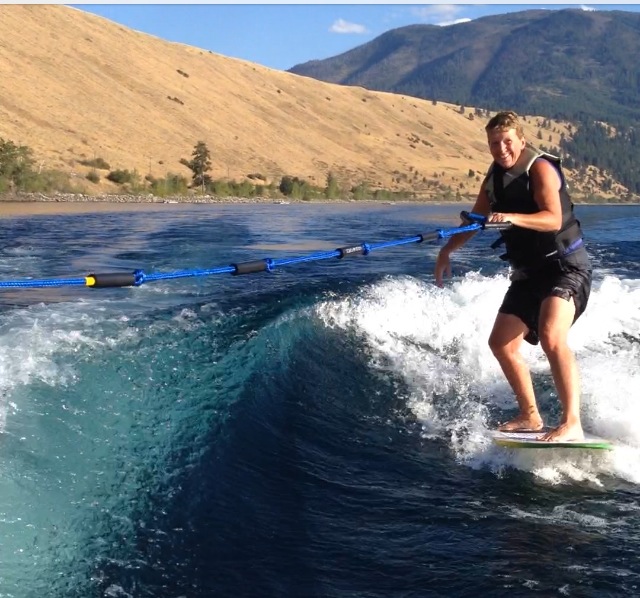
August was not my most prolific haiku month—there was a paper due for my Family Systems Theory class, so Strategic Family Therapy took up residence in my head for a couple of weeks. And now there’s another paper due next Friday, so currently my head is spinning with Narrative Therapy concepts. There was a week of vacation as well, a time during which I thought I might get some writing done, or at least some haiku inspiration, but that time too became occupied with other, more pressing matters (like learning how to wake surf behind my brother’s boat).

I didn’t get as much running in this month as I would have liked, either, though I did enter a race early in the month and came in first in the women’s division (not just for my age group, but among all the women who entered the 5K). So, maybe sometimes it’s not quantity but quality—I’d say about half of the poems I wrote this month were decent and most of the runs I took were solid. My average time came down by about a minute from my July time, even though my overall monthly mileage was down by about 40 miles. I guess the lesson here is that more is not always better.first place

I did run while we were on vacation in Eastern Oregon, up at 4500 feet—quite the difference from running at sea level. My average run, on my favorite running trail, occurs at about 450 feet above sea level. Needless to say, I felt the burn as I ran the roads near Wallowa Lake. I only managed two runs in the thin mountain air, but I also kayaked, wake boarded, and wake surfed.

It’s taken me three consecutive summers to become a competent wake boarder. The first summer, I spent a few sessions behind the boat simply trying to get my ass up out of the water with no success. The next summer, I finally got up, but my runs were short-lived, and I swallowed a lot of lake water. This summer, I popped up on the first try and let the boat pull me around the lake until I thought my arms might fall off. Between my turns on the wake board, I watched my brother, niece, and nephew surf behind the boat—it looked a lot easier on the body, I thought, since there was no rope to cling to (except for getting up on the board), no stiff boots to cram my feet into, and, since the boat went slower for the surfers, less chance of a power douche upon crashing.

I hesitated to try surfing, however, as I remembered the pain of learning to wake board. I felt comfortable in my mediocre competence on the wake board. I didn’t want to fail at surfing. I didn’t want to spend another three summers learning this new skill. Then I remembered my commitment to saying “yes.” So, on our last day at the lake, when the ballast on the boat was loaded for us left-foot-forward boarders, I decided to try, to say yes, to take the risk. To plunge once more into that 65 degree water.

I got up on my first try. I fell, but I got up again. And I surfed behind the boat. And The Little Woman caught it all on video (that’s my very patient brother you hear coaching me). I hung onto the rope, but I didn’t always need it (generally once a wake surfer finds her sweet spot in the wake, she will toss the rope back onto the boat, unless, like me, she’s still learning to find that sweet spot). And isn’t life all about finding that sweet spot?surfing 5
Without further ado, here are August’s haikus. Enjoy!

Our words are relics
Shards from a different time
Sharp broken treasures

Come, worship at my
Word altar. Kneel before this
Poetry’s gospel.

You throw like a girl
Can no longer be hurled as
An insult. Go Mo.

Today’s the day, I’m
living dangerously now.
Carpe that diem.

Despair resonates—
Love is the only ladder.
Rung by rung, we climb.

Whooshing noise and then
flood. Broken water heater.
Theater of despair

Against all advice
And common sense—I reach out,
Touch the white-hot flame.

Break me open like
A rough rock—brush off the dirt,
Find the gems inside

We have already
colored outside the lines—ain’t
No going back now
Haiku Book

So, I did this thing over the weekend–I published an ebook of the haikus I wrote between January and April for the Haiku Room. The book is more of an experiment than anything else, a way to learn how the big bad world of Amazon ebook publishing works, literally works:  how to design a cover, how to upload and design the pages of a book, how to sign up for royalties, and so on.

The first draft I uploaded looked terrible, and I forgot to put my name on the book cover, forgot to write an introduction, and forgot to preview it before I pressed the Publish button. I unpublished that draft and worked up a new one, added some photos, put my name on the cover, fixed some formatting issues. Alas, there is still one small typo in the final version, but for now I am opting to let that go.

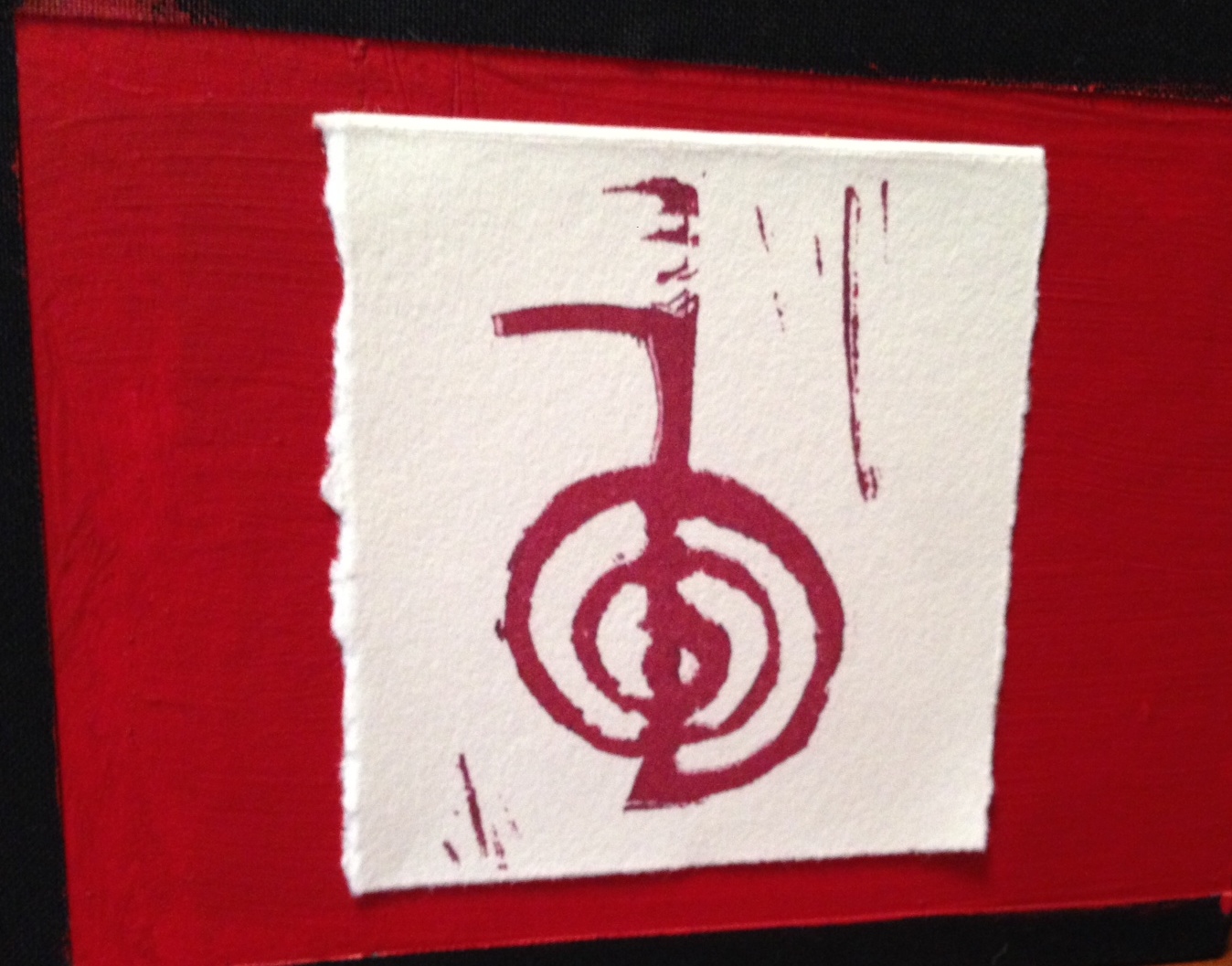
The book cover is from a photo I took of a book I made for a friend. I carved the stamp that I used for the design. It is the symbol for Choku Rei, which means healing and energy and power and is used to clear the space in healing sessions. Given all of the healing energy that I have received as being a member of the Haiku Room and writing and reading haikus, I can’t imagine a more appropriate book cover.

choku rei


If you are interested in purchasing a copy of the book, you can find it here: http://www.amazon.com/s/ref=nb_sb_noss?url=search-alias%3Daps&field-keywords=haiku+love+helberg&rh=i%3Aaps%2Ck%3Ahaiku+love+helberg

Enjoy and thank you for all of your support!

Haiku Memoir–a reblog from a friend

The following blog is from my Haiku Room friend Jenny Douglas whom I met through AROHO. It is such a powerful series of haikus–and a great example of the healing powers of the Haiku Room:
http://lunalunamag.com/2014/06/11/let-tell-remember-mr-gordon/

Let Me Tell You What I Remember, Mr. Gordon:

A Haiku Memoir

by Jenny Douglas

My teacher chose me.

He, thirty-three; me, fourteen.

His beard, my young neck.

Twenty-eight letters

you wrote to me; to protect

you, I destroyed them.

I babysat for

your kids; you drove me home, turned

off the car, waited.

A box, your thumb, words:

“Here’s something I made for you.”

Puka shell choker.

I never wore it.

Classmates would inquire.

You were mystified.

“Best Body,” you wrote

on the blackboard, then my name.

My eighth grade name.

“Let’s meet this weekend,”

you suggested one Friday.

Flattered and panicked.

I spent Saturday

terrified you’d call and my

mother would answer.

Oh, to be needed!

As you—a grown man—seemed to

need me. (So I went.)

Spaghetti boundaries.

Other girls would have said “no.”

But you could push mine.

I did tell someone:

my English teacher, she was

only twenty-four.

“I think you’re being used,”

she said; a foreign language.

So the days went on.

This under your breath:

“You’re stabbing me in the heart.”

Outside study hall.

After school each day

I’d weep alone, then pinch my

cheeks and cry, “Hi, Mom!”

I ripped your letters

up, and threw them out onto the

Shuto Expressway.

My friend remembers,

“Your hair fell out in 8th grade.”

I forgot that part.

Telling you his name

still feels like a betrayal

after all these years.

My child died and I

met my woman years before

her time. I liked her.

Would you judge me if

I told you I loved him? I

Miss the me he saw.

Years later, I asked

my teacher, “Why?” He said it

was for my own good.

This I can now say

(after all these years):

“I am innocent.”

The cave calls to me

airless and dark. Here is where

I will learn to breathe.

Z is for Zebco

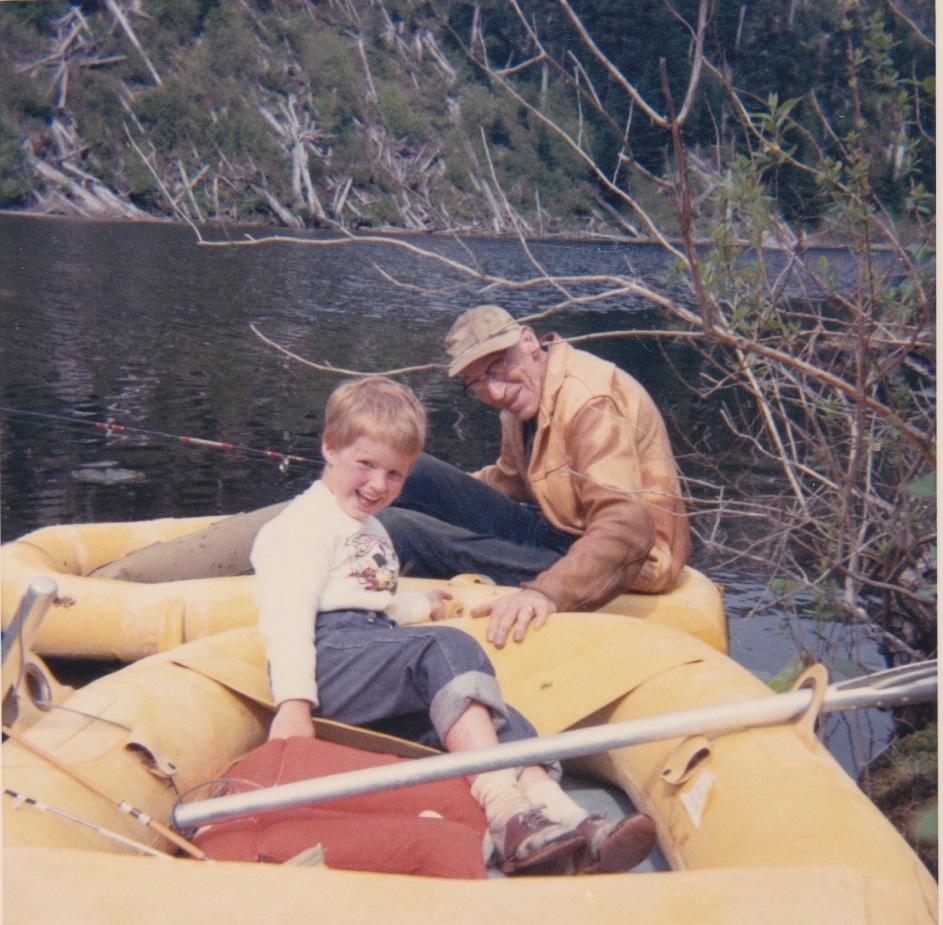
Pam and Grandpa, fishing from rubber rafts

Evidently fishing season opened this week. Fisher people of all stripes line my regular running trail and the funky smell of dead trout permeates the early morning air. That smell—muddy, scaly, wet—it takes me right back to childhood.

Fishing loomed large in my family. Everyone fished. For fun. For sport. On my dad’s side of the family, salmon fishing. Expeditions to Westport. Cases of canned smoked salmon and tales of my father seasick, green and puking. On my mother’s side of the family, trout fishing adventures. Long family vacations up endless gravel roads, hundred of miles into the Canadian wilderness to remote lakes filled with legendary trout.

I never got to go along on the Westport adventures, and truth be told, never wanted to. They sounded miserable. But the trout fishing expeditions? Everyone went along on these trips. We’d pile into our truck, the canopied back filled with our tent and sleeping bags, fishing rods, reels, creels, our green metal Coleman cooler, the green Coleman camp stove, jugs of kerosene. Dad drove while mom, Brucie, and I squeezed together on the bench seat. I generally straddled the gear shift while mom held my brother on her lap.

Brucie and Fish
Brucie with fish much later (not grandpa’s boat)

We didn’t have to go too far to meet up with my mother’s parents where my little brother and I defected for Grandma and Grandpa’s camper. We clambered immediately to the top bunk over the truck cab and rode the hundreds of miles up there, peering excitedly out the window, watching impatiently as the ribbons of graveled roads unfurled endlessly before us.

Behind the camper, Grandpa towed his boat—a silver and red aluminum craft, not fancy at all. Not large. I’m guessing 15 feet. It had one engine, maybe 10 horsepower and a set of oars. Bulky orange life vests, tackle boxes, recycled plastic containers filled with dirt and worms from Grandma’s worm farm, and gorgeous bamboo and cork fishing poles filled the boat.

I so wanted one of those fishing poles with the shiny and complicated reel. Instead, I had a child-sized fishing pole with an attached reel—a Zebco. A simple, plastic, one-piece uncomplicated piece of equipment. The Zebco reel was enclosed around the fishing line and had a button I pressed to release the line as I cast.

At the end of my line, a red and white bobber, a couple of lead weights, and a hook with a worm. At the end of Grandpa’s line? Shiny silver spoons, fancy lures, orange and pink and iridescent. Oh, how I wanted those lures on my line. I did not want my Zebco with its pedestrian bait and hook. I remember opening Grandpa’s tackle box and ogling his lures—so many options, each little tray and compartment filled with candy-like choices, fake gummy worms, fuzzy bumblebee bodies that hid barbed hooks.

My tackle box, yellow, held very little—a small glassine bag of hooks, some fishing line leads, those little brass clippy things that attached the lead to the rest of the fishing line. The spools of monofilament that squeaked when I pulled the line out. bobbers, lead weights. I remember pinching these little lead balls open with my teeth, putting them on the line, and then pinching them closed again—with my teeth (this cannot have been a good idea).

I caught a lot of trout on that little Zebco. I wound Grandma’s fat, coffee ground-fed worms onto those hooks, cast my line out, and watched that bobber with single-minded intensity. I sat in that boat, orange life vest tied tightly under my chin, bulky and smelling of last year’s fish, stained with the blood and slime that washed the bottom of the boat. I rarely ate the trout we caught, though I loved to fish. Loved the ritual, the waiting, the quiet on the water.

When we had caught our daily limit, I helped Dad and Grandpa clean the fish—I had my own knife and knew how to cut down the belly, how to use my thumb to scrape the innards out. I can still feel the trout’s spine under my fingers, the serration against my thumbnail.

anna fish1
Anna with a fish she caught with Grandpa Rick
anna fish 2
Anna and her fish

As I got older, I lost my desire to put the bait on the hook, to slice open the fish, to scrape out the guts. Squeamishness replaced my attraction to the ritual, and I don’t think I ever took my children fishing (though my dad, their grandpa did).  This realization as I ran my laps around the lake this morning made me sad. Fishing filled my early years—that Zebco rod and reel saw me through fishing derbies, represented independence (my brother and I used to camp by a stream near our house, fish and cook the trout we caught for dinner over an open campfire), and connected me to family in ways nothing else really did.

I smiled as I ran this morning to see all of the children with their parents, and grandparents lined up around the lake, building memories, casting their lines, grinning widely as they held their catches. If I ever have grandchildren, we will go fishing. They will have a Zebco.


W is for Work Ethic (or how I learned to work)

If there’s one thing my little brother and I learned from our parents, it was a healthy work ethic. We started working early. I don’t mean that we went out and got paper routes when we were five or anything like that, but we started early being responsible for chores around the house.

We lived in the country growing up, so there was no shortage of things to be done around the old homestead: lawns to be mowed, fences to be built and maintained, horse stalls to be mucked out, animals to be fed, barns to be tidied.

And indoors, of course, Mother expected us to clean up, not only after ourselves but after meals as well, and on Saturdays I vacuumed and dusted. Mom taught me how to iron when I was about six. I practiced on pillow cases and sheets and Dad’s undershirts. I learned how to use the sewing machine and how to wield a needle and thread. I became adept at hemming my own jeans.

When I was 11 or 12, Dad and I fenced in our acreage—we pulled barbed wire around 70 some acres together. We split and stacked so much fire wood. And then things changed. We left the country life and became townspeople, and the nature of our work changed.

During the summer of 1976, when the nation was celebrating America’s bicentennial, our family moved across Washington State, from the foothills of the Cascade mountains in Sultan to the rolling wheat fields of Columbia County. We could not have moved any further south and east and still remained in the state. No longer content to work for his father at The Bellevue American, the Eastside’s pre-eminent weekly newspaper, my father decided to purchase and run his own weekly newspaper: The Dayton Chronicle.

There were (and still are) only two very small towns in Columbia County: Dayton and Starbuck. The entire county had fewer than 5,000 inhabitants when we arrived (I’m pretty sure there are fewer now). Most of these folks subscribed to The Dayton Chronicle, relied up on this tiny weekly rag for their news: who was in the hospital that week, who got married, who died. What the price of wheat was, when the almanac predicted the next round of rain.

Getting this news written, printed, and delivered fell to us, our family of four (and a couple of other employees and at least one intern from Washington Statue University which was, more or less, just up the road). Dad attended city council meetings, school board meetings, high school football games. Mom answered the phones, wrote obituaries, and learned how to operate the typesetting machine. Once Dad pounded out the stories on his ancient manual Royal typewriter, Mom typeset them. She printed them out in long strips, columns, ran them through the waxing machine and pasted them up for printing.

I developed rolls of film and learned how to create the halftone prints that went into the paper, but the real work that fell to my brother and me happened in the basement of the Dayton Chronicle building. There, in the dank dark bowels of the hundred-year old building, we stuffed advertising flyers into those newspapers, and if it were a particularly newsy week, we also stuffed the second section of the paper into the first section. All 2500 copies.

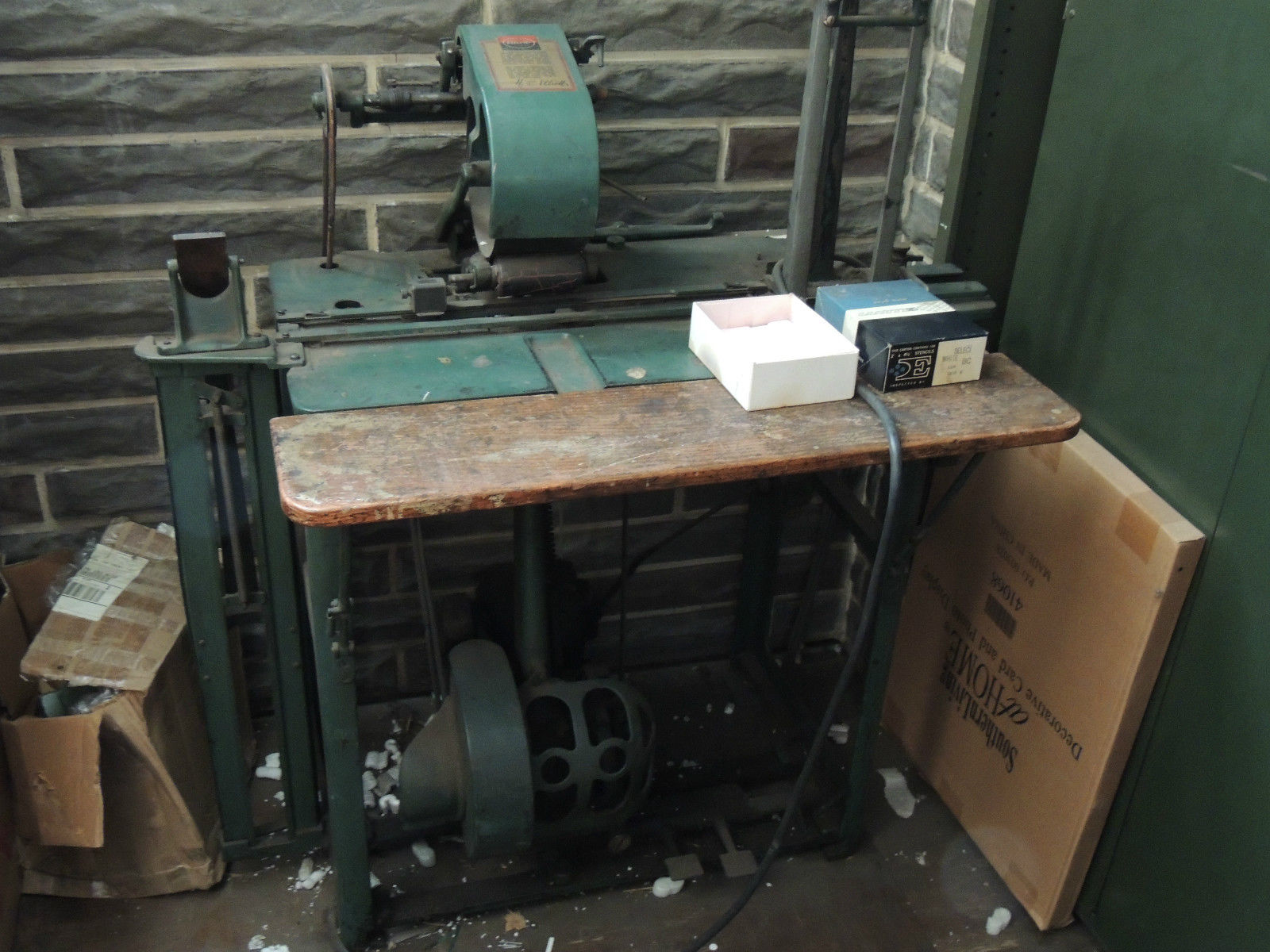
We arrived immediately after school and set to work, Brucie standing on a stool because he was only in 4th grade and small for his age. As mom ran the addressing machine, which was much like a treadle sewing machine, we stuffed newspapers. Open the flap of the first section, shove in the second section, open that and shove in the advertising section. It was good to have a big paper, a fat paper. That meant Dad had sold lots of ads. Ads paid the bills.

There was a rhythm to the afternoon:  the addressing machine squeaked each time Mom depressed the pedal and inserted the folded newspaper so that the address would be printed across the white space on top of the front page. Squeak, squeak, stamp. Squeak, squeak, stamp. Squeak, squeak, stamp.

addressing machine
The addressing machine

Our hands grew black with the newsprint as the afternoon wore on. I ran up and down the steps, bringing down the bundles of newspapers from the back of the delivery van (which doubled as the family vehicle—an army green Ford). I’d pull the bundles down the steps by the oily utilitarian twine that wrapped around them. The smell of ink and twine and musty basement permeated our clothes and hair and skin.

Eventually, the piles of papers diminished from our side of the addressing machine, and grew on mom’s side. I tried to keep the stacks neat as I toted them, addressed now, back up the stairs, back to the van for delivery to the post office.

We didn’t just stuff newspapers. We also ran a printing shop in the back of the newsroom, and at least once a week we worked addressing and stamping mailers to go out to the town folk. I remember stacks and stacks of white envelopes and huge rolls of stamps. Brucie and I had to daub the stamps on a damp sponge and then affix them in the upper right corner of the envelopes and then insert whatever mailer was to go out. Brucie had trouble, being only 8, keeping the stamp in the corner and many envelopes sported postage stamps dead center.

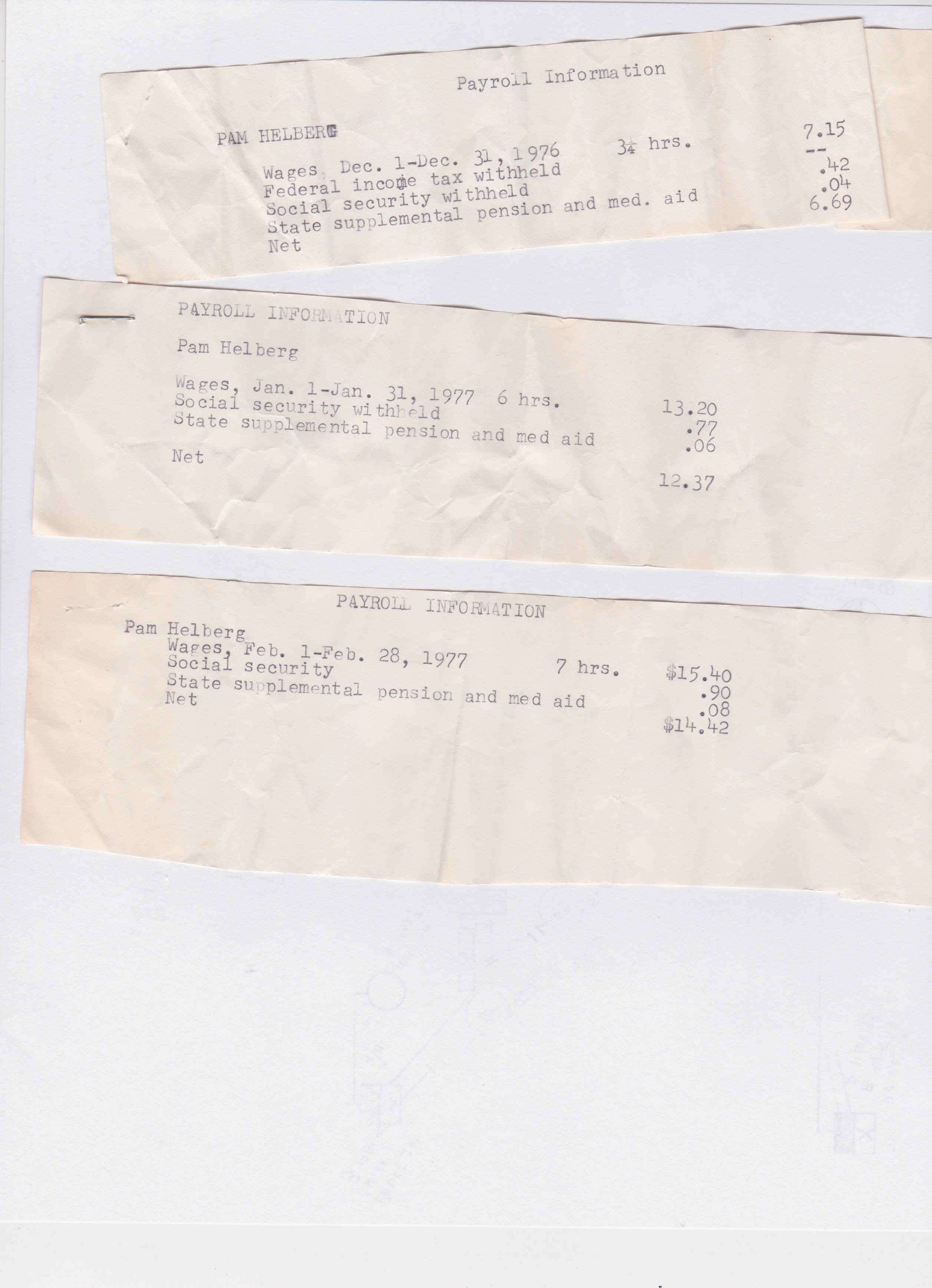
We got paid for our efforts—or at least I did. I can’t speak to my brother. I still have the paycheck stubs that my dad typed out every two weeks. I made $2.38/hour. I think I grossed maybe $20/month. Each payday, I’d walk down the block and deposit my paycheck in the bank.

paystubs

I can still conjure that basement, still feel the rough twine, the oil on my hands, the way it smelled. The ink, the black smudges it left on the papers. When I think about how I learned how to work, I think about that basement—the shining silvery stacks of pig iron (for the printing press upstairs), the old wooden cabinets full of ancient type, the boxes and boxes of yellowing pictures with curled edges. But mostly, I remember my family, working together. Complaining, surely I complained, after all, I was 13, 14, 15. But, learning to work, nonetheless.

U is for Umbilical Cord

leave-it-to-beaver2

Visiting Mother
Our past. My future. Her womb.
Cord blood. Still tethered.

The other class I’m taking this quarter is Family of Origin Systems, or FOO for short. Here’s the course description: The purpose of this course is to facilitate the development of competencies in understanding family of origin systems theories of human development and differentiation. Particular emphasis will be placed on students examining their personal and professional development in terms of their own family history, relationships, and conflicts.

In other words, in this class we will take a close look at how our families, the ones in which we grew up, completely fucked us over and caused us to be the hot messes we currently are. I’ve done a fair amount of self-work over the years and have looked closely at my parents, our relationships, how they raised my brother and me. I’ve listened in many workshops as other people describe their upbringings, how they survived everything from drug and alcohol addicted parents, sexual abuse, beatings, to benign neglect and hostile indifference. Compared to most people, I am practically Beaver Cleaver. In many respects, my parents rivaled June and Ward.

But still. The one thing this class makes crystal clear is that none of us leave childhood unscathed. Sure, maybe my parents, like so many, “did the best they could with what they knew at the time,” but they too were products of their environments. And like their parents before them, they carried on, operating within family systems that have perpetuated all the conscious and unconscious family secrets, tragedies, coping methods, and survival mechanisms.

Take for example just two facts from my childhood: We moved to a small logging town when I was four, and my parents became Born Again not long after. These events alone generated major repercussions for my brother and me.

Our parents subscribed to the “spare the rod, spoil the child” parenting style. They raised us to believe that god knew our every move—He knew when we were naughty and nice with implications far more sinister than any Santa might have dreamed up. I grew up believing I could be struck dead (or at least turned into a pillar of salt) should I displease god.

I learned early on that if Jesus returned in The Rapture and I hadn’t caught up on asking for forgiveness for my sins, I might be Left Behind to withstand horrible trials and tribulations. Should I die with my sins unforgiven (because I’d forgotten to pray in a timely fashion), I’d go straight to hell where I would burn for all of eternity. Never mind what the church had to say about being a lesbian.

So there was that. And I’m just scratching the surface of the religious implications. Then there was life in the logging town. Like I wrote in my blog about my brother, we had a fairly idyllic and unfettered (if you don’t count god always watching) childhood. Freedom to roam was one of the many upsides growing up in a small town offered.

Inferior schools presented one major downside.  I was a pretty bright kid. I scored high on tests, always tested into the advanced groups whether they were for math or reading, and I brought home stellar report cards year in and year out. But the schools we attended were full of first year teachers who were all on their way to someplace bigger and better, and I ended up attending four different high schools. By the time I realized I needed a better education, I was in college wondering why I couldn’t figure out pre-calc and why I was failing basic chemistry.

I didn’t take a foreign language (well, I took a quarter of it at the church-affiliated pseudo high school I attended most of my junior year); I stopped taking math in 10th grade. I dropped out of biology my sophomore year and didn’t take any more science until college. Thankfully, standards for college admission were fairly low in 1981.

To be fair, my parents hadn’t been to college. They didn’t know what a college bound high-school student needed in order to be fully prepped for a higher education. Many people I grew up with didn’t go to college. Many had parents who didn’t think girls even needed to pursue anything beyond an MRS degree.  So, in many respects, I count myself fortunate and very blessed. Yet, what might have transpired had we stayed in Bellevue when I was four? What sort of education might I have received there? How might things have played out differently?

Yet it’s not just about what I know. Families are full of secrets and generational patterns. We all move forward under an ancestral burden (or so they say in FOO). What implications did grandpa’s dead brother have on our holidays? What about grandma’s drinking? How did the antagonism between grandma and her sister get mirrored in my aunts’ relationships with one another and with my parents? What about my grandfather’s upbringing made him so hard on my father, his only son? And why did my grandparents adopt my mother? What was the true story there? Did we move far away to escape these legacies? So many questions.

We have to fill out a questionnaire for class tomorrow, one that describes our roles in our family of origin—for example what sort of child was I? Was I The Rulebreaker? The Delegate (strong self-sufficient and competent)? The Companionate (a friend and peer to one of my parents)? The Rejected Kid? And, why? How did my role in my family of origin affect the choices I made later in life? The partners I chose. The roles I play now. It’s fascinating to ponder.

 ***

I’m not writing all of this to lay any blame on my parents. I’m writing to point out that even when we do the best we can (or the best we think we can do), we still pass on to our kids (and I’m a parent, so I have done this too) a legacy with which they, in turn, will need to grapple in order to fully realize their own hopes and dreams.

I know that my parents discussed parenting before they married. I know that they both had dreary childhoods and problematic relationships with their own parents. Together they resolved that they would do better than their parents. And in turn, I resolved the same thing when I had my kids. And, most likely, if my kids have children of their own, they too will make a similar commitment.

I sat in my FOO class and listened to my classmates tell their stories—felt the hair on my arms rise as they recounted tales of abuse, neglect, grinding poverty, drug addiction, mental illness.  And I felt a sense of hope wash over me because in spite of all the various hardships, and perhaps because of them, here we all were, eager to learn, to move on. To help.

S is for Sibling

My little brother and I enjoyed relatively unfettered childhoods. As was typical of the time, we grew up as free-range children, exploring our surroundings as we saw fit—biking, go-carting, camping, fishing, building forts, and playing dangerous games on the railroad tracks, just existing with nary an adult to report to for hours at a time. Some summer days we’d leave the house after breakfast, bicycle into town with our inner tubes slung across our torsos, meet up with friends and spend the entire day floating the river, dragging the inner tubes back up the winding trails and doing it again. We always made it home in time for dinner.

I don’t remember anyone ever telling me to watch out for my brother who was four years younger than I, to make sure he didn’t drown or get chased by the Doberman Pinschers who careened after us as we raced our bikes down the winding country roads. We all stuck together then, in a tight knit pack as we roamed the small logging town that shaped us.

Our parents often left us home alone together at night as well, in the log home that our father had built. At home we’d play elaborately imaginative games, build blanket forts, take the guns out of the gun cabinet, spread the bullets around on the floor, and imagine that we were pioneers who needed to hunt for our supper. We knew better than to ever point a gun, imagined or real, at any human being. We knew to put the key to the gun cabinet back exactly as we had found it before mom and dad got home.

On one of these nights, I took it upon myself to teach my little brother how to fight. As we sparred in his bedroom, I grabbed him by the arm and flung him into his closet where he landed hard upon a sharp bit of metal toy railroad track. Obviously he was not learning how to fight fast enough for my taste. He let out a wail and held up his elbow, which sported a two-inch long gash, a deep gushing gash.  I’d never seen blood so thick and dark.

Don’t cry! I admonished as I dragged him into the bathroom. Hush. Be brave. Don’t tell mom and dad! I sat him on the closed toilet seat and gave him a comb to bite on (my dad had done the same for me once when I’d gotten the soft flesh of my palm caught in a pump-action BB gun). Bite! I ordered and dug around in the cabinets for a BandAid and some Bactine.

He screamed as I dumped the Bactine into the wound, and the blood soaked through the BandAids as fast as I could put them over the gash. Hold your arm up! I commanded. Up! Higher! I pushed the loose skin together and peeled more bandages, slapping them on as fast as I could. Finally, the bleeding stopped.

You cannot tell mom and dad, I whispered fiercely so he’d know I was serious. We—I emphasized this—will get in so much trouble if they know you got hurt. Somehow, that wound went undetected for several days. Somehow, I never got in trouble. Somehow, as these things tended to do in the days of unfettered childhood, the injury healed without complication.


He still sports the scar on his elbow, a long jagged coil that has faded over time. We are still close in spite of the occasional childhood brutalities I meted out. He insists he doesn’t remember his childhood. I maintain he must have blocked it out.

He’s grown up to be a lovely man, a wonderful father, and amazingly talented at whatever he tries: banking, woodworking, grilling, restoring houses. He balances a complicated schedule but always has time and his full attention for whoever finds themselves sitting across the table from him. I count myself fortunate when I am that person.

We used to work in the same city—he drove north from his home in Oregon, and I drove south from my house in northern Washington. We each spent the better part of the week away from our homes and families, but we re-forged the bond we’d had in childhood.

I’m grateful we had those few years, the opportunity to reconnect as adults, the two of us away from the usual family settings in which adult siblings generally interact, settings fraught with the emotions of holidays and travel and aging parents. Our paths still occasionally cross when just the two of us can enjoy a meal or meet up to catch a Mariners’ game. When we can enjoy the rare days that are unfettered adulthood.

Q is for Quiet

This is sort of a repost of a blog I wrote last month, but I think the basic concepts bear repeating.

Carl Jung described introversion as “the turning inward of psychic energy with an orientation toward the subjective. Introverts are tuned in to the inner world with all its biases, fantasies, dreams, and individualized perceptions.” Jung himself was an introvert, though he feared becoming “lost in his inner world and so managed to find a balance between introversion and extraversion” according to at least one textbook I’ve recently read.

Yet, introversion might not be all that awful. In her book Quiet: The Power of Introverts in a World that Can’t Stop Talking, Susan Cain claims that introverts are vastly undervalued. In fact it is they who often have the best and biggest ideas, are the brightest students, and make the most important discoveries. In her TED talk, The Power of Introverts, she argues that we are making life difficult for introverts to get in touch with their ideas because we are designing schools and office spaces based on what stimulates extraverts: noise, interaction, conversation. But what introverts need, what we all need, in order to get in touch with our creativity, in order to dream and imagine, is quiet. The time and space for flights of fancy and rumination, the chance to work alone, and the opportunities to create. Great people, great thinkers, Cain points out, spent lots of time alone: Rosa Parks, Ghandi, Abe Lincoln, Steve Wozniak. Every religion, she reminds us, had a figure who spent lots of time alone, wandering the desert.

Cain warns of the dangers of group think, how when people are together they begin to lose their individuality and mimic one another’s ideas and behaviors. Such interactions quash individual creativity and can lead to groups taking greater risks as they are urged on by the more extraverted group members. True collaboration occurs when introverts and extraverts come together in a well-moderated environment to share their ideas (the Bay of Pigs is a great example of group think nearly leading to disaster).

As Cain points out, there is ZERO correlation between being the best talker and having the best ideas. She says that we have given in to a new group think—that all creativity comes from a gregarious place. But, she says, quite correctly, most creative people have a serious streak of introversion because creativity needs long flights of fancy. Kids in school don’t get any time to pursue individual thoughts as they are all involved in group work, even when it comes to creative writing, and if you’ve been in a modern office building lately, you’ll see that the open concept is all the rage. No one gets an office where they can close the door on the noise–now they sit together so they can share ideas. I don’t even know how anything gets accomplished. 

As we catapult ourselves through the 21st century, all plugged in and grouped together, we would do well, Cain says to try these three things:

  1. Stop the madness for group work. Give students and employees the opportunities for solitude, autonomy, and privacy.
  2. Go into the wilderness—we need to have our own revelations, to be like Buddha, and unplug in order to get inside our own heads.
  3. Share with the world what we carry in our metaphorical suitcases—particularly if we are introverts. The world would do well to see and learn from the things we carry.

 Introverts. My people.


N is (as promised) for Nancy (by Nancy)

Note: Nancy is my wife and I couldn’t think of any better way to write about her than to let her speak in her own words. Therefore, I’ve asked her permission, and received it, to repost her latest blog post here and to provide a link to her blog, Running and Rambling.

Clarity and Re-orientation by Nancy

In a mere eight weeks I have gone from the depths of depression to the heights of contentment. I can only describe the ride as emotional whiplash. At the bottom, despair mired me in complete darkness. At the top, blackness gave way to glaring sunshine and lighter steps.

One of the repercussions of coming out of a depression is the disorientation of being present again. Depression detached me from my mind and body. Today I am reacquainting myself with my skin, my feelings, and the multitude of thoughts that barrage my mind.

With the help of my therapist, I am sorting out the rapid ride from bottom to top and how to adjust back into the land of the living. There are days when I am so high that I border on manic. On those days my mind races, I pulse with frenetic energy, I over-focus, and I feel semi-invincible. I try to recognize the signs and slow my mind and movements to a more controlled pace. Not always a manageable task.

I have a fabulous team of caring support professionals continuing to help me through my recovery and guiding me back to a healthier place in life. They have seen me through the highs and the lows and still they let me back in their offices.EmotionalRollercoaster2JPG