So Far From the Tree

I just finished reading Andrew Solomon’s Far from the Tree.  I managed to get through the 700 pages in a couple of weeks and right up to the last chapter, I found it engrossing and revelatory.  As the parent of two adopted children, the sister of an adopted brother, and the daughter of a mother who herself was adopted, I know a bit about horizontal relationships in parenting. As a lesbian, too, I know a bit about falling far from the tree.
That said, I have some serious issues with what seems to be his bias toward creating a family biologically rather than via adoption, as well as the notion that it is better to breed than to adopt, even when biology is clearly flawed.  On page 678, he writes that “the right to reproduce should be among the inalienable ones,” and later laments with one mother who didn’t consider adoption because it would be heartbreaking not to be pregnant or give birth (even though she would have a handicapped child).
As he continues on with his own quest for a perfect bio baby, I fail to understand how one person’s desire to be pregnant and birth a biological child, even though the chances of said child being profoundly handicapped, trumps creating a family through adoption. As a gay man, Solomon should know the value of creating a family of choice. I find the selfishness and narcissism rampant in his final chapter sufficient to render the preceding chapters nearly meaningless.
My mother was placed in a children’s home when she was about a year old by a single mother who couldn’t both work and support an infant. The people who became my grandparents adopted her when she was three years old, even though her birth mother came to visit her regularly.  
My little brother (my only brother, my only sibling) arrived with only a week’s notice the year I was four, right around Thanksgiving.  One day the phone rang and my mom asked me (rhetorically, I’m pretty sure) if I wanted a little brother.  Seven days later, I’m at the hospital with my parents picking him up. I cannot imagine life without him.
Nor can I fathom the possibility of life without my daughters, children born into and then given into impossibly complex circumstances. I may have once been ambivalent about motherhood, but their arrivals in my life eradicated any indifference I may have ever had about being a parent.
I wasn’t one of those women who felt incomplete without children, or maybe I should say I wasn’t a young woman who felt that my life wouldn’t be complete should I not ever have children.  I just didn’t think about it that much given that I was a lesbian.  I figured that kids just weren’t in my future, and this realization did not cause me any angst.
Then I met and fell in love with a woman for whom having children was critically important, an imperative, even. Myself, I didn’t really understand how much I valued my role as a mother until I faced losing my children when my relationship with my co-parent went south. At the point where I could choose to remain a parent or walk away, I decided to stay.  I guess in this way, I am like some of the parents in Solomon’s book.
My eldest daughter came to live with us three days after she was born.  Her birth mother had decided to place her for adoption and had chosen my partner at the time as the person she wanted to raise her as yet unborn child.  Given the times (1990, pre-Will and Grace, pre-Rosie, pre-Ellen, pre-gay marriage, even pre-Don’t Ask Don’t Tell), it made sense for my partner to adopt as a single parent. I was a willing, if somewhat ambivalent, participant in this process, until I held Anna. Once that baby was in my arms, any uncertainty melted away.
One of my greatest pleasures is wearing a sweatshirt my daughter Anna got for me one year for Mother’s weekend at her university—the sweatshirt has a large pink apple tree on it and says The Apple Doesn’t Fall Far From the Tree.  I love the irony. I take certain pride in the fact that Anna is more like me than I ever could have imagined. But I didn’t adopt her so she would reflect myself back to me. I adopted her because I fell in love with her.  I parented her because I loved her, from the moment I first held her.
Taylor, my youngest, found her way to us from Philadelphia.  At the very moment I got the phone call as I was sitting at my desk at work, she became my precious and beloved child. When I first saw her tiny (and she was very, very tiny—a full term 4 lb. baby) little person, I had no doubts that I would love her with all of my heart and soul. She couldn’t be more different from me, and I love her fiercely.  Taylor’s adoption got all kinds of complicated before it became final, but she was as much my child before the birth certificate arrived as she was after.
The paperwork is a formality—it doesn’t make my love or support for Taylor and Anna any more real.  In that way, adoption is a bit like gay marriage—the paperwork grants us privileges under the law, but we are already a family without the judge’s decree.
I suppose Solomon is to be admired for not hiding his fears and feelings in the final chapter of his book, but I find his quest for the perfect child completely antithetical to the notion of parenting.  As his book so profoundly shows us, there is no guarantee that our actual children will even remotely reflect our ideal child. And I would go so far as to say that the greater our expectations are that our children will arrive and fulfill our dreams for us, the greater our disappointment and the greater damage we as parents will inflict upon them.
Becoming a parent is a crapshoot any way it happens, but I do believe the children we need find their way to the families they need. May we all be able to accept these gifts with grace.
Spoiler Alert: No Rainbows. No Unicorns.

I’ve been trying to be upbeat, Dear Reader. Trying to write something meaningful and reflective, attempting to provide my audience with happier, more peaceful, less cynical insights, but  then I go and read the news.  The news does not bode well for humanity folks.  Doesn’t bode well at all. How can I write rainbows and unicorns when shit like this is making headlines:
Woman’s corpse found in LA hotel’s water tank.  Holy f$ck that is just disgusting.  She’s been decomposing there for two weeks.  TWO WEEKS. I am horrified on so many levels.
Testosterone found at Pistorious’s home.  NO! Say it isn’t so! I’m shocked. Shocked! How many more women are going to die at the hands of enraged husbands and/or boyfriends? 
Teens get strippers.  Mom gets arrested. Again, I’m shocked (not).  This sort of thing is inevitable when parents start getting their kids limos for their sixth grade dances.  What is left for the kid’s 16th birthday party? Strippers and booze.  Piñatas and cupcakes just ain’t gonna cut it. What are these boys going to do for their next momentous life passage? See above.
Jesse Jackson, Jr.: “Guilty Your Honor” No wonder he stepped down and checked into the psych ward.  I’m thinking he’s the least of our collective worries. It’s just money.  Nobody died. 
What IS the world coming to? 

Go! Just Go!

I’ll admit it Dear Reader—I am a notoriously impatient driver. Anyone who has ridden with me knows this and has listened to me carry on about slow drivers, Subarus, and left lane campers. They have also most likely pumped the imaginary brakes there on the passenger’s side for all they are worth.
That said—you know, my culpability adequately addressed— I must complain vociferously about three drivers I encountered in my recent mile and a half drive from my home to my favorite writing spot (no snarky comments about driving a mile and a half—I’m not in the mood). 
Three drivers in less than two miles managed to piss me off. All three drivers parked themselves, unmoving, in their cars, in the middle of the road.  And not only were they stationary where they should have been moving, they didn’t even bother to get out of the way when I approached.  I sat patiently behind the first car and eventually it saw me there, in my large well-lighted black Jeep and moved, albeit slowly, to the curb.
The second car was parked at a four way stop pretty near my final destination, which was fine, for a minute, but then even when no more cars were at the other corners, it still sat there.  I could see the driver and the passenger discussing something, discussing, discussing.  I calculated my chances of a successful pass on their right but dismissed this option, not because it was illegal, but because with my luck they’d turn right and smash into me (even though their left blinker flashed incessantly as they just freaking sat there).
I muttered profanities about their mental capacities to myself when they finally made a decision and got their ass out of the intersection, but I kept my hands off the horn, firmly gripping 10 and 2 so as not to make any rude gestures that might result in them shooting me.  I drove on slowly as my hopes for an empty parking space dimmed. When I came to the next four way stop, a car just sat there, in my lane while its driver conversed with a pedestrian who stood beside her car, laughing at something that passed between them. 
Dear Reader, I did not snap quickly.  I waited while they wrapped up their little chat, as the pedestrian made moves to get off the road; I waited for the driver to proceed since no other cars waited at any of the other stop signs.  But she continued to talk, and the man came back into the street. She even made eye contact with me via her rear view mirror.  Still, she did not move.  Still, I did not gesture.  Still I did not honk. 
My patience seemed to be rewarded as the man finally moved away and driver’s window went up.  Again she locked eyes with me in her rear view mirror (I may have been tilting my head at a severe angle in quiet desperation, but I was not honking, gesturing, or yelling).  She just sat there, unmoving, waiting for nothing, as her window went down again and she said something to the aforementioned pedestrian.  That’s when I snapped.
I honked, long and hard.  I threw my hands in the air, and hoped she didn’t have a gun. She threw her hands in the air. Looked at me again in her mirror and rolled slowly across the intersection and up the hill.  
I dunno, Dear Reader.I think I am losing my moral compass, not to mention my marbles  Was my frustration uncalled for? Are common courtesy and common sense on the decline? What would you have done in my place? And don’t say you would have walked the mile and a half. I’m not in the mood.

Stop, Just Stop

On Tuesday or Wednesday evening this week, I sat down to write a blog about all of the crazy shit going on in the world: North Korea’s nuclear test, the Pope’s resignation, the poopy cruise ship debacle, gun violence, our rape culture.  I didn’t finish the blog—it’s still here on my laptop, languishing.
I thought I’d add a couple of more batshit crazy items to the list today and wrap it up: the meteor exploding over Russia for starters. The apparently imminent downfall of Oscar Pistorius.  
I rolled over in bed this morning—it’s my Friday off—and squinted in the dark at my smartphone Twitter feed only to discover that the sky was falling.  I wish I knew Russian as I would have loved to know what people thought as that bright bright meteor lighted up the dark northern skies. What did they think was happening when the sonic boom followed minutes later? I can’t even imagine.
That’s nature for you—wildly unpredictable with nary a concern for humanity. How many mornings have we awakened to such surprises? The Haitian earthquake, the tsunami, too many hurricanes to mention, snowstorms, tornadoes, etc., etc.  You’d think that given so much random natural chaos, humanity in general might work harder to ameliorate manmade chaos, but no.
Crazy North Korean dude sets off a nuclear test that registers as a 4.6 magnitude earthquake.  Crazy ex-policeman starts gunning down innocent offspring of his former coworkers. Men, famous and not so much, routinely kill their wives, girlfriends, and children. And NRA fanatics decry gun control as unnatural and antithetical to freedom.
Call me overly sensitive, but I find untimely and violent death at the hands of a “loved one” unnatural and antithetical to freedom. We live in a rape culture that glorifies the subjugation and domination of women.  Have you watched any television sitcoms lately?  Even my most favorite (Big Bang Theory) has devolved into advocating forcible sexual conquests (last night’s episode, Raj’s outburst as he leaves the comic book store).  Don’t get me started on Two and A Half Men, and even The Middle’s Valentine’s Day episode smacked of misogyny. 
I’m exhausted. Tired of being indignant. Frightened for my daughters’ futures.  Appalled that I find myself laughing at the ubiquitous anti-woman jokes before I catch myself.  Wait, what? Why am I laughing? This isn’t funny. Stop it.
Just stop. 

Pamopoly

A few weeks ago, after a rather rigorous therapy session, I came home in a very contemplative mood.  I’d been feeling blocked in my writing for a few weeks, since before Christmas at least, and so I had rummaged through some life events with My Therapist. 
We searched my mind’s attic looking for some treasure we might dust off and take to the psychological equivalent of Antique Roadshow.  I offered up a few memorable/traumatic/life changing possibilities from the past 49 years, but even after polishing a few of these babies up, nothing really stuck out for either of us.  
I came home ready to rummage more thoroughly.  I could feel, as I often do when I get introspective, those creative juices welling up.  I knew then that even though I wasn’t getting any writing done, I still felt that urge to create, to make something.
I started making books quite a few years ago, as a frustrated writer.  And since then, I’ve done many wild projects, even one that  compelled me to rip up my childhood bible and turn it into something much more relevant: My views on religion.
I made one book that was an A-Z guide to mental breakdowns and crazy writers. Another one, a gift for a friend, reflected my take on the 12 Steps.  Pretty much nothing is sacred when I wield my Xacto knife and my straight edge.

I sat down and started flipping through my new picture book of handmade books—over 1000 pictures of amazing books made by wonderful artists.  Every time I thumbed through my book books (weird, right?) I found something new.  

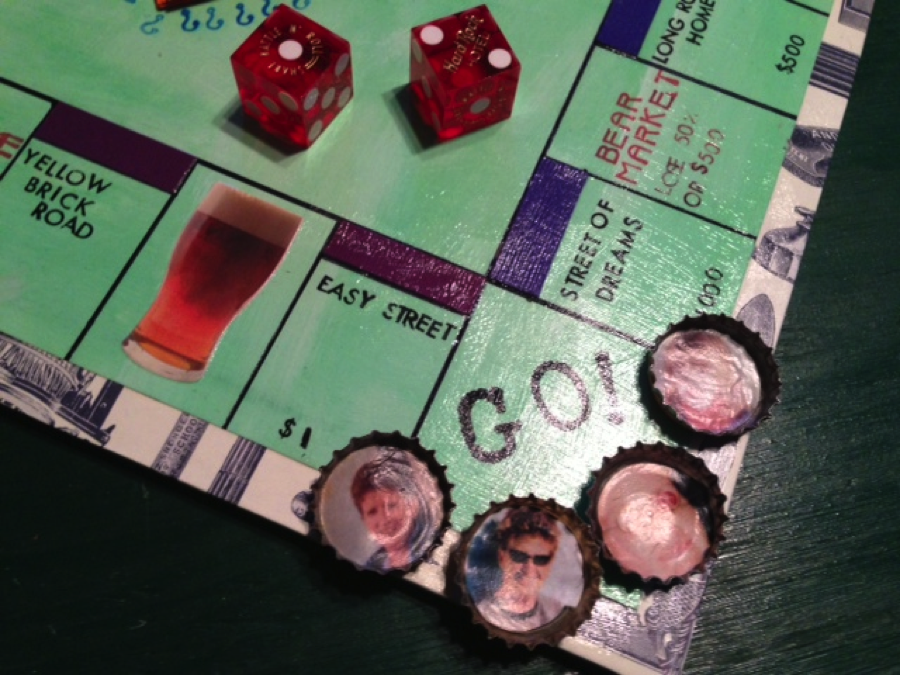
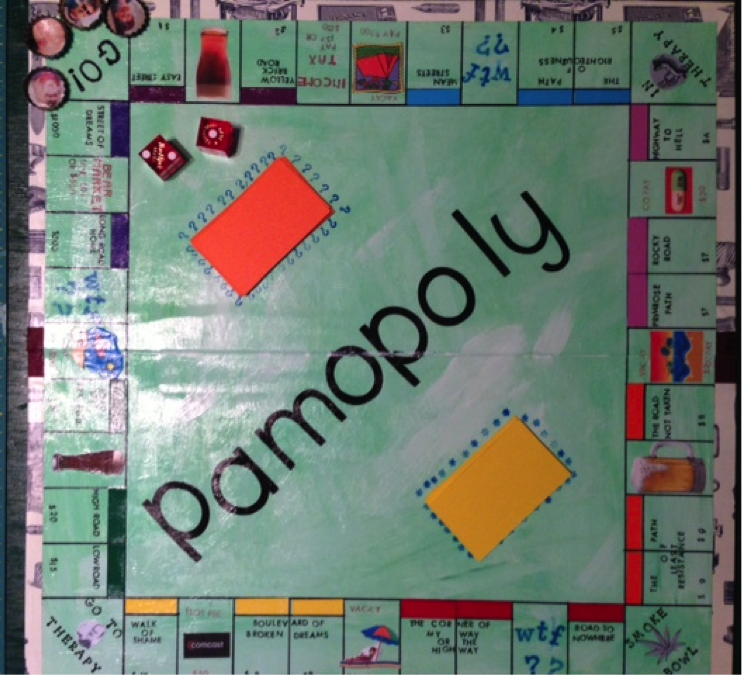
This time, a homemade Monopoly game caught my attention.  I jumped up (honestly) and ran to the Casa Durberg Art Wing muttering Pamopoly, Pamopoly, Pamopoly.  I needed to make my own version of this classic game.  So I did. It turned out pretty cool. I’m still working out some strategy details and refining the play, but I played with writer friends last night and we had a pretty good time.

Feeling the Fear

Writing terrifies me–the act of putting my deepest feelings and thoughts on paper and then offering them up to the world makes me ill.  At the same time, these same acts invigorate and empower me. This dichotomy resonates with so many other aspects of my life that I just have to hold my nose, squeeze my eyes shut, let go, and brace myself for impact.

Please check out my writer’s webpage: http://pamelahelberg.com where I am practicing overcoming my fears, one small bit of memoir at a time. 
My hope is that with time, I won’t have to hold my nose and squeeze my eyes closed, that I’ll be able to participate fully, my senses primed and ready to welcome what comes.
This story belongs to me. Others may write their own.

Inscrutable

The first thought I had upon hearing that Ruth was dead?  “Did I do that?” I had wished her dead for so long, and now she was. Colon cancer finally killed her. She’d fought it for years, on death’s doorstep one day, back on the treadmill the next. Deathwatch 2004 we called it initially, though she didn’t die until 2008. In death, now as she had in life, Ruth agitated me, inscrutable and maddening.  Even though we had never been friends, our lives were intimately entwined, and I often felt trapped in a relentless dance with her—the same steps over and over and over.

We were on vacation, Taylor and I, on our annual trip to the Oregon Coast when the call came, beckoning us home for the funeral.  Ruth cut everything short when it came to my kids. Taylor upset, because at 14 she thought she should have been contacted directly. Trust me, I would have preferred not to be the bearer of this bad news.

In my fantasies Ruth generally died in a car wreck. Her five-year-old van had over 300,000 miles on it. That van, full of toys and treats, her clothes, toothbrush, old woman shoes. Stuffed animals and children’s books. Sports equipment. Balls, racquets, running shoes. Games. She had a house of her own, but lived on the road, in between our home and hers.

I did not believe the cancer would kill her.  She seemed invincible, omnipresent, immovable.

How many times had I driven past the large wooden church on the corner and watched as black-draped mourners filed in? How many times had I wondered what unfortunate soul inhabited the casket being extracted from the back of the hearse?  I hadn’t been to many funerals in my life, just the expected ones, never for someone so much a part of my everyday life.   And never for someone I actively wished dead.

Now I tried to find a parking space so we could join the long black line into the church for Ruth’s funeral. I could barely keep my soul and body together as I prepared to confront the death of the woman who had hijacked my family. I kept reminding myself I needed to be there to support my children.

“I wonder if there will be a casket,” I said to Nancy, my wife, as I waited, not patiently, for the old people in front of us to hobble their walkers out of the parking lot.  I peered intently at the old couple, certain I recognized them but so many years had passed, I couldn’t be certain.

“I hope it’s not an open casket,” Nancy commented.  “She wasn’t much to look at on a good day.”

“She was such a scientist though,” I said, surprising even myself with my equanimity. “Maybe she donated her body to science. She loved taking those anatomy and physiology students to see the cadavers, though I can’t imagine her naked on a stainless steel gurney for some random college kids to carve on.  For a PE teacher and a coach, she sure had a fear of being naked in the locker room.”

I recognized Ruth’s profile well above the chrome rim of the casket as soon as we entered the sanctuary. Her faced looked weirdly green. I took a deep breath. The church and the people swam before me–I could feel my soul disengaging from my body.  Too many people from the past. Two of my ex’s longtime friends handed out funeral programs and attempted to usher people towards seats. I let Nancy take the program and tried not to make eye contact, still uncomfortable 12 years after our divorce.

 “Where are my kids?” I surveyed the pews, expecting to find Anna and Taylor sitting with my ex, Narcissa, their other mother, near the front, where the family usually sits.  They were as close to family as Ruth had.

“There’s Anna,” Nancy pointed to the middle row, front pew where Anna sat among a long line of her good friends and schoolmates.  Most of these kids had grown up with Anna, and some had been with her in school since daycare.  All of them knew Ruth, knew what she meant to Anna. I was relieved to see Anna was nearer to the foot end of the coffin and not directly in front of Ruth’s strangely green face.

“That’s weird.  Where’s T?”  I frantically scanned the rest of the church. “I can’t believe she’s not here.” I started to grow indignant on her behalf.  Figured, I thought to myself.  She always came second with Ruth–I wouldn’t be surprised if she’d been forgotten at home. 

I swooned (not in a good way) to recognize a cadre of Ruth’s former field hockey players–all mullets and capped teeth, awkward in their funeral attire.  I averted my gaze again and then bugged my eyes out at Nancy, our universal signal for “help me!”  She took my arm gently and guided me toward an empty pew.

 “Let’s sit down before your head explodes,” she whispered.  We sat a couple of rows behind Anna and her friends, and I thought I should say something to Anna, at least let her know I was here.  I stepped forward and put my hand on her shoulder.              

“Hey sweetie,” I began but had no idea what to say next.  She knew how I felt about Ruth, not the entirety of my pain, but she knew well enough I did not much like Ruth. How could I convey that in spite of my anger and disdain for Ruth, I deeply felt Anna’s hurt?  “I’m so sorry, honey.  I know she meant the world to you.”

Anna, just two months out of high school and within a week of going off to her first year of college just stared at me blankly.  I knew she must be completely unmoored by this.  In spite of my most vigorous efforts, Ruth had been her primary parent–her biggest cheerleader, her most unfailing supporter, her own personal chauffeur and ATM.  And, I suspected, the primary reason Anna had chosen a school a good seven-hour drive from home.  Anna knew it was time to start cutting the cord, but I knew she wasn’t prepared for Ruth to just be suddenly gone.  I patted her inelegantly on the shoulder and hugged the friends on either side of her, relieved to head back to my seat, on edge because I still didn’t see Taylor.

Nancy poked me when I sat down and pointed to the casket where a woman I did not recognize was trying to put a tennis racquet in Ruth’s cold dead hands. Ruth had donated much time and money to Anna’s high school tennis team over the past four years. Evidently, this woman had been charged with expressing the team’s appreciation.

We could not look away as she first positioned the racquet so it stuck out of the box as if Ruth might be holding it, and then as she rearranged it so the strings crisscrossed Ruth’s head and the racquet framed her green face.  Not happy with that look, she attempted to put it behind the body where it simply looked ridiculous.  The woman also had a folded pile of clothes, green sweats, and she attempted to wedge these in the coffin as well.  Nothing said goodbye like a good racquet and a set of team tennis sweats.  There was no way for the tennis accessories to look anything but weird and the woman mercifully gave up, but I do think Ruth would have admired her persistence.

Throughout the funeral service, I keep telling myself that I was young.  Too young and inexperienced to have known about Ruth.  And optimistic. Hopeful. Naïve. Twenty-five years of therapy later, I know that all I could do was leave, but not all choices are obvious or easy. I stayed.  We both stayed, hoping for a place in Narcissa’s life. Ruth provided the money.  I provided the sex. Ruth had history and everyone else could see that she was part of Narcissa.  I couldn’t have Narcissa without Ruth, but I didn’t see it.

Narcissa’s friends asked how the three of us were getting along.  I didn’t understand.  Why the three of us? Ruth’s part of the package, they said.  Narcissa didn’t warn me. She denied the truth if I asked. I learned slowly. Something about being in the 1980 Olympics.  I’d written a paper about that boycott.  I was a junior in high school in 1980. Narcissa a 29-year-old member of the US Olympic Field Hockey Team. Ruth her coach. Bitterness.  I didn’t know field hockey.

We started as an affair—sexual attraction, a broken relationship. And hard to get.  I dated a girl my own age then. Finished graduate school. What now? Two degrees in English.  I wanted to be a writer.  Narcissa found that sexy. The Girl My  Age wanted to be a writer too.  Whom to choose? I played it both ways.

When The Girl My Age started driving by my house at midnight and yelling obscenities from her car window if she saw Narcissa’s truck, when she started calling me at 1 a.m. asking if I were alone, I chose Narcissa. Stable, settled and starting a family.  I thought those were my dreams too. I often consider the path not taken. I did not count on Ruth.

Ruth raised my children. Her ubiquitous presence drove me out of their lives as she became a puzzle I couldn’t solve. There were too many pieces. I couldn’t see how it all fit together. I should have known, should have seen it that first night when she arrived, unannounced, immovable.  She never left. How could I have known?

Shameless Self-Promotion

Well, Dear Readers, last week I got my check for the essay I wrote which is included in the soon-to-be-published anthology from Seal Press: Beyond Belief: The Secret Lives of Women in Extreme Religions. I made a copy of that check (not for fraud, but for posterity) and finally cashed it this morning.  I saved one of the dollars, which I fully intend to enshrine on my mantel.
And, if that weren’t exciting enough (!) today I also learned that on April 28 @ 4 p.m. I will be part of an event at Village Books celebrating the anthology’s publication.  So, Save The Date! Come and join the party!  I will post more details as I learn them. 
I cannot wait to read all of the stories in the collection, and I just have to say that I am astounded and humbled to be included with the likes of Kyria Abrahams, Lucia Greenhouse, Donna M. Johnson, Mary Johnson, and Julia Scheeres, writers whose works I’ve admired and desired to emulate. 
When I submitted my story for consideration, I had no idea what an amazing collection this would turn out to be, nor do I think I even actually believed the whole project would come to fruition.  Thanks to the hard work of editors Cami Ostman and Susan Tive, the dream became reality.
A word about community—none of this would have happened without the amazing support of my writing buddies, my writing group, or my longtime friend, mentor, and altogether wonderful person, Laura Kalpakian, all of whom nourished me with superior feedback and excellent friendship. I have found a rich and fertile writing community for which I am eternally grateful.
Most critically, I’ve had the love and support of The Little Woman, who has given me the space and support to pursue writing.  She’s often a writing group widow and her complaints are few. I know she believes in me. Nothing matters more.
I realize this all sounds like I just won the freaking Pulitzer, and really, that’s how I feel. Like I just won the freaking Pulitzer.
Thanks too, to my family, the members of which have provided me with a lifetime supply of most excellent material.  

A Serious Topic*

*warning, real names are used.  I sincerely hope no one minds.

A couple of years ago, a woman with whom I was neighbors for many years died of cancer, the first death of someone I knew as a friend, the first in what inevitably will become a longer and increasingly more personal list.
Recently, more women whom I called friends at different times in the past 25 years have died.  I am very sad for their families, for the women they loved  for their children. I cannot imagine the pain of losing the woman I love, of suddenly becoming “a me instead of a we” as one of the surviving partners described her loss.
Each death notice—Betty’s, Joanne’s, Cathy’s — in the newspaper (for that is how I learned of their deaths) has stirred up something visceral in me, and I’ve been trying to figure out what, something beyond the “life is short, appreciate what’s in front of you” cliché.  I think we all experience such urgency when someone familiar to us dies too soon and unexpectedly.
My reactions grew increasingly more intense. Even though each of these friendships was situational, they were not without meaning.  Each woman was older than I; not older enough to be my mother, but older enough that we came from different generations, enough older that they simultaneously inspired me and (unintentionally) intimidated me. 
I saw in each of them ways of being in loving and lasting marriages (though the legalization of gay marriage came too late for most); I saw kindness, exuberance, artistry, and their absences now, too early, sadden me.  Even though our lives converged only briefly, we shared a larger community, and even once our paths diverged we occasionally bumped into one another.
I sensed when I stumbled across the most recent obituary, just this past Thursday, that I had a deeper lesson to learn here. I slept on it.  I drank over it. I ran on it. I finally figured it out today. I finally realized that one common thread winds through each of these relationships.
My friend Pj.  PJ has been the one constant through all of these times these women represented for me. PJ is the one person who has been privy to the ups and downs of more than half of my life.  She has seen me grow and struggle and survive. PJ has been there to cheer me on and can be credited with saving my life during a particularly dark time.
I called PJ immediately upon seeing Cathy’s obituary.  I didn’t even hesitate, even though we have been on divergent paths the past few years.  We’ve grown apart especially in the last year, which is ridiculous because we live less than five miles from each other.
I assumed I’d run into Cathy, Joanne, or Betty again, that we’d see each other at a play or in Fred Meyer, down at the bookstore or in a coffee shop around town where we’d smile and nod and maybe catch up a bit, but I won’t.  The chance is gone.  I don’t want this sort of disconnect to happen with PJ and me.  We’ve shared too much these past 28-ish years—we have history, friendship, genuine caring for each other.  We are so deeply connected that we are, in many ways, sisters. 
I don’t want to see her face staring up at me from the obituaries, only to realize that the last time we saw one another we just smiled and nodded, too distant to even catch up.

I want our friendship to continue.  When we die (and we all will), I don’t want either of us to wonder what we’ve been up the past five, ten, fifteen years.  I want to know. I want to be there on the rest of the journey.  I hope she wants to be there, too.

Argo F*ck Yourself!

The Little Woman and I decided to venture out tonight–big Saturday night, dinner and a movie at the new megaplex in town.  As is always the case, we left plenty of time to dine and get to the theater to secure decent seats. In the megaplex foyer, we ran into our friend Leslie and stopped by the gumball machines for a handful of M&Ms and some Mike & Ikes.  Nancy only got five Mikes & Ikes for her fifty cents, so as she went to complain to the manager (hey, money is tight for the grad student), I mosied on in to find us some seats.

I snagged a couple of new comfy seats close to the aisle and not far from the door. Not great seats, but good enough ones, where we got to enjoy the befuddled faces of the latecomers as they discovered a rather crowded, but by no means sold out, venue.

The woman next to me had her purse in the seat between us, and TLW had a single seat next to her.  As more and more Hamsters dawdled in late (Bellingham Time, five minutes after it starts), we could feel their beady little eyes staring at us and the empty seats next to us.  There were PLENTY of seats down in front, but somehow even the latecomers felt entitled to the good seats, the UP seats as opposed to the DOWN seats. Our seats, rather than the empty seats.

A sense of relief flooded over me as the previews started and no one had asked us to move. Bellingham is the sort of town where people kind of expect to be rewarded for tardiness, but I’d decided I wasn’t going to move even if someone did ask.  We always get to where ever we are going early.  Always.  Both of us, even separately, are perpetually early.  Sometimes it’s awkward sitting alone in an empty theater 45 minutes before the movie begins, but sometimes–like tonight–early arrival pays off.

So, smugness settled over me (and probably TLW as well) as we watched latecomers try to figure out how they could possibly rearrange us early arrivers to accommodate their late asses.

“I’m not moving,” I said to TLW.  She nodded her assent.  And so, when the first brazen late couple asked if anyone was sitting in the seat next to me I said “Nope.”

“Will you move over so we can sit here?” she asked.

“Nope,” I shook my head. “There are plenty of seats down there.”  I jutted my chin toward the front. “I planned ahead,” I announced. “I’m not moving.”

TLW nodded in agreement.  “Should have got here earlier,” she added.

The late couple kind of stared at us and turned in confused circles before settling into the “Reserved for Handicapped” seats right in front of us. Good move, I thought.  See, that wasn’t so bad, I wanted to say.

More previews rolled and more people trickled in, most of whom sighed and settled in to the seats closer to the front.  One entitled couple, however, espied our empty seats and headed for us.  I braced myself and gathered my resolve. 2013 just became the Year of No.

When the guy asked if anyone was sitting next to me, I told him he’d have to ask the woman who belonged to the purse.  He did.  She grimaced and moved her purse grudgingly.

He asked me to move over.  I shook my head no.

“Then we will sit on either side of you,” he said.

“Fine, go ahead,” we said.

“Fuck you,” he said and stomped away.

Meanwhile, the first annoying couple had turned in their seats to watch, as if this confrontation would turn out any better than theirs had.  I think they were disappointed.

These people certainly had some cajones, asking us to move. They weren’t elderly or differently abled. They were just freaking late. They should have said no to dessert or maybe driven their Subarus a little faster to get there on time.

I made a choice to leave early.  They can make the same choice  Or not. But their failure to plan does not confer any responsibility on me.

Like Alan Arkin said many times in the film:  “Argo Fuck Yourself.”

p.s. Good movie.  Two thumbs up,  Suspenseful, edge of your seat.  Great 70s outfits, great 70s technology.  Highly recommend you get there early.