Waffle Stompers, or How I Came to Shop in the Boys’ Department

Waffle Stompers
Waffle Stompers

These days as I work on my memoir, I’m writing about shopping for baby clothes, writing about the days when I’d throw baby Anna in the front pack and walk to a nearby children’s clothing consignment store. I loved to look at those tiny little jeans, the impossibly small shirts and sweatshirts, miniature jean jackets. As a lesbian mom I was determined to dress my daughters in gender-neutral colors and clothes, but I was also very aware that as a lesbian parent, whatever I chose to dress my kids in would be scrutinized closely. Evaluated for any hint of agenda. Judged as too masculine, too political, or god forbid, too dyke-y. Too much an extension of my own taste in clothing.

I don’t think I was prepared for the politics of clothing when I first became a mom. I certainly wasn’t aware of the enormous gulf between boys and girls clothes, even for kids who were not yet walking. Who knew toddler wear could be sexualized? And as much as I wanted to put baby Anna in those tiny blue jeans and a miniature grey sweatshirt, I resisted the urge, unwilling to open myself up to whatever criticism might come my way. Really, my dilemma only lasted until Anna could express a preference, which happened by the time she was two and demanded to wear only clothes that bore a picture from The Lion King, preferably Simba or Nala. What I wanted her to wear mattered not one whit after that. I felt fortunate if I could get her to swap the Nala dress for the Simba tshirt once a week for washing.

As I wrote about my experiences with Anna, I wondered if my mom worried what people would think about the clothes I wore as a kid? From the time I could walk, I preferred cowboy boots and buckskin jackets (thanks Grandpa) to Mary Janes and more lady like outerwear. I ached to wear my cowboy hat and checkered cowboy shirt with the pearl snaps. My mom still mostly dressed me in dresses if we left the house and until I was in the third grade I had to wear dresses to school. Granted, the year was, well, the year was sometime in the early 1970s, but feminism was taking hold by then, though the ERA would not be defeated for a few more years. I remember my parents lamenting the droves of hippies that had invaded our small town: men with long hair and women without bras. Gender lines were being crossed already, so I was not so much of a pioneer, though I had begun to stage my own little revolution.me_horse - Version 2

On the days that I had Bluebirds and had to wear the insidious blue and red uniform dress, the saving grace was that I also wore a white blouse under the uniform so I could smuggle jeans to school in my lunch box and change once I got to school. I’m not sure how my mother missed the great bulge in my little tin lunchbox, the red and yellow plaid pattern straining at its edges. I loved the way I felt in my jeans, saddle shoes (not so much), and white shirt. I felt free. Boys couldn’t look up my skirt when I climbed on the monkey bars. I could properly propel myself out of the swings without worrying about skinned knees or my dress hiking up around my waist. I could play kickball and kick my hardest without worrying that my dress would fly up and reveal my little girl panties to the entire outfield.

By the time third grade rolled around, my mom and I struck a deal: I could wear pants three days a week. I was still in Bluebirds, still smuggling my jeans on Bluebirds day, so realistically, this meant only one day of dresses a week for me. This meant shopping for jeans when we went to Sears for Back-to-School shopping, and by jeans I mean shopping for boys’ clothes in the boys’ department. I would not be satisfied with some girly version of jeans; no side zippers, nor zippers up the back; no wussie zippers that might break should I slide into home plate during kickball. No. I insisted on Sears Toughskins, reinforced knees and all. And while we were in the boys’ department, why not some practical t-shirts as well in some good colors, like blue and green and red. I had no use for ruffles and pastels. I despised the scoop neck t-shirts and peter pan collars reserved for little girls. In fact, I would have been over the moon with super hero pajamas and some tightie whities as well, but Mom had to draw the line somewhere.

Happy? Comfortable?
Happy? Comfortable?

I saved my most vociferous arguing for the shoe department, however. I had enough of the saddle shoes—which it turns out were my mother’s own leftover fantasy from her childhood, seeing as how her mother forbid her to wear saddle shoes—what I wanted now were Waffle Stompers. Anybody remember Waffle Stompers, named for the shape of their tread, with padding around the ankles and sliver triangle eyelets? They came in dark blue, maroon, or green, and I loved them. Back in the days before Merrells and Salomons became ubiquitous, before tennis shoes/sneakers were limited to PE class, before Nike was anything but a winged Greek goddess, Waffle Stompers offered a little budding lesbian like me a sensible shoe option of which my mother was hard pressed to disapprove. For reasons that still escape me, we (and by we, I mean all children of the time) had to have dress shoes and play shoes (just as we had school clothes and play clothes). Heaven forbid the two should ever be confused. No one could wear a pair of Chuck Taylors or those insipid Keds when in school clothes. But Waffle Stompers! Waffle Stompers offered a much needed middle ground—they weren’t tennis shoes, they weren’t dress shoes. They were sturdy and leather, and they definitely did not go with dresses. I had to get me some of those. And I would not relent. I finally got my Waffle Stompers. I wore my mother down.

But what, I wonder now, did Mom make of my tomboyish ways, my insistence that I dress like a boy? With my short carrot top hair and my Toughskins and Waffle Stompers, did I give anyone pause? Did anyone pull her aside and accuse her of having an agenda? (A sales clerk did object to my father buying me a toy rifle for Christmas one year, but that’s a different blog).

It’s interesting, the politics of clothing. Still, after roughly 43 years of dressing myself and choosing my own clothes, I struggle with what to wear, with how I want to look, how I want to be seen. What I am comfortable in. Except for a brief adolescent period, from roughly the ages of 13 to 16, I’ve always felt more comfortable in decidedly unfeminine clothes. Dressing up for me has mostly meant putting on pants that aren’t jeans, a shirt/pullover combination, or a polo shirt when it’s warm enough, and something on my feet besides sneakers or hiking shoes (though recently I’ve taken to wearing my red Chuck Taylor’s as dress up shoes).

Do the shoes make the woman?

I’m such a casual dresser that even my doctor made a note of it in my chart one time: Neatly dressed. Extremely casual. At Christmas gatherings when I was in college and in my early 20s, my grandmother used to say “Pam, you look like a boy!” I always took that as a compliment, as confirmation that I was slender and fit. Now when I get called “Sir,” and I do, regularly—just a couple of weeks ago, at the LA airport, dressed in my very womanly Izod golf shorts, not to mention my more obvious and, increasingly matronly, girl parts—I just look, like “Dude? Really?” More often than not, people are appropriately mortified. But I have to wonder, what are they seeing when they look at me?

(I do realize I’m laying myself wide open here) It has to be the clothes and my short hair—I think we’ve gotten to the point that women’s clothing is so drastically different than men’s clothing that most people don’t bother to look beyond clothes to determine someone’s gender. No visible cleavage? Guy. No floral patterns or ruffles? Guy. Short hair? Guy. Not pastels? Guy (though if you’ve been to a Ralph Lauren store lately, you know that the men are wearing a lot of pink, green, and yellow these days). Last summer, I was out and about town in a tshirt, a pair of cargo shorts, and flip flops. As I was locking my bicycle to a parking meter near the Saturday Market, a woman behind me kept saying, “Sir!” “Sir!” She got mad at me for not responding and when she found out I wasn’t a Sir! she was still mad at me. I thought that was rude. And especially now that I am a woman of a certain age, I think a certain amount of invisibility is inevitable.

Early in my professional career, I put a fair effort into dressing nicely, but in my very classically tailored clothes I was often addressed as “Sir.” I shopped exclusively in the women’s sections at Nordstrom’s and Macy’s (which was then The Bon Marche) and a gal could get shirts sans floral patterns and ruffles; I wore women’s Bass Weejuns with tassels, and (tragically) a woman’s London Fog raincoat. I even occasionally wore panty hose and a dress, and sometimes tights and professional shorts, and blazers (remember that bad 80s trend?). Eventually I tailored my career choices so I wouldn’t have to ever wear panty hose again, and these days I feel dressed up if I put on a pair of worn cords and a polo shirt for work. Most days I show up in saggy-assed Levis, a gray hoodie, and my black Converse. How I dress has no bearing on how I perform at work, except that less formal makes me happier and happier workers are better workers.

So, to bring it all back around to where I started . . . maybe what’s really important about clothing is that it makes us comfortable, because when we are comfortable, we are confident. If we are confident, we are happy. If we are happy, we are better learners, players, workers, partners, lovers, parents, children, and friends. Choosing our clothes, dressing our kids—these are political acts, not just across gender, but also across class and race (different blogs altogether). Being comfortable in my own skin, let alone in what I’m wearing? Judging one another according to what we wear? I don’t have any illusions this will change, ever. I just wish I could get over it, myself.

Simply a Love Story

One of the giant, impossible, gnarliest questions nearly all writers face is how to handle the people in their lives, particularly the people who might people their stories.  Of course this is a theoretical question at first.  And is handled as such in writing classes and groups and in discussions with writing gurus.  Sometimes the fear is simply dismissed as a worry for amateursIf we don’t write something, anything, nothing will ever be published, rendering our worries moot.
Published writers have expounded upon this fear in encouraging fashion, and I’ve long been an adherent to Anne Lamott’s pithy comments on the subject: Write as if your parents are dead” and You own everything that happened to you. Tell your stories. If people wanted you to write warmly about them, they should have behaved better.” Because if I didn’t believe this while I’m writing, I’d be paralyzed with anxiety, even more paralyzed than is normal for a writer.
At some point, if one is a serious writer, this concern blithely traipses across that line from theoretical to real. And this is what we serious writers want, what we yearn and ache for . . . that our work, our words, our views gain traction in the world and have lives of their own. Writing is not unlike having kids—we nurture, feed, hone, discipline, stay up at night, worry, fret, and finally let them loose to have lives of their own, and nothing prepares us for what comes next because we just don’t know, we no longer have control.
We celebrate. Publication parties, excited phone calls. Flowers. Like a graduation, an 18th birthday. Ours but no longer ours. Reflections on us forever it seems. And so.
I have always wanted to be a writer, but for many years did not write due to fear, fear that my words would be misunderstood, misinterpreted, used against me; fear that my words, my experiences would wound, maim, alienate, damage. I can trace that fear back to a specific incident, and what I learned then was this: I am not okay. Who I am, my deepest most intimate thoughts and experiences, the ones I dared to commit to paper are all wrong. Wrong, bad, evil even.
I hadn’t written a Unabomber manifesto or a hate-filled credo, simply a love story, a story between two teenage girls, the thralls of first love, the whispers, the profound moments of stolen passion, found time. The untimelydiscovery of this story scrawled in my loopy teenaged hand set me on a path that has led me directly to this day, yesterday, and the day before that. The past month, the last two years when I started taking my writing seriously again.
That story, the one that launched me into a world of trouble and onto the path that found me here, found the light of day again in a recently published anthology, and then again as it was reprinted by The Friendly Atheist Blog at patheos.com which is where I think my mom must have read it. She’s known for a good while now that I had an essay that would be published, and she knew the general context of the story, but she wasn’t prepared for the reality of my words. This time though, she’s not mortified by who I am or the story I am telling, but by her actions at the time, the beliefs she (and my father) held then, the ways in which these beliefs colored and shaped my life.
She emailed me a couple of weeks ago after I’d blogged about being raised Christian fundamentalist and the resulting damage to my psyche. She emailed to apologize and to beg forgiveness. I wrote back easily, telling her that forgiveness had long ago won out, that I no longer held that anger. We’ve been close in the past twenty some years, my mom and I. She’s been my biggest champion.  I think I can write now about what happened then because I know we have a good relationship.
So I was sad when she emailed yesterday, telling me she wouldn’t be able to come to my reading and the book launch party for Beyond Belief on Sunday. She thought she might cry and be embarrassed and she still felt really awful about all of the Christian craziness of my childhood. She asked for my forgiveness, again. I reiterated what I’d said a few weeks ago: We are good. We have come to this place from those times. I forgive you. I love you.
My mother has her own stories. We all do. We own them. We can’t let fear in any of its guises (shame, guilt,vulnerability, martyrdom) silence us because then fear has won.

The First Time

Beyond Belief Contributors:  Cami, Pam, Susan, Colleen, Elise

So, Readers, the reading at Elliott Bay Book Company was fantastic! The first time was all I expected it to be ~ magical, terrifying, exhilarating. Every last one of us did ourselves proud—Cami, Susan, Colleen, Elise, me. At first, I didn’t think anyone was going to show up, and I wondered if we’d still carry on with the reading for a crowd of six, five of which were us, one of which was The Little Woman. 
But then Greg—our Elliott Bay liaison— told us to wait til 10 after the hour and sure enough, next time I looked up, the place was packed. And while I definitely know that a full house is the better than an empty one, I had a small moment of panic.  That panic I wrote of last week—the fear of being seen.


I had practiced my reading the night before with TLW who told me that I needed to be more passionate in my delivery.  So, I had that in my head as I stepped up to the microphone there in the basement at Elliott Bay Books (what is it with basements as reading areas?).

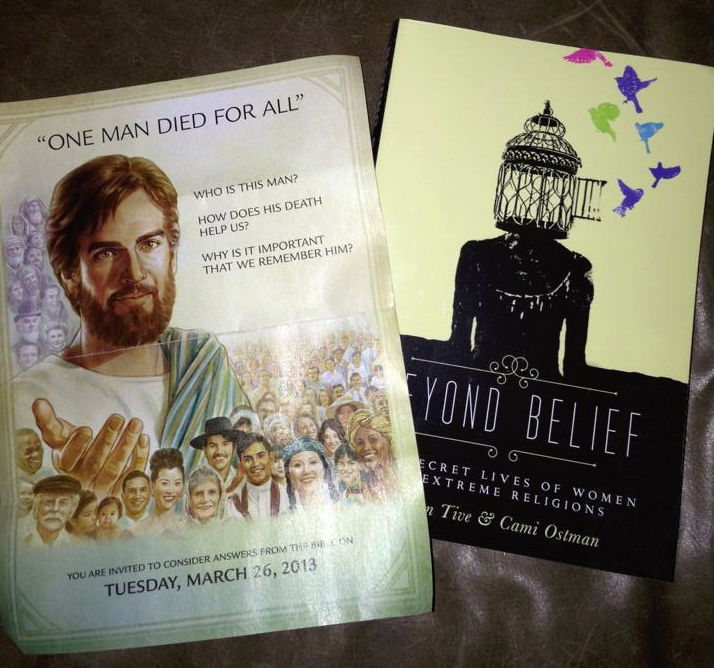
I intro’d my reading with the story of the Jehovah’s Witness flyer with its metrosexual Jesus that arrived on my doorstep the same day I got my copies of the BB anthology in the mail.  That got a good laugh—a good sign.  And I tried my darnedest to read with passion.  (TLW reported later that I nailed it, passion-wise). Still, I was nervous, nerves that come from the fear not just of being exposed, but of being misunderstood by strangers and misinterpreted by those closest to me.

Anne Lamott advises to “write as if our parents were dead” and that seems good in theory, but it’s scary in reality.  My story paints a rather unflattering portrait of my parents, and this is one of my primary anxieties—both that my parents will be hurt/angry/sad that I wrote so honestly about what transpired AND that the audience will think they are bad people with whom I’ve severed all ties. 

That’s ME! At Elliott Bay Books!
So, it was with great relief that an audience member asked The Question—the one question I hoped hoped hoped someone would ask:  “How is your relationship with your parents now?” I’m happy to report that I have solid relationships with both of my parents and that we’ve all come out the other side of this crazy religious nonsense.
And really, that’s the best part of my story. 

Writing is Daring Greatly (thanks Brene Brown)

Dear Reader—Tomorrow night is my debut as a published writer—my first reading of a piece of writing that is actually in a book.  Not on a blog, not off my printer, but there on the printed page amongst other pieces in a collection of published writing.
Pretty sweet. I have to say that it is about damn time considering I’m closing in rapidly on the big  Five Oh (mere months away) and considering I’ve wanted to be a writer for, oh, all of my life. So what conspired to keep me silent and unpublished all these years?
Fear. Fear of being known, of being vulnerable, of being reviled. Shame. The certainty that what I had to say didn’t mean anything to anyone else. The terror that what I thought made no sense to anyone else. Scared that if I committed the thoughts in my head to paper that I would be forever judged by what I wrote down, by the ink stains.
So, what changed? What enabled me to throw caution to the wind, to finally put pen to paper and let the world in on my innermost thoughts? Fear. Ha! How’s that for irony? But seriously, the fear that I might never realize my dream of being a writer impelled me to write.
What if suddenly I were unable to write tomorrow? What if I’d played it safe all these years, thinking I had unlimited time ahead in which to overcome my fears slowly, always confident there would be time later to pen my memoirs, and suddenly I found myself incapacitated? I’d be pissed—angry that my fear of vulnerability, the shame of being thought less of had kept me from sharing my most authentic self.
I didn’t write for so many years because I thought that a) I would be laughed at or, more likely, told my ideas were heretical and would ultimately land me in hell (seriously) or b) I didn’t think I had anything worthwhile to say, that my ideas weren’t universal enough to catch on with anyone outside of my own head.
I realized, in small, baby steps, however, that people did listen when I read, my words did resonate, and slowly, I found a writing community, a group of other writers to cheer me on and for whom I could root. As Cheryl Strayed told us at the Wild Mt. Memoir retreat a couple of weeks ago, we should write from a place of abundance, that is sharing our joy and passion with other writers and cheering them on because there is plenty to go around.
I’ve been reading a lot of Brene Brown lately, and if you haven’t had a chance to catch one of her TED lectures, caught her with Oprah on Super Soul Sunday or read one of her books, make the effort. She’s got some amazing research to share, some great life lessons about living with vulnerability, abundance, and passion.
So, tomorrow. That’s it. Tomorrow I lay myself bare in front of complete and total strangers. Wow. That’s daring. Greatly.

Mawwage . . .

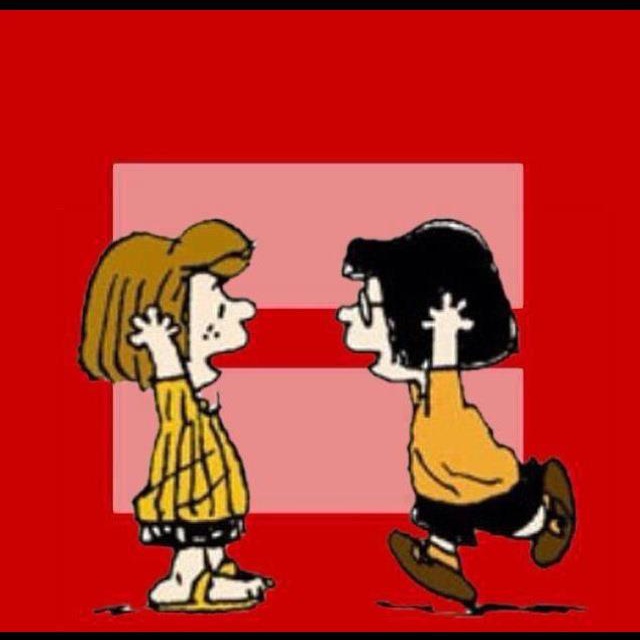
After much internal deliberation, I changed my Facebook profile picture this week, going with the Peanuts version of the red HRC equal sign (gotta love Peppermint Patty, Sir).
I’m not usually one to jump on such bandwagons—I don’t know if I’m trying to remain hip and aloof or if I’m apathetic, but I’m not a joiner.  Typically.  My whole life has pretty much been about not belonging, not joining, being outside/other. I’ve been going back and forth on gay marriage . . . not that I don’t believe that gays and lesbians should have the right to marry—we definitely should have that right.  
I’m just not quite sure why, exactly, we want it.  Oh, I know, I know—it confers upon us the rights that every person in an intimate partnership should have.  I get that. I do. I want those rights, too. But do we have to get them through the institution of marriage?

Think about it. What’s so great about marriage? Besides the rights, I mean. And why should we have to rely on marriage to confer upon us basic human rights? Marriage is both a religious and a patriarchal institution. The fact that we have to buy into it in order to share birth, life, and death events with our lovers/partners/co-parents is just plain ludicrous. Insulting.
When I was in graduate school way back in the mid-80s, my girl friend at the time and I had a commitment ceremony.  We planned to raise a family together. So we sat in a circle with some close friends, cast a pagan circle to the South, North, East, and West and promised to “love and honor each other’s growth and change.” A friend of mine at the time, a lesbian-feminist, a dyke if ever there was one, asked me why I wanted to get married. It’s just mimicking the patriarchy, she told me. Marriage is about women as property, she said.  Women as chattel. 
I saw our commitment ceremony then as sort of a fuck you to the patriarchy—which is sort of how I saw myself as a lesbian as well.  As painful as being closeted and as hard as it was to be invisible as a lesbian, I got a charge from being a stealth lesbian, from flying under the radar. I feel kind of the same way about marriage now. I didn’t ever see myself as buying in to the patriarchy because we weren’t.  We were taking a hetero ritual and turning it on, if not its head exactly, at least on its side, an action that felt subversive.
So much of my life has been lived subversively, on the down low. Under the radar. And for good reason—life above ground could be dangerous: emotionally, physically, psychically. I’m having some trouble letting go—I feel a bit like a mole just coming to the surface. Kind of pissed off about all of the noise and that it’s so bright up here, and annoyed that the rest of the world has decided that we are worthy of the attention.
I feel like “you know what? We’ve taken good care of ourselves so far, no thanks to anyone else. We’ve come together in crisis, we’ve marched bravely in the streets in spite of what the rest of the world might think, enduring shame and refusing to take it anymore. Who are YOU to think you can even debate my most basic rights?”
We have all the paperwork we need to guarantee our future together: powers of attorney, wills, joint ownership of the house. We have taken it upon ourselves to ensure our future, as much as anyone can ensure the future. So why, I asked myself, do we need to be granted the right to marry?
Why do we need a law? I have to say, it’s hard for me not to feel like straight and privileged culture is deigning to let us in, saying “oh, well, I suppose, if you insist, you can come and sit at the adult table with us grown ups, us normal people. Just, you know try to behave while you are here.”
So, I changed my Facebook picture to the red equal sign because, even after I had this internal rant with myself (now external—I know, I couldn’t keep it to myself, it needed air), I think that we need equality. Period. We are all different, but we are all equal and deserving of the same basic human rights, and apparently, we are going to have to continue to legislate the obvious because no one seems to be giving this shit away. 

Imagine

John Lennon said it best:  Imagine no religion. It’s easy if you try . . . no hell below us, above us only sky. Imagine.  I try to imagine what my life might be like had I not been subjected to fundamentalist christianity between the ages of 5 and 21.  Those 17 years more than any in my life shaped me indelibly. Those years of being labeled a sinner who would most likely face eternal damnation burning in hell still color my life. Even more than 25 years after I decided I could no longer subscribe to the tenets of christianity.

Last Wednesday evening,  I sat with a group of women, all writers, all of us contributors to Beyond Belief: Women in Extreme Religion, an anthology of stories about women’s experiences getting into, staying in, and getting out of fundamentalist religions:  Mormonism, Judaism, Islam, Catholicism, Scientology, the Unification Church, fundamentalist Christianity, and others.

Each of us read an excerpt from our story, and as we went around the room, a deep sadness overcame me (that and a not irrational fear that an angry god might smite us for talking smack about him). Sad about the potential wasted, the time wasted, the energy wasted—all the ways in which we’d been shamed, subjugated, stigmatized, separated in the name of god. Imagine growing up female and never feeling shame about being a girl, a woman. Never having to hide: our bodies behind burkas, our brains and intelligence behind our bodies. Imagine life as a woman without the imposition of religious constraints.

What could we have achieved, each of us, I wondered, had we been free to follow our natural impulses?  If we had been encouraged to embrace our talents and truths rather than forced to shut ourselves off from the world, to shut ourselves down, to hide our true selves because our religions taught us our very essence—our loves, our bodies, our desires, our thirst for knowledge–offended some made up god. Eventually, we all  managed to overcome the limits our various religious experiences imposed upon us, to come to an awakening, an awareness that we would never have a genuine life within the confines of these religions.  But what had our lost time cost us, I wondered?

What might we have accomplished if our  energies all those years had been channeled toward, say, science?   Instead many of us worried constantly about going to hell, expending our resources both literal and emotional, on impossible reconfigurations of our minds and bodies. What if instead of having to be vigilant against every carnal thought and deed, I could have spent those years, oh, I don’t know, learning to play the drums or studying computer programming? What if instead of worrying about proselytizing and “saving”  my neighbors, I had reached out across common interests and laid foundations for lifelong friendships instead of worrying my god would cast us all into the fiery pits of hell. Imagine.

As we each read our excerpts, sex emerged as a dominant theme.  So much time and effort expended in our struggles to come to terms with our bodies, our sex, our sensuality. Our natural way of being in the world.  Why, I wondered is religion so preoccupied with sex? Why so much devotion to not-sex?  What better way to control people than by creating fear about the most basic of human instincts?

I was at a writing retreat last weekend, in a workshop on writing about sex, and one of the participants posited how crazy it is that our (judeo-christian) culture prefers to pretend that “good people” don’t have sex despite all evidence to the contrary.  Religion’s powerful constraints spill out into culture and impact everyone, not only the believers, which is one of the most annoying and dangerous aspects of extreme religions: that misguided notion that there is only One Truth.

We only need to look at history (yesterday, two weeks ago, 500 years ago) to see clearly the evils perpetrated by extreme religions.  Where could all of our energy go if we weren’t fighting for rights that religious leaders want to take away? DOMA. The Inquisition. Joan of Arc. Matthew Shepard. A woman’s right to choose. Westboro Baptist Church.

What else might that energy have cultivated had it not been hijacked by the holy?

Imagine.

Imagine

John Lennon said it best:  Imagine no religion. It’s easy if you try . . . no hell below us, above us only sky. Imagine.  I try to imagine what life might be like for me had I not been subjected to fundamentalist christianity between the ages of 5 and 21.  Those 17 years more than any in my life shaped me irrevocably. What happened during those years color what I do still, more than 25 years after I decided I could no longer subscribe to the tenets of christianity.
Last night, I sat with a group of women, all writers, all of us contributors to Beyond Belief: Women in Extreme Religion, an anthology of stories about women’s experiences getting into, staying in, and getting out of fundamentalist religions of many stripes: Mormonism, Judaism, The Moonies, Catholicism, among others.
Each of us read an excerpt from our story, and as we went around the room, a deep sadness overcame me (that and a not irrational fear that an angry god might smite us for talking smack about him). Sad about the potential wasted, the time wasted, the energy wasted—all the ways in which we’d been shamed, subjugated, stigmatized, separated in the name of god. Imagine growing up female and never feeling shame about being a girl, a woman. Never having to hide: our bodies behind burkas, our brains and intelligence behind our bodies. Imagine life as a woman without the imposition of religious constraints.
What could we have achieved, each of us, I wondered, had we been free to follow our natural impulses?  If we had been encouraged to embrace our places in the world rather than forced to shut ourselves off from the world, shut ourselves down, hide our true selves because our religions taught us what we felt was wrong—our loves, our bodies, our desires, our thirst for knowledge. We all have managed to overcome the limits our religions  imposed upon us, but at what cost, I wondered?
What might I have accomplished if my energies all those years had been channeled toward, say, academics instead of directed constantly at worrying about going to hell? What if instead of having to be vigilant against every carnal thought, I could have spent those years, oh, I don’t know, learning to play the drums or enjoying each moment, guilt-free instead of feeling pressured to proselytize so my god would smile upon me, so my god would not cast me into the fiery pits of hell. Imagine.
 The red thread of sex ran through most of our stories, which was a little surprising, given our diversity as a group—each of us spent so much time and effort struggling to come to terms with our bodies, our sex, our sensuality. Our natural way of being in the world.  Why, I wondered is religion so preoccupied with sex? Why is so much devotion to not-sex?  We can see how well suppressing those natural urges and biological imperatives has worked out for the Catholics, after all. 
But, back to religion and wasted time. Oh, sure, I am what I am because of my experiences, and I’ve got lots of rich material thanks to years of being repressed and, frankly, terrified at times that my basic humanity was enough to condemn me to an eternity of damnation. But what else might I have been? What else might that energy have cultivated had it not had to be engaged in a religious jihad against my very own nature? 
Imagine. 

A Pivotal Moment: Memoir is Made of These

Twenty years ago I spent a long weekend at a workshop/retreat that fundamentally changed my life, or at least served as a pivot point in my journey. I had one incredibly emotional moment that weekend—a moment that has stayed with me all these years, through tremendous changes and ups and downs in my life.

One of my favorite parts of this retreat was that it was silent, a fact the participants did not know going in.  We could talk only during the workshop sessions, and not with each other, but to the group as a whole. The food was intentionally less than optimal for those few days as well. And every morning we had to run a mile.

But, I digress.  One evening, the retreat facilitator led us through some guided imagery and we were to be constructing our future home.  What would it look like? Where would it be? Who would be there?

And here’s the part where I burst into tears:  My future home was warm, with dark wood and candles, and inviting comfortable furniture, and it was full of many, many children, children that looked like my children.

At this point, the imagery had taken over and I was just a recipient of this vision.  I wept for probably a good fifteen minutes, maybe more (it’s been twenty years—details are fuzzy), but I know for sure that tears and snot rolled down my face uncontrollably.

I did not understand then why I had that vision nor why I reacted so emotionally to it. The tears were neither sad nor joyous, just bursting with raw and uncontrollable feeling. Looking back now, I understand I was weeping because my vision was so radically, radically different from my reality.  I wept for the pains and joys I had yet to experience on my path to my vision.

Writing my memoir these past 18 months has prompted all manner of self-reflection (the cynics among us might say navel-gazing—there’s a whole other blog), and I’m finding much of that reflecting to be awkward, if not downright painful. So, I was sort of happy when recent events coincided to prompt me to remember this image.

My youngest daughter’s biological brother (both of my kids are adopted) recently moved to our home state and last weekend came to have dinner with us—he and his wife and their four children.  This was the first time I’d met her brother, though she had spent time with her biological family (including her birth parents) over the past few years.

 As the day of their visit drew closer, I grew calmer—which is not really my MO. Usually I ramp up into a bit of a frenzy before such events. There were going to be ten of us, including four children, going out to dinner. I remained calm, grounded even. Even as the day grew closer and we had to redo the plans, I rolled with it, strangely confident that dinner would be what it needed to be.

 And it was. I was home, surrounded by children that looked just like my daughters, surrounded by family new and old and new again.

A Pivotal Moment

Twenty years ago I spent a long weekend at a workshop/retreat that fundamentally changed my life, or at least served as a pivot point in my journey. I had one incredibly emotional moment that weekend—a moment that has stayed with me all these years, through tremendous changes and ups and downs in my life.
One of my favorite parts of this retreat was that it was silent, a fact the participants did not know going in.  We could talk only during the workshop sessions, and not with each other, but to the group as a whole. The food was intentionally less than optimal for those few days as well. And every morning we had to run a mile. 
But, I digress.  One evening, as the retreat facilitator led us through some guided imagery, we were to be constructing our future home.  What would it look like? Where would it be? Who would be there?
And here’s the part where I burst into tears:  My future home was warm, with dark wood and candles, and inviting, comfortable furniture, and it was full of many, many children, children that looked like my children. The children flowed into my home in my vision.
At this point, the imagery had taken over and I was just a recipient.  I wept for probably a good fifteen minutes, maybe more (it’s been twenty years—details are fuzzy), but I know for sure that tears and snot rolled down my face uncontrollably.
I did not understand then why I was witnessing nor why I reacted so emotionally. The tears were neither sad nor joyous, just bursting with raw and uncontrollable feeling. Looking back now, I understand I was weeping because my vision was so radically, radically different from my reality.  I wept for the pains and joys I had yet to experience to truly get home.
Writing my memoir these past 18 months has prompted all manner of self-reflection (the cynics among us might say navel-gazing—there’s a whole other blog), and I’m finding much of that reflecting to be awkward, if not downright painful. So, I was sort of happy when recent events coincided to prompt me to remember this pleasant image.
My youngest daughter’s biological brother (both of my kids are adopted) recently moved to our home state and last weekend came to have dinner with us—he and his wife and their four children.  This was the first time I’d met her brother, though she had spent time with her biological family (including her birth parents) over the past few years.
As the day of their visit drew closer, I grew calmer—which is not really my MO. Usually I ramp up into a bit of a frenzy before such events. There were going to be ten of us, including four children, going out to dinner. I remained calm, grounded even. Even as the day grew closer and we had to redo the plans, I rolled with it, strangely confident that dinner would be what it needed to be.
And it was. I was home, surrounded by children that looked just like my daughters, surrounded by family new and old and new again.

Dash of Dysfunction. Pinch of Crazy

I’ve started working on my proposal for my memoir, and one of the features of said proposal is a list of competitive titles. You know, books that might be similar to mine, books that might share a theme with mine. Books that might share shelf space with mine—when and if . . . I came up with this short list off the top of my head:
The Commitment by Dan Savage (Gay marriage)
The Kid, by Dan Savage (Gay parenting)
Kramer vs. Kramer by Avery Corman (quintessential acrimonious custody battle)
Operating Instructions by Anne Lamott (unexpected parenting)
Why be Normal by Jeanette Winterson (adoption, religion, lesbianism)
Jesus Landby Julie Scheeres (religion, cross-cultural adoption)
In each of these books, I can find one thread of my story, but I couldn’t think of a single book in which two white lesbians adopt two racially diverse children, split up when one mother decides she can no longer send her daughters to daycare and so quits her job, a move that gets her kicked out of the house, and forces her to spend the next 16 years and tons of money on therapy trying to remain relevant in her daughters’ lives.
I think I may have found a niche in the market, Dear Reader. Throw in some subtext about fundamentalist Christianity, add a dash of dysfunction and a pinch of crazy. I think I just might have a winner.
The thing about writing a proposal . . . the proposal goes out to agents with the intent of wowing an agent who will then sell the book to a publisher. Selling the book to the publisher means the story will be, uhm, published. For the entire world to read. For family and friends to read.
What if family and friends find the book distasteful? Objectionable? Disastrous, even? Then what? What if our words change the way people see us? What if our words reveal our deepest truths and our families and friends and co-workers reject our truth? Unfriend us? Treat us differently? What then, Dear Reader?
Experience tells me that some will be upset when I speak my truth and that some will find me brave. Some will admire me and others will turn away. But I will be able to face myself, and that, I think, matters the most.