E is for Español

The last time I spent more than a couple of weeks in a foreign country I was in my early 20s and backpacking around Europe—I didn’t spend too much time in any one country, so only had to pick up enough of each language to ask for a room and to navigate the trains and metro systems. Knowing enough of a language to actually live in a country is another matter entirely—it didn’t take us long to feel like we had no idea what was going on most of the time we were in Mexico.

We picked up a few cultural nuances easily. For example, I learned to say “Buenos dias” in the morning as we encountered local folks, and at some point I noticed that many Mexicans would either greet me or reply to my greeting with a shortened version: “Buen dee-UH (instead of Buen-O dee-AHH-sss).”

So, I started greeting folks with the shortened version. It sounded friendlier, more akin to a “Mornin!” than the more formal, and let’s face it, mouthful, “Good Morning!” And for the most part, I got the same thing back, and no one seemed to care. Until one morning as I was out for a short run, I panted a quick “buen dee-UH” and what came back to me was a very precisely annunciated and less-than-friendly “BUEnos Di-AH-sss.” I felt slightly reprimanded and not a little confused. Had I violated a cultural norm? Was I being inadvertently rude? I just didn’t know.

This flauta was deliscioso, but I never was quite sure what I might end up with for dinner.

Somehow, I managed to graduate from high school and college (with three degrees) and still not have a mastery of any language but English (in my defense, I can parse the hell out of any sentence in English). I finished high school with a single quarter of Spanish, taught by an extremely Nordic woman (it was an unaccredited Christian church-affiliated school, so I kind of give them props for even trying). Still. Somehow, I managed to get into and back out of college without nary a drop of further language education. It’s no one’s fault but mine, but it’s not like I skirted any requirements. There weren’t any. And the younger version of me was very committed to coasting as painlessly as possible through my degree.
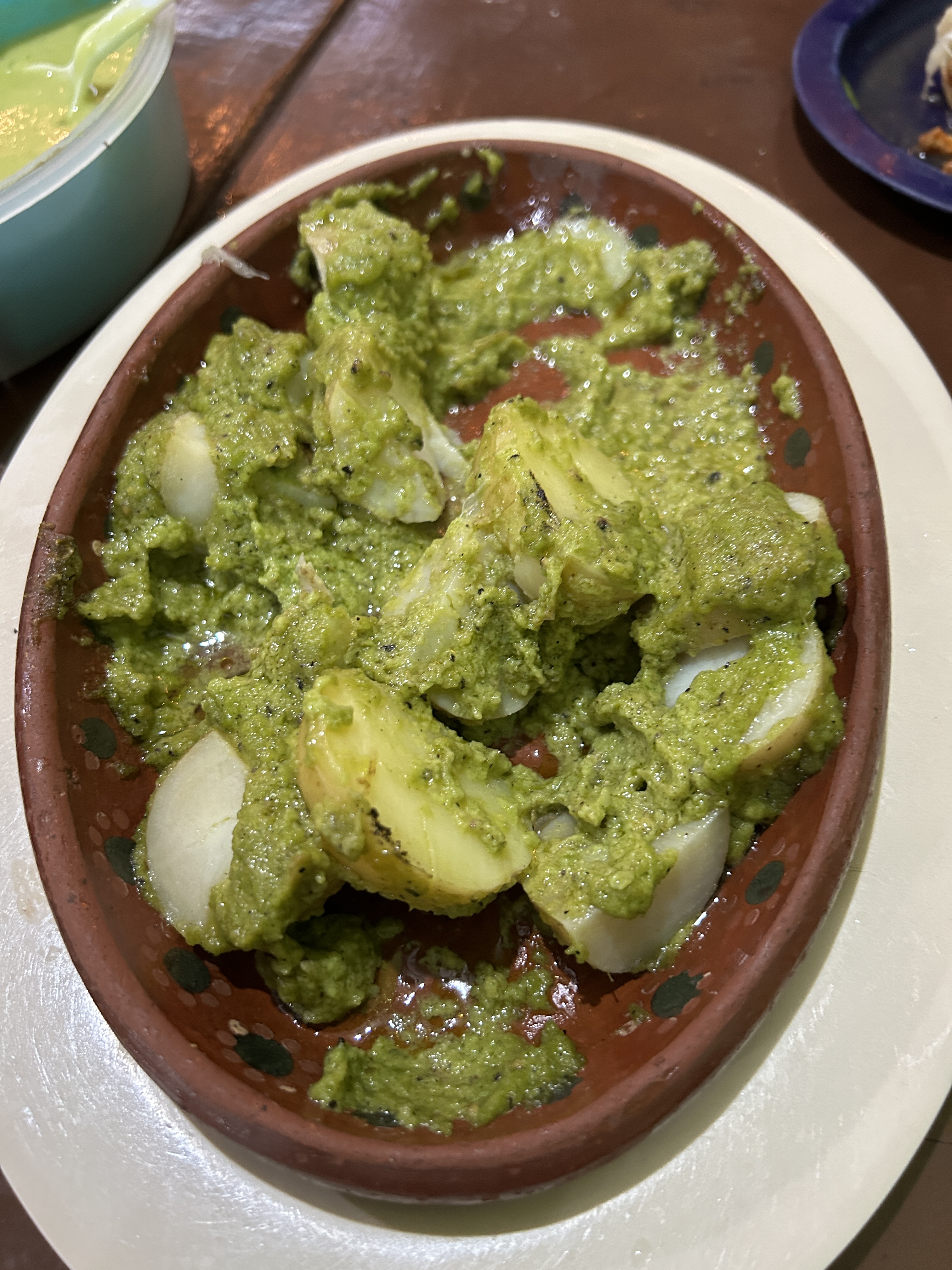
Papas picante. Muy bien.

Even so, as a tourist, I’ve never expected folks from the countries I visit to speak English, and, I try my best to communicate with the rudimentary skills I have, often leading to unintentionally comic results. Like the time I felt fluent enough in the little Spanish I had picked up during one short trip to announce to a roadside seller of coco frio, “Mi papas casa es in Mexico.” He handed me my coconut with the straw poking out from it with a puzzled look.

Only later did I realize I’d told him that my potato’s house was in Mexico. No wonder he looked confused! There’s something about being in the moment while a local is awaiting a response–the pressure builds and even if we’ve studied intensely beforehand, whatever we know leaves. That’s what happened to my pal who came to visit. She faithfully listened to and practiced a Spanish lesson every day for weeks before she came to visit. And still I ended up interpreting for her most of the time. Me!

I never had trouble ordering a margarita.

It’s one thing to navigate the market and menus, ordering and paying, conducting basic transactions, but quite another to understand a response in Spanish to any sort of question I might ask. And forget about understanding why things are happening, like why the brand-new bus station is roped off and the buses all stop at the Pemex station instead or why the cops look like The Militia and often, but not always, take the license plates off the buses.

Why do Mexican drivers pass on blind corners or use their flashers so often? Why don’t any of the restaurants on the beach stay open past dark? Why, exactly, can’t we drink the water? Where in god’s name do I buy a ream of printer paper and how am I going to act out printer paper and do you think anyone will understand if I pantomime typing?

On my first attempt to procure distilled water for a visitor’s CPAP machine, I thought I had used enough accurate hand gestures and replicated what Google Translate gave me sufficiently to indicate to the farmacéutica what I needed, but when I got home I discovered I had ended up with a bottle of sodium chloride. Just the opposite of agua purificada.

Yes, Google Translate helps, but not always. I can ask for a haircut using Google Translate, and I can show the barber a picture of myself with what I would like, but once the barbero puts the cape on me and picks up the clippers, I have to surrender. I got two haircuts in Mexico. More on that later, in H is for Haircut.

I can’t imagine learning another language sufficiently enough to express the nuances of a haircut or well enough to banter with the barber like I would chat with my hair stylist at home. It’s a deeper sort of awkwardness. I’ve become somewhat accustomed to being away from home and the disorientation that often accompanies waking up in different towns, states, campgrounds, and driveways, but say what you will about these United States, it is very good to be back on familiar ground.

C is for Casa (or how hard could it be to find a place to live in Mexico)

I’m ready!

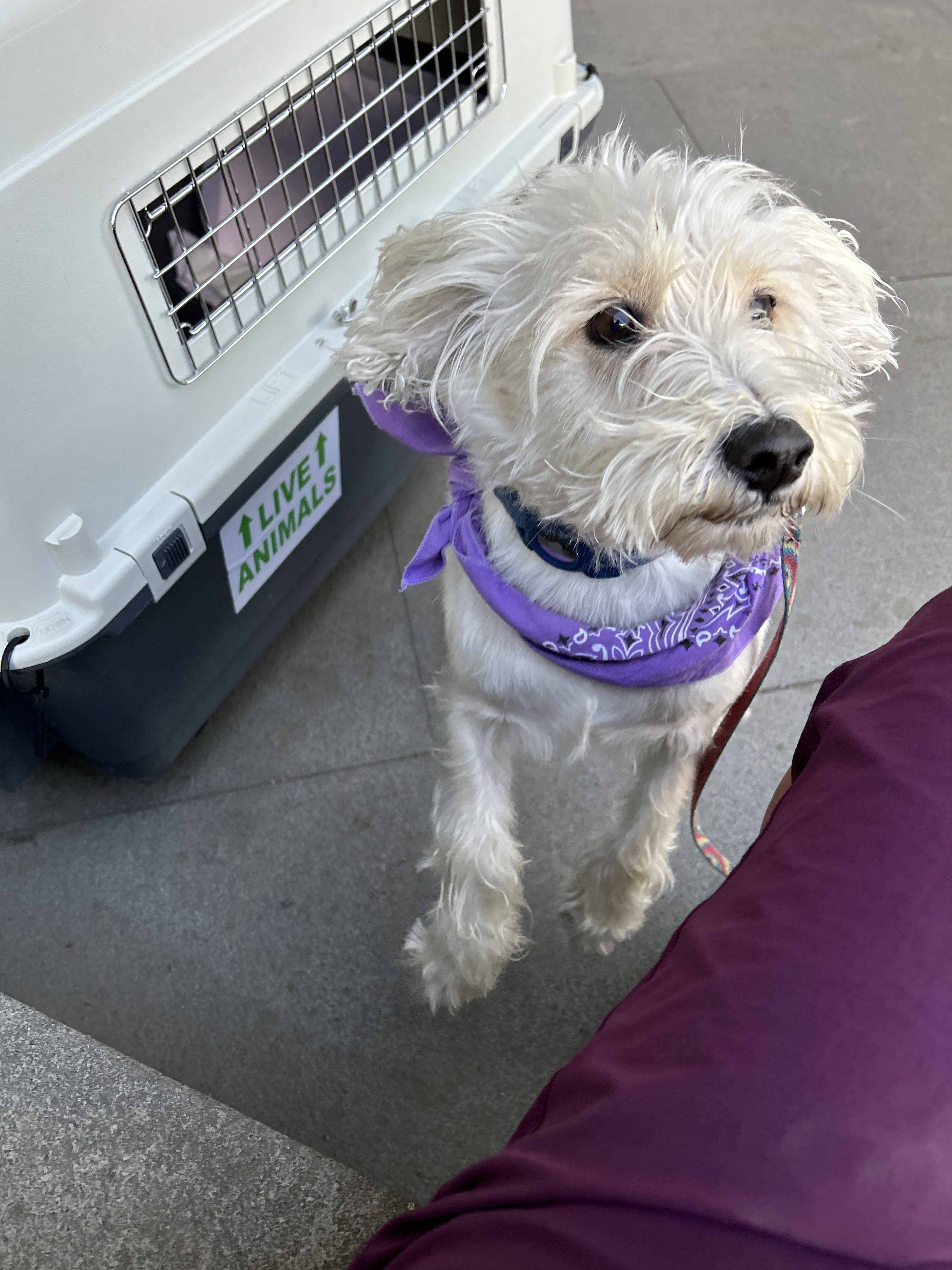
The phone rang late on Thursday night. I was supposed to be in Mexico, but I was still in Texas because, in spite of showing up to the airport at 6:30 that morning, I hadn’t been able to fly out. It was too cold to put Bodhi in the cargo hold. Come back tomorrow, the Aeromexico attendant said. It’s going to be warmer tomorrow.

My travel companion’s panicked voice pierced the late night quiet: “Pam, this place is awful. We can’t stay here. The driver took one look around and asked me if I’d already paid. He said he couldn’t leave me in danger.”

“Hey,” I tried to be reassuring, “it’s been a long day of travel. I’ll be there tomorrow. Try to get some sleep. I’m sure it’s fine.” I rolled my eyes. We’d picked this place out on Airbnb, the pictures were cute. How bad could it be? I tried to muster a reassuring tone. “I’ll be there soon. Just breathe and get some rest. It’s Mexico—it’s gonna be a little funky.”

I arrived the next day, and it was just as bad as she had tried to tell me. Way worse than funky.  

There was really no way we could have known the kitchen chairs were broken and uncomfortable or that the one (as in only, single) non-kitchen chair in the room sank all the way to the ground if one sat on it. Or that the “river” was a dried-up mud pit that, when it flowed, flowed with sewage. Never mind that they didn’t bother to mention to rooster farm next door nor the 24/7 cockadoodle-dooing. I have to admit reader, we didn’t read between the lines on the reviews: “exactly as advertised,” and “basic but fine.” No one mentioned the construction next door or the cranky mama pitbull.

It took us five days, but we found another place, for less than half what we’d paid for this one. We snuck out under the cover of early morning darkness because by now we had read the reviews thoroughly, especially the one about the fight with the landlady’s husband and the tone with which the landlady replied to all of the negative reviews, well, let’s just say, she gave us pause.

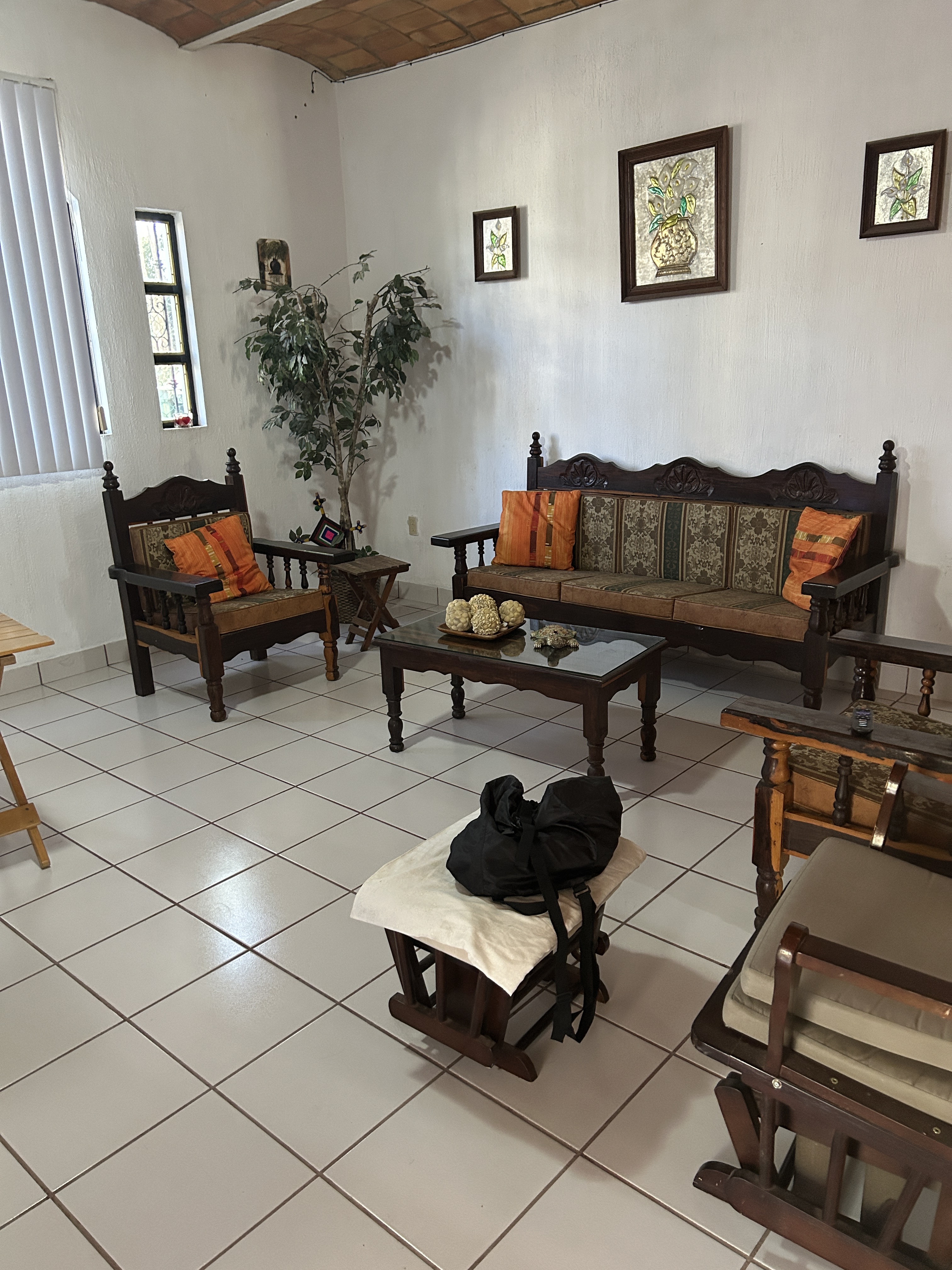
Our new house was perfect. Clean, quiet, affordable. Cute enough. Safe. The owners, made sure we had what we needed and then left. It was perfect. Until we realized we’d landed in the Mexican suburbs. Suburbia. Where nothing happens, where there’s nothing to see but a gazillion homes that all look alike—a lovely representation of the Mexican middle class. Just one problem—I had not come to Mexico to spend three months nowhere near the beach.

My travel companion didn’t seem to mind, but I knew we could do better. She advocated for nearby Bucerias (so crowded, so expensive, so clogged with gringos) or Nuevo Nayarit (ditto). We just needed to head north, I explained, up the coast, beyond Sayulita. A handful of lovely beach towns dot the coast between the touristy cesspool that is Sayulita and San Blas, an ancient military stronghold about four hours to the north.

“C’mon,” I begged my friend, “It’s so much better in San Pancho (though it is too pretentious for its own good), or Lo De Marcos, or Guayabitos—cheaper, cleaner, better/cleaner, more sand and surf, more bars and restaurants to explore on the beaches.”

She reluctantly relented, and we headed north to Guaybitos, the little Mexican resort town, a feisty town full of tourists, sandwiched between Los Ayala, to the south and  La Penita to the north, a place I’d spent several vacations visiting my father and his wife who’ve lived there for 16 years.

The funny thing about this town is that it’s very near the dateline between Central and Mountain time, which meant we spent a lot of time asking strangers for the correct time. As we sat at Juan’s Place on the beach, sipping our morning margaritas, I turned to ask a gentleman for the time. Which led to a longer conversation about our need for a nearby rental.

“Our neighbor’s house is for rent—he’s leaving tomorrow for California. It’s about 400 yards from here.”

Reader, it was perfect. Affordable. Clean. Close to the beach, fenced for the dogs. Big enough for guests.

A casa to call our own.

A is for Adios Amigas!

Last summer, after a couple of bottles of wine, and addled by the summer sun, a friend and I decided it would be a great idea to spend the winter in Mexico. She had spent six weeks the previous winter on the Caribbean side in Porto Morales, and I had spent several short vacations north of Puerto Vallarta over the last decade visiting my father in Rincon Guayabitos. We both knew we’d rather walk our dogs on the beaches than in the snow and rain.

Initially we thought we would drive my van down, meeting up in Austin (where I had spent November and December), and departing from there, winding our way to the Nayarit Riviera. Our friends and families, however, had strong opinions about why that might not be a good idea:

“That van would make a nice cartel drug van!” “Two old ladies alone in a nice van? Are you nuts?” And so on. I remained undeterred.

Our original rental in Sayulita. Pictures can be deceiving!

We scoured Airbnb for affordable places to stay and finally settled upon two that looked suitable. One in Sayulita for six weeks and one in a sweet little beach town up north called Chacala.  We put our money down. But as the summer days dwindled into fall, my courage waned. I was mere days away from departing the Pacific Northwest for Texas, but I didn’t know how to tell my friend I was chickening out on driving. I didn’t want to get killed by the cartel. I didn’t want them to steal my van. I didn’t want to be a headline. And neither of us spoke Spanish which made the drive seem even more reckless.

It felt like chickening out, but I gathered my courage and confessed my fears. Turns out my friend was thinking the same things but was also afraid to tell me, sucking up her fears and putting on a brave face. After all, she had navigated around the world on her sailboat. Why would she be afraid of a little drive to Mexico? But, age does funny things to us. As does the news media.

We laughed and reconfigured our travel plans. My biggest challenge was figuring out how to get my dog, Bodhi, down there, but I didn’t have the bandwidth to worry about it yet. I still had over 2000 miles to drive, camping sites to secure, work to do, sites to see. I would have to fly now, and my dog, Bodhi, too big to travel under the seat, would have to fly in cargo. I’d figure it out, I told myself. Shouldn’t be too hard Dogs fly all the time.

I didn’t have the bandwidth to worry about it yet. I still had over 2000 miles to drive, my sweetie and a rental awaiting me in Austin, Texas, camping sites to secure, work to do, sights to see.

I is for Imagination

spongebob_imagination

I often say that I write non-fiction essays and memoir because I lack imagination. I’ve never been good at making stuff up, and whenever I sit down thinking I’m going to write a short story or embark on writing a novel, I get a few pages in and stop, overwhelmed by the apparently limitless options.

Taylor, my youngest daughter (she’s nearly 20 now), loved to watch SpongeBob SquarePants when she was little. She loved SpongeBob so much that we had a SpongeBob bathroom (The Little Woman painted it SpongeBob blue and yellow with hand drawn and painted replicas of Patrick and SpongeBob on the walls) complete with a SpongeBob shower curtain and SpongeBob toilet seat cover. Taylor’s bedroom was also SpongeBob yellow, and she had SpongeBob posters, blankets, pillows, sheets, Legos . . .

Of all the characters populating childhood during those years, I found SpongeBob endearing and definitely the least objectionable. He was happy, undaunted by failure, cheerful, a good friend, a hard worker, compassionate. But most of all I loved SpongeBob because he had Imagination.

That Taylor loved SpongeBob made sense, because she too had a great Imagination. I could give that kid two sticks and a small rock and she could entertain herself for hours, making up stories, creating characters, playing alone in her own world.

When Taylor was eight, the two of us went on a three-week camping adventure across Washington and Oregon. We set off without much of an agenda, except that we were going to see Grandpa in Bend, OR. Other than that, we were footloose. We started our trip by meeting some friends and floating the Yakima River. I worried a bit that T would be bored, hanging out with three adults and our friends’ high school-aged son, but she proved to be an excellent traveling companion.

TaylorORvacay2 copy

As I set up camp, pitching the tent and getting the camp stove ready for dinner, she played in the hammock, creating entire worlds from just leaves and twigs. What amazed me the most, I think, is that on her own T wasn’t much of a reader. She loved for me to read to her, but she wasn’t one to sit in camp (as I would have done as a child) with her nose in a book. Instead she was engaged, making up her own stories. I so admired that quality.

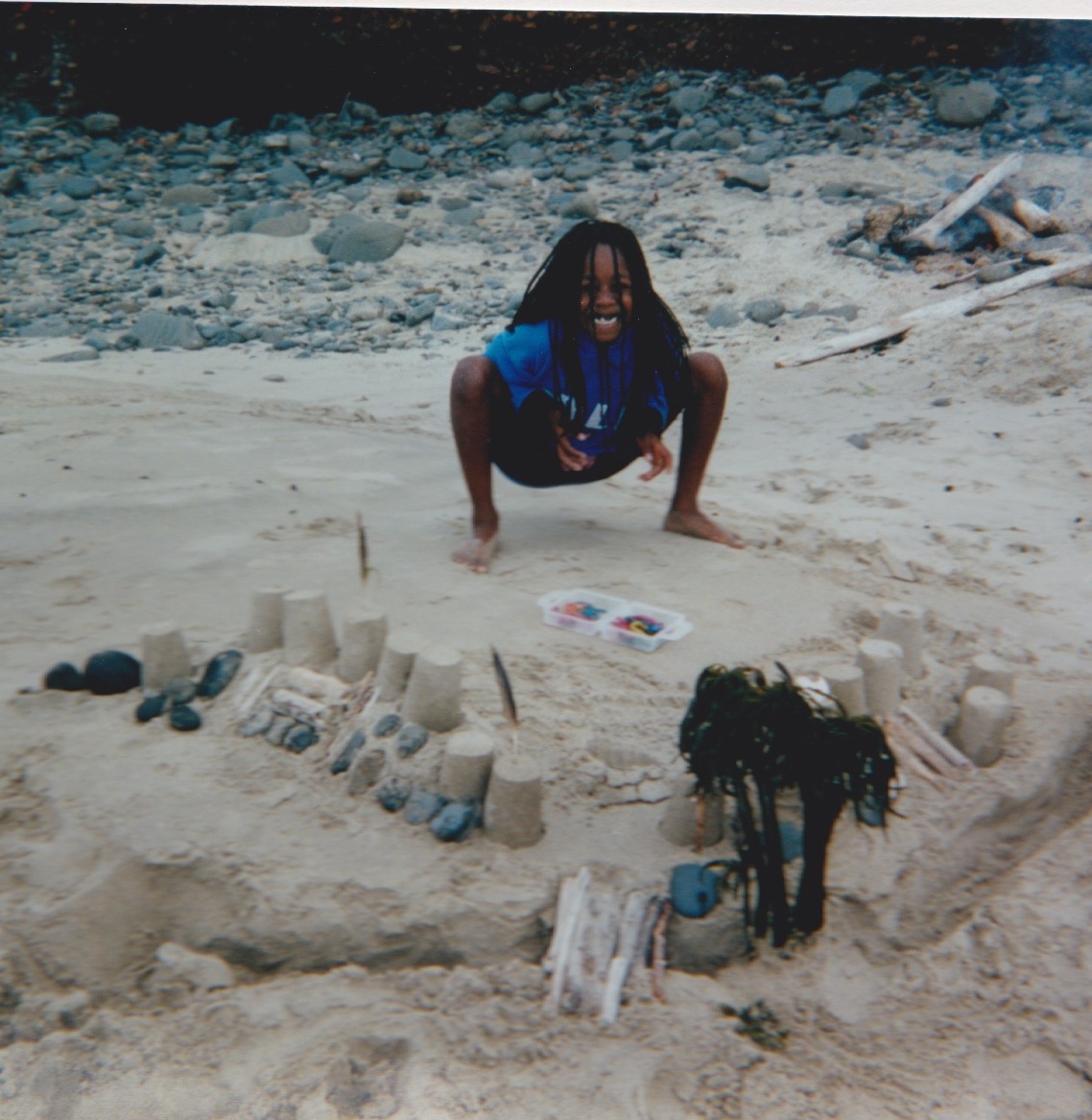
We spent a lot of time at the beach on that trip, and while I went to the beach to read, T went to the beach to play, to create. Every foray was an adventure for her, a chance to create new worlds, to see everything in a new light, with new possibilities. I stopped taking my books with me because I ended up pulled into her world each time, building sand castles, searching for agates, creating new worlds.TaylorORvacay1

When we had fires on the beach at night, they weren’t just for roasting marshmallows or for keeping warm.TaylorORvacay2 2  Each fire presented an opportunity to create, even fleetingly, something new—Taylor delighted in burning sticks and then running to the water to put them out, creating steam. Or, drawing in the sky with the red ember end, writing words for me to guess.

TaylorORvacay2 1

One of our stops, a little town in Northeast Oregon called Shaniko, had been a ghost town and was now just a town stuck in time for tourists to wander through. I didn’t find it particularly interesting, but I made a point of walking around with her, reading some of the historic descriptions. I think we got ice cream cones that melted rapidly in the eastern Oregon summer sunshine. I didn’t think it would hold much interest for T, but she still talks about “that town that was just full of old people.” Something there captured her imagination.

Our last stop on our adventure was Manzanita. We pitched the tent at the campground on the beach and walked the shoreline into town to have some dinner. We’d heard about the great pizza place, and found it jammed. We finally got a table, one that could easily seat more, and so when I saw two women come in who wanted to sit down, I invited them to join us.

Taylor started telling these women about our trip. She didn’t leave out a single detail. And when I thought she might run out of material, she started embellishing, sprinkling in details about my personal life, adding a few false statements, entertaining the women who joined us. No one else could get a word in. On our walk back to the campground, I thought I’d take the opportunity to discuss the difference between talking about our adventures and sharing personal and/or made up details.

She looked at me and said, “It’s just imagination, Mom.”

That’s it–just imagination. No need to be overwhelmed or caught up in the details. Find some kelp to turn into palm trees. Make the sticks talk to the leaves. Just put my stick in the fire and write in the sky.


On the Road to AROHO: Feel the Fear (and the Heat) and Go Camping Anyway

Good late morning from Twin Falls, Idaho, Dear Readers.  I’m about a third of the way to my destination, Georgia O’Keefe’s Ghost Ranch in Abiquiu, NM.

Let me just start by saying that if you’re in menopause and experiencing random and frequent hot flashes, camping in the desert southwest might not be the best way to travel the 1700 miles between Bellingham, WA and Abiquiu, NM.  Too bad I didn’t consider this issue before I was pitching my tent in 102 degrees last night.
I’ve been planning this trip for several weeks, but somehow camping in the heat didn’t really cross my mind. Perhaps because I’m a PNW “blue-tarp” camper. Whenever I think about camping, all that comes to mind is rain and cold, wet sleeping bags and damp fires that never quite get started.
Nonetheless, I had a somewhat satisfying camp experience last night—I managed to get some sleep, at least until some Muslims pulled in around 1 a.m. and started cooking goat.  I kid you not. I listened to these two guys speak in a language I did not recognize before some English speaker started talking to them. As I lay there not sleeping and cursing their bad campground manners, I learned a lot about middle eastern cooking and spices, the Muslim response to 9/11 (at least these Muslim’s responses), and why these two young men were going to college in Idaho.
Ironically, the fact that two middle easterners were camping in the remote hills outside of Boise actually made me feel better about my own choice to camp alone. If they weren’t afraid, I wouldn’t be either (though I did sleep with my hunting knife within reach). I have to say, there was so much unsolicited consternation about my decision to drive to New Mexico that my confidence started wavering soon before I left, and as I looked for a suitable camping spot last night, I had to beat back my fear.
I thought a lot about Cheryl Strayed’s adventures in her memoir Wild—what she had to say about Fear came rushing back to me as I set up my camp and perused my surroundings:  I knew that if I allowed fear to overtake me, my journey was doomed. Fear, to a great extent, is born of a story we tell ourselves, and so I chose to tell myself a different story from the one women are told. I decided I was safe. I was strong. I was brave. Nothing could vanquish me. Insisting on this story was a form of mind control, but for the most part, it worked. Every time I heard a sound of unknown origin or felt something horrible cohering in my imagination, I pushed it away. I simply did not let myself become afraid. Fear begets fear. Power begets power. I willed myself to beget power. And it wasn’t long before I actually wasn’t afraid.” 
So, fear conquered, at least last night. I woke up partially refreshed, made myself a thermos of coffee and hit the road.  I stopped at a payphone to check in with my sweetie since there was no cell service, and steered the Jeep toward Salt Lake City.
This morning I thought I might get a hotel for the night, but as of this writing, I’m not so sure.  If I can camp in 102 degrees in remote Idaho, surely Utah has even better experiences to offer.

Some random observations: it is far too hot to take the top off the Jeep which is rather disappointing. I have to stop every hour or so and scrape the dead bugs from my windshield.  Gas is getting cheaper the farther south I go. Drivers here are much more polite and aware than drivers in Washington State (i.e. they move over and don’t hog the left lane on general principles). The landscape is very dry—many side of the road fires, and one very large one near my campsite last night (extinguished the day before I camped).