Shameless Self Promotion

As I embark upon this new adventure, I’ve been pondering ways to integrate my past experience with all things technological with my writing life and my new life as a therapist—how to intertwine computer support, writing, and therapy? I believe I’ve hit upon a solution and am launching a computer support service for writers.

As any writer who has been to a workshop knows, these days it’s all about platform. Platform. Platform. Platform. Marsha. Marsha. Marsha. (Sorry.) Not everyone who writes wants to promote themselves. Some of us just want to write. But the hard truth of the matter is that regardless of what you write or who ends up publishing your writing, you are going to need a platform. For the uninitiated (and sorry if this sounds preachy or redundant, but I’m guessing there are some out there who don’t know), platform is the means by which you promote yourself and your writing and starts with the basics: A Facebook page, a Twitter account, a website. I’m sure, just by virtue of my age, that I’m unaware of the latest social networking tools, but I’m according to this website, FB and Twitter are in the top few still. If you want to sell a book, you need to have an audience and an online presence. This summer at the PNWA conference, one agent said that if we even wanted a publisher to look at our work we needed a minimum of 10,000 Twitter followers. At the time, I had fewer than 80.

I’ve managed to build my Twitter following to nearly 600, but this endeavor is time-consuming. Enter me—budding therapist, aspiring writer, retired technology guru. I can help you build your Twitter following. I can put that Twitter button on your WordPress site for you. I can show you how to create lists and give you tips on generating a following. If you don’t have a Facebook page or if you have a FB page but just one for family and friends, I can help. I can show you how to create an author page and generate followers. If you want a website but aren’t sure if you should go with WordPress, Blogger, or SquareSpace, I can help you decide and walk you through the fine points.

For eight years I worked at a Catholic elementary school helping teachers integrate technology into their classroom. Before that, I taught computer repair skills to adult learners, and prior to that I taught freshman composition to community college students. I’ve taught some of the most difficult subjects to the most challenging students (come on, have YOU ever taught a room full of teachers or displaced workers?) I can certainly help you build your platform. If I can talk Mrs. Koreski into having an interactive whiteboard in her classroom AND teach her to use it, I can help even the most tech-phobic and recalcitrant writer build her platform. I’m even willing to manage said platform (for the right price).

So, lock yourself away in your writing garret if you must, but if you want to sell that shit, you’re going to need a platform. I can help. Drop me a line: pamela.s.helberg@gmail.com

My Surprisingly Not So Dubious Work History

I’ve long held the apparently erroneous belief that aside from being a writer, I am otherwise unemployable, but when I take an objective look at my work history, that just isn’t the case. Now, given the fact that I quit my last job over six months ago and have developed an online presence as a lesbian, feminist, atheist author, I may in fact never get another job, but up until last August, I did a pretty fair job of bringing home the bacon. I guess my belief about my employability stems more from my longtime desire to be a writer than from my willingness to do whatever it took to stay afloat. I’ve even managed to put together a couple of careers amid what seems to be a mishmash of jobs.

I’ve been a college English instructor, a college Computer Information Systems instructor, the technology director for a Catholic elementary school, and a systems analyst for an oil refinery. I’ve owned my own bookstore and managed the bookstore at a technical college. I’ve worked at our local independent bookstore in town a few times over the years, as well as at a national bookstore chain (and for a while I worked both places at once). Not long after I graduated from college I managed to get a job at the local university as a Secretary 3 by lying about my knowledge of filing systems, but my shorthand skills were not what they should have been and I didn’t take orders very well.

During high school I worked at Kentucky Fried Chicken and while in college I dropped out for a quarter and took a gig at Arby’s, but I’ve never waited tables. During the summers while I was in college I worked as a forest fire fighter, first for the department of natural resources and then one summer for the National Park Service. I spent the summer between my junior and senior years of high school in the Youth Conservation Corps on the Olympic Peninsula. Once, I had a job in a television tower putting on local commercials in place of the national ads. I don’t remember much about that job except that I drove miles and miles up a gravel road to this boxlike structure where I climbed a ladder, locked myself in, and watched a lot of tv.  And I did a stint during high school at a print shop where I learned to make silk screens and plates for printing presses, skills I wish I still had today.

Currently I am not working. Ostensibly I quit my job last August in order to pursue my career as a writer, but that’s not really going very well. I’ve discovered something new about myself:  I don’t like to work in isolation. That thing that Robert DeNiro said at the Academy Awards the other night about writers—was so accurate. The mind of a writer IS a terrifying thing—the isolation, the neurosis, the procrastination, panic, self-loathing, it’s all true.  I couldn’t hack it. So, I decided to go back to school. To get my masters degree in mental health counseling. So I can help writers battle the isolation, neuroticism, self-loathing, panic, and procrastination. I mean who better than I to provide this service? I am not planning on giving up on being a writer, but I am going to add “therapist to the worried writer” to my resume. Naturally, I plan to write about this adventure as it unfolds.

Starting a new career at the age of 50 is frightening. Taking on student loans terrifies me (though I do my best not to let on to The Little Woman), but I look at it like this—I have one life, one shot to get it right, one chance to find out really what I was meant to do. I don’t think I’ve figured it out yet, and I’d really like to before all of this comes to an end.

Monkey Mind: On Time

Turns out there are writing prompts for this daily blog posting event. Yesterday’s was Five Interesting Things About Me. I made a list, but I am so tired of Internet lists. I’m going to start with just one of my endlessly entertaining quirks, and hopefully, Dear Reader, your curiosity will be piqued and you will return tomorrow and thereafter.

Shall we begin with a haiku?

Your hands sweep across
My face—time moves so slowly
And life rushes past

I am pathologically on time. My wife, The Little Woman, shares my sickness. We arrive early for everything. Movies, appointments, ferries, interviews, coffee dates, events. I don’t know what drives TLW, but for me I can trace my punctuality to two things: a self-help/self-awareness/personal growth workshop I took many years ago and a previous marriage. I guess maybe people were trickling in late to the workshop and the presenter asked them how important the workshop was to them. If memory serves, they all answered that it was very important. Then why are you so late? She pressed. Traffic. Kids. Spousal issues—the answers varied. Then the workshop is less important than all those things, the presenter said. They protested. No. Not at all. Stuff happens. If the workshop were more important than all of those things, the presenter said, you would have been here on time.

They went round and round for awhile longer on this topic. I squirmed in my seat, hating the conflict I wasn’t even a part of. The upshot was this—we will make time to get to the things that matter to us on time. How important is that job interview? Is it important enough that you refuse to risk being caught in a traffic jam? Is it so important you will arrive the night before and get a hotel room to avoid being late? How important is teaching your class? Your livelihood depends on being on time. You make time to get there. How important is this workshop? She asked again. Light bulbs went on. Pennies dropped. Heads hung. The lesson was not lost on me. I internalized that lesson.

The other reason for my punctuality has a lot to do, I think, with having once been “married” to a woman who, given an extra twenty minutes, would paint a bedroom before we left for an event. Didn’t matter if we were going to friend’s for dinner or to a play at the university. She could squeeze an extra chore into any sliver of time, no matter how small. Ten minutes? She’ll weed whack the back yard. Fifteen? Give the dog a bath. I hated living like that. Hated arriving out of breath and with paint in my hair. Hated the stress.

Being early for things certainly has advantages. I can find parking. I generally don’t arrive to anything sweaty and disheveled. I get good seats. Sometimes I get in to my appointments early if no one is ahead of me, which gets me out earlier. Getting to movies early is particularly entertaining—TLW and I have sort of made a sport of watching people arrive and choose their seats. Generally it’s comical. Sometimes it’s annoying. Occasionally we will be in a virtually empty movie theater and someone will sit right in front of us. One time, when there were at least another 50 seats available a woman and her friend sat right next to TLW—right next to her. No one seat courtesy. Just bam, right there to share the armrest. That was a WTF moment. But sometimes getting somewhere too early is awkward. People aren’t expecting me. I have to sit in the car an uncomfortable amount of time. Time drags by. I worry and wonder if people think I’m casing their homes.

So, I’ve been trying to fine-tune my time management skills, looking for the sweet spot between being too early and being late enough to cause stress. I’ve been noticing how much time I waste waiting. Since I got my iPhone ‘lo those many years ago, waiting is rarely boring, but perhaps I’m spending too much time on LOLz when I could be a tad more productive. I can take an extra ten minutes to finish up a piece of writing or to rinse out the coffee pot or to stop for gas so the low-fuel light doesn’t go on. I’m not going to start a major remodeling project, certainly, but I could wrap up a few small tasks instead of monkey-minding my way through my Twitter feed or flipping through my Facebook posts. Yesterday, for example, I made myself sit until I finished my blog and posted it. I had plenty of time, but I had to force myself to stay in my seat. I knew my pending appointment was only a ten minute drive away, max. Even in Bellingham where we may as well just make the speed limit 20 on every single road because no one drives faster than that, ever, I could get there with time to spare. So I sat. I finished typing. I edited. I glanced at the clock. Still plenty of time. I copied. Pasted. Posted. Even with the slow Internet at the café my blog post showed up before I needed to leave.

I put on my jacket. Finished my tea. Bussed my table. And sauntered to my Jeep. I drove the speed limit all the way. And I still arrived ten minutes early. I guess there’s still some work to be done.

NaBloPoMo

I did a crazy thing the other day. Overwhelmed by inspiration from attending AWP 2014, I signed up with Blogher.com for NaBloPoMo, their monthly blog writing challenge. The idea is to write a blog a day for the entire month. I’m already failing. It’s March 3 and I’ve yet to produce a blog. It’s not like I don’t have any ideas, but I have this fear that when I start a blog, I won’t be able to finish it or wrap it up sufficiently. I am afraid I won’t be able to bring it on home, I guess. This is not an unfamiliar fear. It creeps in often around writing, especially after a dry period.

I have the same fear about running after a few days off. Due to snow and AWP, I’ve not been running for the past five days, and so when I got up this morning the pressure to go for a run was nearly paralyzing. I employed all of my tricks to move past the fear—I got dressed in my running clothes even though I knew I wouldn’t be heading out for a run anytime soon. I reminded myself that I had been feeling exceptionally healthy these past couple of months—a direct result, I am pretty certain, of my increased running activity. I looked at the pants I’ve been wearing recently—pants I couldn’t button before Christmas. That was motivating. Eventually I worked up enough momentum to propel me to lace up my sneakers and hit the road.

Writing is like running I thought as I surveyed the landscape on my run. There were huge branches all over the place, shaken from their trees by recent storms. Writing is like that too, I thought as I gave some trees with suspicious looking branches wide berth. I didn’t need a branch falling on my head. Writing shakes out those loose branches, those fears I encounter before embarking—what if I don’t get very far? What if I make it a mile and then I can’t go on? What if it hurts? But it’s raining. The bottom line is that by beginning, I will be no worse off than I was by not starting and the chances that I will be better off increase each time I put on my running shoes and hit the pavement. Past experience tells me this—it is a fact. I feel better when I run. I feel much better if I run more. I feel shitty if I run less and I feel shittier still if I don’t run at all. I know these things.

I know that if I write, I will feel better. If I write more, I will feel better still, and if I don’t write or write less, I will feel shitty. Furthermore, if I don’t write I will have no material. I cannot reach any of my writing goals without material—I can’t send anything out for publication. I cannot finish my book. I can’t even apply to attend writing retreats (at least the ones I want to attend) if I don’t have anything written down. Starting writing is as scary as putting on my running shoes—facing the blank page or the glowing white computer screen is a lot like taking that first step of a five mile run. What if I get to the end of page one, the end of mile one, and I can’t go any further? What if I run out of things to say?

Here’s what I know:  I’m not any worse off than before I started. In fact, I now have approximately 500 words that I did not have a few moments ago. Just like after running a mile, I am ahead of where I was before I embarked. No worse off, certainly. Most likely better. Because one step leads to more steps just like one word leads to more words and sometimes the miles and the pages fly by and before I know it, I’m bringing it home. I’m cresting that hill, finishing that essay, posting that blog and running the final few steps to my driveway. I know that finishing feels so damn good.

Monkey Mind, Monkey Run

I’ve been thinking all week about external validation, beyond the likes and blog comments and more into  (what I used to believe was) my non-digital life. Most days I struggle to walk away from my keyboard. After all, that’s where my livelihood (such as it currently is) resides—writing, school, job applications. To counteract all of this screen time, I’ve been trying to push away and spend at least an hour each day running. I was on the massage table the other day, telling my massage therapist about my last blog, recounting for her how I thought that running so much these past two months had significantly calmed my annoying physical symptoms of the past year. I told her how good it was for me to spend that hour each day away from the computer screen and out of my head. Then I mentioned in that offhanded manner that so often carries the weight of truth that I run with my iPhone because my phone is where my Nike app lives along with my running music and my Fitbit app.

“So, you’re not really getting away from the external validation,” she noted.

“I don’t answer the phone and I don’t check my blog stats when I run,” I said, a little miffed, before adding, “Usually.” Slowly I began to see her point.

As I run through the miles, my iPhone via the Nike app, tells me how far I’ve run and at what pace.  My Fitbit vibrates when I hit 10,000 steps for the day (generally by the time I’m done with my daily run). I listen to a playlist of music and when Florence and the Machine comes on with Dog Days, I know that I’m nearing the two mile mark and that about 20 minutes—give or take half a minute—have gone by. I know then I have about 30 minutes left. I know the first of the Lady Gaga songs come on around mile four, and I know that if I’m still running when The Band starts playing that I’m closing in on mile five. I know if I’m running better than I did the day before. Hell, I even know if I’m running better (or worse) than the average of my last seven runs. On good days when I’ve finished running and before I stretch, I’ll even post my run results to Facebook with a comment along the lines of “nailed it bitches!”

“What would happen if you ran without your phone?” the massage therapist asked me and then answered her own question. “You’d be able to hear the birds.”

“I’d just hear myself huffing and wheezing,” I countered. “And I’d lose miles. My averages would plummet.” As soon as I uttered those words I knew I had a problem, or, in the parlance of the mindful and aware, I knew I had something I might want to pay attention to, something to look at.

She laughed when I said I’d lose miles. Absurd, right? Of course I wouldn’t be losing the miles—my body, my health would still benefit, clearly. But would I be able to tolerate not documenting my progress? Would I be able to derive the same pleasure from running if I couldn’t compare today’s run with yesterday’s?  And how would it be to run without music? Would I be faster or slower? Could I stand to listen to just my own heavy breathing? I’m not sure I can. I’m not even sure if I want to, but I’m interested in taking a closer look at the whys of the situation. I’m interested in noticing.

I’m interested in noticing because when I pay attention, I can begin to make more conscious choices about this one life I’ve been allotted. On the surface these choices seem trivial: whether I run with or without music, with or without digital feedback on my performance, with or without compiling and parsing each mile. But are they really insignificant or are they indicative of a larger problem? Even as I type this piece I can’t refrain from flipping back to the Internet, to Facebook, to my email. I cannot focus just on this bit of writing for any sustained period. I don’t know if my monkey mind is getting worse or I’m just noticing it more, but I’m beginning to worry that I’m not paying close enough attention in other areas of my life, that being easily distracted could be taking a toll on my relationship and my career (or lack thereof), on my desire to be a writer. Is this inability to focus on just one thing at a time without soliciting feedback and validation getting in my way?

For one of the psychology classes I’m taking this quarter, I had to read about and then write a page and a half paper on BF Skinner—I had to pick out my favorite theory of his, write a paragraph on said theory and then find a related online source to write about that had to do with my favorite Skinner theory. I started this exercise thinking I wasn’t a big fan of Skinner—I think (or used to think) that behaviorism was reductionist and limiting. After all, behavior modification techniques did not work at all when I tried to use them on my kids. My kids could give a flying fuck if they got a gold star on a refrigerator chart. I came out of my active parenting years with the firm belief that nature will always triumph over nurture. But, a funny thing happened on the way to writing my Skinner paper—I started connecting the dots. Duh. I remembered a book I had purchased but only partially read a few years ago, Nicholas Carr’s The Shallows: What the Internet is Doing to Our Brains. I looked Mr. Carr up on youtube and listened to him read from and discuss his book at the Harvard University bookstore.

If Carr is correct (and I do believe he is), the Internet really is changing the way our brains work. My brain has been changed to actually need to push the levers at Twitter and Facebook, to peck away at my email icon. All of this screen time is rewiring my grey matter, new neural pathways are being formed based on Skinner’s Operant Conditioning theory. I have been trained to push the levers just like the lab rats. Nike and Fitbit, Apple, Facebook, Twitter, WordPress, Google are delivering enough random little doses of oxytocin to keep me coming back for more.

Now that I have this awareness, what am I to do? Initially, I’ve decided to just be aware, to simply notice (is it obvious yet that I’m taking a mindfulness class?). When do I press the levers? What distracts me? Do I feel better or worse if I stop writing and check an empty inbox? What do those Facebook likes and new Twitter followers mean to me? Does my self worth rise and fall with my stats? Why? And maybe most importantly, am I engaged in meaningful and purposeful relationships outside of these places? Am I moving forward, toward my goals for the next year, the next five years?

This afternoon I thought briefly about leaving my phone and earbuds behind when I headed out for my run. After all, I knew the run from my front door to Boulevard Park and back again is just over five miles. I don’t need iTunes to mark my distance. But, I do know that I seem to be in a running groove right now that works for me. I am aware enough to know I don’t want to fix something that’s not broken. I’m getting fit. My pants are getting looser. My body feels great. I LIKE having Macklemore, JayZ, and Rhianna in my head. Screw the birds–S & M motivates me. Today I chose to run with the technology in place. Tomorrow I may decide differently. Tonight I will decide if I want to read a book or spend my time before sleep anxiously checking online stats. I’m leaning toward the book. I’ll let you know what actually happens.

My Drug and My Vice

Feedback hits my veins
Smack for my ego, mainlined
I close my eyes, sigh

I wrote this haiku over the weekend, fueled as I was then by a steady stream of positive feedback for my writing and after a really great response to the Whatcom Writes reading on Sunday. But like any good addict knows, that euphoric feeling fades fast without a continual infusion.

I managed to ride the wave for most of the week, getting by on a steady stream of Facebook likes and occasional comments, but on Friday I hit bottom.  Two months ago I sent out some queries to a handful of agents and within days one agent requested I send sample chapters of my memoir. This is it, I thought. I’m golden. I worked feverishly for a week to put some high polish on a few of the better chapters and sent them off into the ether. I tried hard to stay in the moment but really, who among us writers doesn’t live at least part of the time on that fantasy book tour? On the bestseller list in our own heads? I’m a legend, if only in my own little monkey mind.

Things came crashing back to earth for me on Friday when the agent got back to me with a kind and generous email indicating that perhaps my pages aren’t quite ready for primetime. Honestly, I can’t say that I wasn’t expecting this—I know the odds. We all do, when we sit down and dare to think we have a hope of seeing our words in print. The statistics are depressing, but still, we dream.

This crash, this bursting of my ego and the view from down here at the bottom set me to thinking about how fortunate we are now, though, as writers. We have an audience if we want one. We don’t have to toil in obscurity—relative obscurity, maybe, but not completely. We have communities that welcome our imperfect work, places where we can get our hits and fixes, venues even if they are of our own making.

I started wondering, though. What was it like as a writer to wait months and months for feedback on a piece of writing? Or to not get any at all? Imagine—writing something, spending a few hours, or weeks, months, years, on a piece and then just . . . doing what with it, exactly? Sending it to an agent or publisher and then waiting for a single letter to come by post. No instant gratification. No thumbs up or down within minutes. I suppose after a week or so trips to the mailbox might become something like obsessively checking Facebook within a few minutes of posting a particularly witty comment or status update. The worn path to the mailbox might have been a little like the iPhone-shaped silhouette on my back pocket—there because I want easy access to my inbox, the ability to quickly check my blog stats. My self-esteem rises and falls with the number of hits I get.

All of which leads me to ponder just how healthy it is, this continual trickle of sporadic feedback and my incessant need to check in on it. On the one hand, when the stream dries up a bit, we can just post something new. On the other hand, why? What’s my motivation? To continue the high or to hone my craft? I’ve been reading about B.F. Skinner and the behaviorists, operant conditioning—the key to operant conditioning is the immediate reinforcement of a response. Suffice it to say, I’ve been thoroughly conditioned by variable reinforcement. I feel a bit like a used lab rat, and the unpredictable rewards are messing with my monkey mind.  One day there might be these beautiful little gifts waiting when I press that lever, other days there’s nothing. Does the nothing keep me from pressing the lever? No it does not. The nothing makes me press the lever even more—there must be some mistake! Where’s my feedback? My next hit? I need my fix!

So. I enroll in a mindfulness class. I employ hypnotherapy and guided imagery. I run. I run and run and run. They say the endorphins produce a natural high. It doesn’t really compare, but there are 30, 40, 50 minutes a day where I’m away from the lever at least. And I’m getting healthier as a side benefit. I’m not sure I want to give up the drug, the high, the next hit long term, but I’m trying to get better at living in the moment and focusing on writing just because.

Oh hell. No I’m not. If I were, I’d not be posting this damn blog.  Hit me baby. Just one more time.

My Life in 17 Syllables

**disclaimer:  I’ve spent the last two hours trying to format this freaking post. I give up. It is what it is**

At the beginning of January, I accepted an invitation to join a Facebook Group, the premise of which is that each member will write one haiku a day for the year. Since leaving my job in late summer, I’ve been struggling to put words to paper (or computer), so I joined this group with two thoughts: the accountability and peer pressure would be good for me (not that anything untoward would happen if I didn’t perform), and surely I could manage 17 syllables a day. If I couldn’t manage three lines, then maybe I needed to reconsider this whole writing gig.

So, January 1 being what it is, the first day of resolutions, I set out to meet two of mine: a haiku and healthier eating. The two goals collided into this:

 
First resolution 
Fails Rice Krispies taste icky
With coconut milk
 
Not deathless poesy, but good enough for a couple of LOLs in the comments section. At first I felt kind of bad because some of the haikus were awesome and heartfelt—I thought maybe I was playing a little too fast and loose with my allotted syllables. I persevered nonetheless, and as the days passed, I really started looking forward to not only posting my own creations but to reading other members’ haikus. Each day felt like a treasure hunt, each little poem, a gift, a bit of insight into lives I hardly knew, and some I didn’t know at all, reflections from around the world on death, politics, weather, climate, gardens, families, words (always on words), jobs, teaching, writing, and lots and lots of snow.

My own haikus began to reflect what was going on in my life, from the simple things like travel:

 
Pesky roundabouts
Gordian knots of travel
Complicate my drive
 

To the more complex emotions that I couldn’t otherwise articulate (and that make The Little Woman slightly crazy—because she truly wants to understand the creative, writer me and make me feel less anxious): 

The wanting, a bloom
Like ripples across the pond
Mysterious ache

I started doing body work, massage and acupuncture and physical therapy in search of ways to lessen my anxiety and annoying/mysterious physical symptoms I’ve been having since last spring, which led to haikus like these:

Poetry loosens
the tight place in my center
a deep word massage
 
Knead me with language
Releasing tightly coiled,
Naked emotions

(and this one, when my massage therapist returned from a trip to India):

Massage therapist
Returned from enlightenment
Lay your hands on me!
 

There have been haikus as a result of therapy and hypnotherapy sessions as I’ve struggled to come to grips with the new course my life seems to be taking—or as I’ve tried to take some control of my life as I contemplate changing careers:

 
Face my face. Reflect.
Self love trapped in the mirror.
Eyes see naked fear.
 
Trust Occam’s Razor
That’s right. The simple answer
Is likely correct.
 

Haikus as I’ve wrestled with self-doubt: 

Invisible girl
Becomes an opaque woman
Turn toward the light
 
Spinning syllables
Like so many sticky strands
snaring self esteem
 
Face down my deep fear 
breathe deeply, write word, word, word
sentence, paragraph
 

And more on writing:

words, flat black squiggles
unequal to the challenge
litter my pages
 
writing: like pulling
quarters from your ears or like
your head from your ass?
 
strings of syllables
strung across the abacus
clacking back and forth 

There are clusters of 17 syllables about family:

 
Visiting Mother
Our past. My future. Her womb.
Cord blood, still tethered
 
Freshly cut cedar
Takes me back to childhood
Dad mom brother me

And then there are those that I can’t explain—the ones that come as I’m deep in thought pondering images and metaphors and playing with words. Some of these are my favorites, though if pressed to explain them, I don’t think I could, and that’s what I love about this process—I don’t know what is going to show up day to day, but every day I get something:

Words like locks tumbling
Falling into place just so
Speak the key to me
 
This rucksack’s stuffed with
IOUs and promises—
words, my currency
 
Play me for a fool
Or like a Spanish guitar
My heart strings, your song
 

And everyday, I am excited to see what others in the Haiku Room have posted—to read, 17 syllables at a time, what we are all making of this journey:

 Sunday morning mass
in the haiku room, poems
our catechism

This is a place I can worship. Like one of the group members commented when I posted the haiku above:

Oh, this filled my heart with joy! And it reminded me of one of my favorite Hafiz quote: “The great religions are the ships. Poets the life boats. Every sane person I know has jumped overboard.”

Posted By Blogger to Putting on My Big Girl Panties at 2/04/2014 11:41:00 PM

Makeup Beauty Doll and Other Problems with White Privilege

Many years ago, flummoxed by the joys and perils of raising two non-white children in our predominantly white culture, I wrote an essay expressing my doubts and fears, and (surprising to me now) my certainties (you will recognize them when you see them). Some of what I wrote makes sense and some of it clearly needs rethinking. Yesterday on the day we celebrate Martin Luther King, Jr., my eldest daughter, now 23, texted me (this is how we communicate these days). She was wondering if I thought it odd that the company for which she now works didn’t celebrate the national holiday. I do find it odd, odd that only governments and banks shut down on this Monday when the world grinds to a halt, more or less, for other national holidays: Christmas, Thanksgiving, Memorial Day, the 4th of July.

My initial response to her was yes, MLK day is like Veterans’ Day or Presidents’ Day—national holidays that go unobserved by most businesses in the name of productivity and profit. She replied that businesses should do more to honor a man who inspired the policies so many companies tout when they brag about being diverse and multicultural. I agreed.

I dug up that essay and I emailed it to my daughter yesterday. We had an enlightening and informative (for me at least—I can’t speak for her) email exchange about White Privilege after she read this. She asked if I’d ever blogged about the subject. I haven’t. I’ve been fairly quiet about it over the years. Why? Fear. Fear of offending someone, fear that I didn’t know enough about the “issues,” that I hadn’t read enough, studied enough, experienced enough. I thought overnight about this fear and I’ve decided that if someone is offended by me writing about my experience, then they are missing my point. I also decided I haven’t talked or written enough about race, in spite of the fact that I helped raise two African-American children. (Point of clarification—Anna, my eldest is mixed race—Native American, African-American, white; Taylor is African-American). Maybe it’s not too late. So, I am posting my long ago essay publicly for the first time—I’ve revised it some for clarity but mostly this is as I wrote it 18 years ago. Here it is:

Last week my daughter’s preschool teacher asked me if I’d talked with her about discrimination. I haven’t. But I’ve been thinking about it a lot lately. What do you call the adopted multiracial child of white lesbians? I don’t know, but I’m sure as the years pass us by we’ll learn more than we care to know. I told the teacher that our family had discussed variations in skin color and the many other ways in which people are different and alike. How to explain discrimination based on skin color to a five-year old?Halloween 1994

Our oldest daughter carries an acute awareness of her skin color. She knows that her skin is much darker than ours. She also knows that her little sister’s skin is darker than her own. “I have browner skin than you, but Taylor has the darkest skin, right?” She’s been known to ask this question on more than one occasion. And when we brought her baby sister home, Anna unwrapped her, peered beneath the baby blanket and with some relief announced, “Oh good, she has brown skin, just like me.” She knows which kids in her daycare have brown skin, though ethnicity is an elusive concept. For her, the world is comprised of people with varying shades of brown skin—from very dark brown (like her sister) to not brown at all except for little brown spots (freckled, like mine)—and people with porcelain white skin and long blonde hair.

I had no idea how deeply children internalize societal messages until we began dealing with what, in our house, has become “the hair thing.” Anna’s hair is a crop of silky brown ringlets, which we have, until recently, kept short for the sake of simplicity. Imagine my surprise when, after we agreed to let her grow it out, she expressed her delight at the prospect of finally having straight hair. She was shocked to learn that her hair might grow long, it would not grow straight.

I’ve read The Bluest Eye. I know the world bombards our children with images of white babies, white Barbie Dolls, white Make Up Beauty dolls, and I know that I too eagerly try to overcompensate at times, for this deluge. This year for the first time, Anna knew early and consistently what she wanted for Christmas:  a pogo stick, a computer, and a Makeup Beauty Doll (which really is just a head with hair). Being the sensitive, aware, and hip parents that we are, we bought her the African-American version of Makeup Beauty, basically the white doll painted brown with straight brown hair instead of straight blonde hair. These details were not lost on Anna. Her face lit up as Santa handed her a box just the right shape for the coveted Makeup Beauty, but the excitement faded quickly into disappointment when she pulled the brown doll from the box. Anna suffers our political correctness with a sigh and a roll of her eyes, but she knows that Makeup Beauty is supposed to be white. After all, she told us, the make up only shows up on white skin. She has a veritable rainbow selection of Barbies residing with her African-American Cabbage Patch Doll, her Black Raggedy Ann and Andy dolls, but she only plays with the white ones.

So, how do we talk with her about discrimination? There’s color awareness, and there is discrimination or prejudice based on difference. How does the five-year-old mind wrap itself around that one? Is Anna being excluded at school because of her skin color? Are teachers, parents, workers excluding her or making decisions based on stereotypes? Anna’s teacher gave me a book for kids about discrimination, Black Like Kyra, White Like Me, that is full of stereotypes. Kyra lives in a violent section of the city. She meets her white friend at the Youth Center. To escape the violence, Kyra’s parents move to a predominantly white section of town and encounter nothing but resistance, violence, and harassment. The message, it seems, is that people of color live in places that need escaping from, but the white people don’t exactly roll out the welcome wagon in the desirable neighborhoods. And I should share this information with my five-year old? Where is the line between preparing a child to meet challenges and adversity and raising a child to expect conflict and harassment?

Right or wrong, the one feature by which my children will always be judged in this country is their skin color. Before strangers know Anna and Taylor have two moms, before anyone knows their socioeconomic status, their spiritual convictions, their occupations, my children will be judged as other than white. The content of their characters will come later. The question is, do I teach them to expect this judgment as inevitable? Do I read them books in which people of color are run out of white neighborhoods? Do I tell them that one day they may not be invited over to play at a friend’s house because they are African-American, Native American, multi-racial, obviously different?

Or do I teach them about respect, about the value of difference and diversity, about some people’s narrow mindedness. Do I teach them to expect acceptance if that is what they offer? And if I teach them these things, what will I say the first time one of them encounters a racial slur or rejection simply because of their skin color? A great gulf exists between my experiences and what my children will encounter. I cannot be naïve and pretend it won’t happen, because it already has. I expect discrimination and prejudice will continue to find their ways into our lives in more potent measure than they have thus far.

Sacred Sacrament My Ass

Yesterday Mark Zmuda the vice principal of Eastside Catholic High School was fired for marrying his male partner (you can read about it here), joining dozens of other Catholic employees across the country who have been similarly fired or forced to resign for making their love official. This news, while not surprising or even unexpected in light of the luddite misogynist (who shall remain unnamed here) leading the Seattle Archdiocese, kind of broke my heart. I know that the parents who send their children to this school are not, for the most part, bigots or homophobes. For eight years I worked (as a mostly out lesbian) for a Catholic elementary school that fed directly into ECHS. I loved that job—I loved the people, the families, the community. I wasn’t crazy about the Church as an institution, but hands down it was the best job I’ve had in my career. This in spite of our differences on topics such as birth control, abortion, LGBQT issues, women’s place in the church, and pedophiles. I was able to separate the institution at large from the community in which I worked.
The job was so good, in fact, that when a change in administration occurred and I learned my boss would be leaving, I looked within the archdiocese for another position. Five years ago I was offered a job at Eastside by an administration that was quite familiar with my lesbian status. (Ultimately, I declined the job offer for reasons completely unrelated). It doesn’t take much to connect the dots between my wedding this past weekend and the “there but for the grace of the universe, go I” feeling that swam uncomfortably in me yesterday afternoon and into the evening. I even woke up feeling nauseated by the whole thing this morning.
So what gives? Why this guy? Why now when the Catholic Church seems to be crawling out of its hole and into the 21st century with Pope Francis? As my good friend and former boss pointed out yesterday, it doesn’t matter what is happening in Rome. The henchmen installed by Pope Benedict are still in control. The church isn’t going to turn on a dime, if indeed it will turn at all. Good people are still going to lose their jobs because some Catholics are still wedded to doctrines like The Baltimore Catechisminstead of the gospels. They’ve forgotten all about being true Christians, ignoring Christ’s own words about love and compassion. Here are a few bible verses I remember from my church going youth:
Matthew 7:1—Judge not, lest you be judged.
Matthew 7:5— You hypocrite, first take the log out of your own eye, and then you will see clearly to take the speck out of your brother’s eye
Luke 6:31—Do unto others as you would have them do unto you
1 Corinthians 13:13— And now these three remain: faith, hope and love. But the greatest of these is love.
The church owes its very existence to the gospels, but because of its status as religious institution, it (and by extension its schools) is not compelled to pay into programs that other employers are required by law to pay into: unemployment, COBRA, OSHA. So, Mr. Zmuda who was fired for participating in one of the Catholic Church’s seven sacraments, Marriage, will not be receiving an unemployment check next week. He will not be offered to continue his healthcare insurance through COBRA. He has no safety net.
Since leaving the employ of the Catholics, I’ve become a much more strident non-believer. My atheism springs from an inability to reconcile the hypocrisy of the church, and not just the Catholic Church, but most churches. The whole do as I say, not as I do sort of theology has poisoned organized religion. The gospels urge care for the sick and the poor, and the Catholics even have a social teaching to that effect, but the church continues to flaunt its wealth while vast majority of its members live in abject poverty. When I worked for the Catholic elementary school not only did none of the employees qualify for COBRA or unemployment, but healthcare did not include birth control. Even women in menopause who needed to go on the pill for reasons unrelated to contraception had to get notes from their doctors stating as much.
For an institution that holds the Holy Mother in such lofty regard, it treats the rest of the world’s women with utter contempt, from the nuns to third world women to women who want to enter the priesthood. But, I guess that makes sense given that the Holy Mother is such a bundle of nonsense: virgin mother. Right. Inseminated by God. Right. No earthly woman could ever achieve what this mythical creature did.
And don’t even get me started on the pedophile issue. To articulate my thoughts on that issue will require an entire series of blogs.
What I am trying to say is that I am sad and furious. Sad because good people are being fooled into complacency, people like Mr. Zmuda who felt safe enough in his role at Eastside Catholic High School to come out to his coworkers about his marriage. People like me who thought I could be an exception if I just behaved myself and kept my mouth shut. Furious because we continue to let our rules and laws and lives be dictated by an ancient and cruel institution that clearly has no regard for real human life. How long will we allow ourselves to be lulled into complacency by those who will try to tell us “it’s not the people, it’s the institution.” The people are the institution, dammit. We need to stop fooling ourselves.

The Road to AROHO Day 6: I’m Here! Gratitude and a Few Other Things

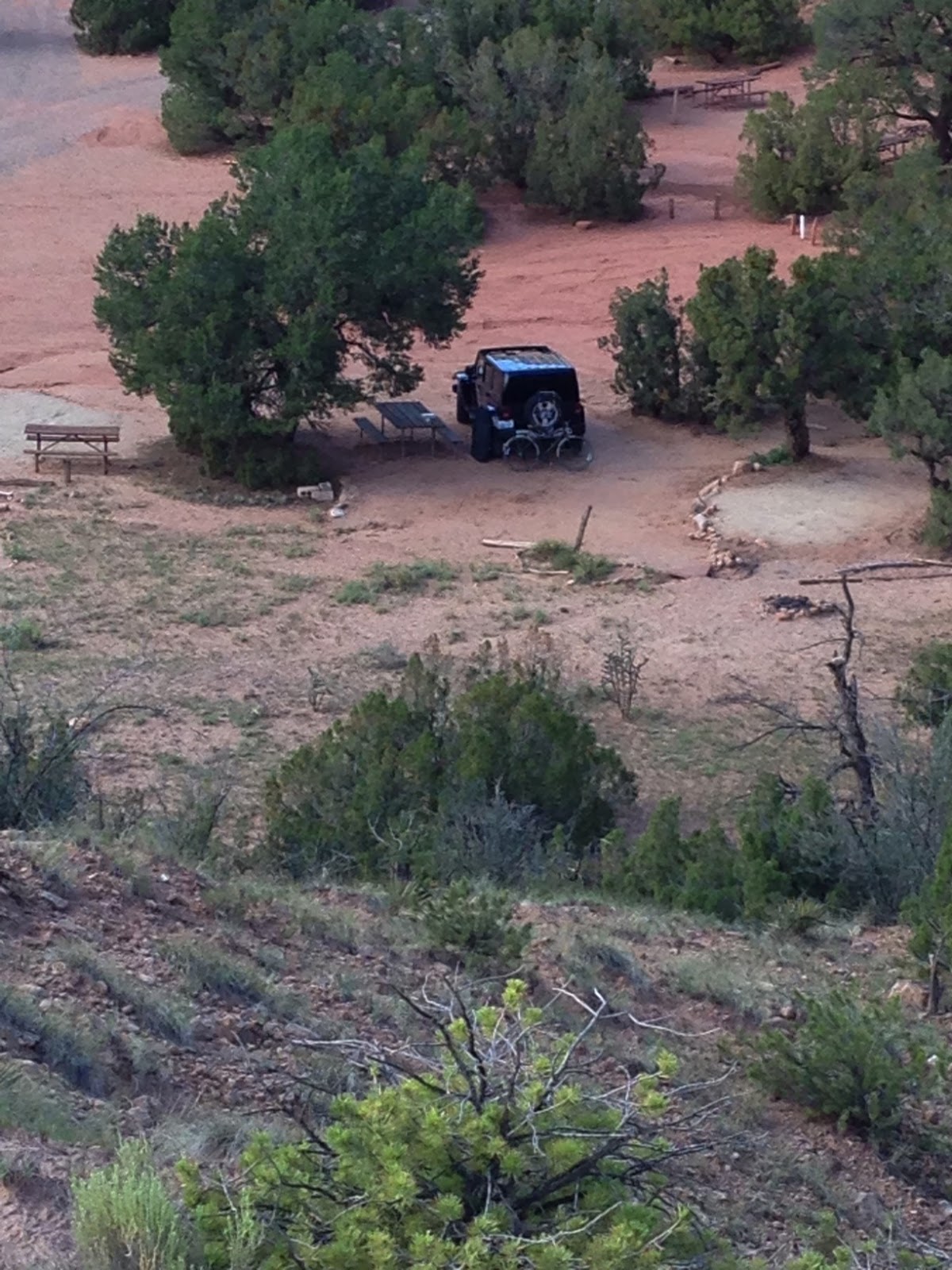
I pulled up stakes in Pagosa Springs late yesterday morning as I had to wait for my tent to dry out after Saturday night’s deluge. Fortunately the sun came out early and hot and I was on the road by noon. The drive from southern Colorado to northern New Mexico was surprisingly verdant and lush. As I wound my way through the San Juan National Forest, I breathed deeply, loving the aroma of pine needles baking in the summer sun. I could have been in Washington, everything was so green.

As this trip has progressed, I’ve been making a list of the things I am thankful for, on this trip, and in general. Of course, I’m so grateful to SugarMama and her unwavering support of my dreams. I say “of course” but we all know that sometimes we need to hear (or read) the gratitude as well as know it. So, a heartfelt and loving shout out to Nancy, the best partner a woman could have.
I didn’t plan this trip they way some of you might have. I didn’t make reservations ahead of time at any campgrounds. I didn’t have a list of stops I wanted to make a long the way. I set out with my only agenda being to get to Ghost Ranch and to have fun getting there. So, I’m very thankful that each night I found a safe place to camp, and in retrospect, each place was the right place each time. Every site had exactly what I needed that night whether it was solitude (helping me overcome my fears) or WiFi (so I could share my adventure) or laundry (so I wouldn’t smell) or showers (ditto).  I had to let go of my notions about camping—what constitutes real camping vs. what is practical and smart.

I’m thankful for a hundred other things as well: my jeep (even though it sucks gas, it is reliable and FUN to drive and makes a nice makeshift place to sleep in the rain); the two tarps I bought on a whim—one has provided shade and the other a nice clean pad for my tent; the bottle of lotion I threw in at the last minute because my hands have been so dry on this trip; the lantern my brother gave me for my birthday last year—it is so cool, so compact, and so bright; my headlamp for reading in the tent; my bicycle—I debated whether or not to bring it, but it’s been awesome to have, and here at Ghost Ranch, it’s invaluable. This place is sprawling.

My sleeping bag. I realized a few nights ago that I have had this sleeping bag since I was 19. That’s 31 years! My dad bought it for me for my birthday that summer in 1982—it’s a North Face bag, and it wasn’t cheap all those years ago, but it had a tiny flaw in the fabric, easily patchable, and so he got a great deal on it. It’s down and still has its feathers and plenty of loft. It’s warm. It has a history—we have been to Europe together, to the mountains, to the beach. We’ve camped with my parents, my kids, my lovers, my wife. We’ve been to the southwest, twice now. I suppose there are more technologically advanced bags, ones that will keep me warm even if they get wet, ones that won’t leave feathers on my pjs. And maybe someday I’ll get one. But right now, I’m thankful for this sleeping bag.
Not everyone grows up camping, but I did. And for that I am thankful. My parents took me camping when I was just a baby and dragged me to the wilderness kicking and screaming when I was a teenager. We rode horses into the high country, fished in cold mountain lakes, and camped in the August mountain snow. I learned how to light a fire, how to make eggs on a camp stove, and how to set up a tent. I’ve slept in smelly pup tents surrounded by horse blankets for warmth and on straw in a huge canvas army tent with a stove in the middle. I don’t mind sleeping on the ground. 
I learned not to touch the sides of the tent when it rains, how to dig a trench around the tent, and I know the importance of keeping my matches dry. I’ve also learned to pack a lighter. There’s nothing like the night sky in the pitch dark, and I’ve learned to get out my tent and look at the Milky Way.
I’ve learned the art of self-sufficiency. There’s nothing more rewarding than sitting in my campsite, in my camp chair, drinking the camp coffee I made on my camp stove, and gazing at the surrounding countryside.
And now that I’m here, I’m thankful for a safe journey, for the cooling rain (now that I’m not camping anymore), and for the adventure that lies ahead.