Beyond Belief: The Secret Lives of Women in Extreme Religion, the anthology for which I am honored to be a contributor, just got a great write up in the Washington Post. Check it out and add some comments! One thing to note, the publisher added the word Extreme to the title. What do you think?
This morning, I woke up early, the result of a nightmare. I haven’t had a dream that I can remember for months now, but there was a grizzly bear in my early morning REM, pointed out to me by the bobcat that was in my house. I hate waking up in fear. It makes it that much harder to roll over and go back to sleep, so to ward off the boogey men (and bears), I turned on the light, put on my glasses, and fired up my iPhone so I could read the news.
As if the news would make me feel better. Yesterday morning, I read about two little boys who were squeezed to death in their sleep by an escaped python. I hoped things would be better this morning. And they were. On NBC.com (still listed in my favorites bar as MSNBC), is a story about how difficult it is for same sex couples to get divorced.
Normally, divorce isn’t cause for celebration, but this article warmed me to my very core because it validates my story and the reason I’ve been working on my memoir. For years now, my writing coach, mentor, and friend has been telling me that I was a pioneer, Daniel-Fucking-Boone is how she put it, and here is proof, validation from others inside the struggle, that indeed, I was a pioneer and that as a matter of fact, gays and lesbians who want to get divorced are STILL pioneers all these years later. Which makes my story, though it is 16 years old, relevant.
One of my biggest fears in writing my story about my lesbian divorce and custody battle was that I’d be a big old caution sign on the road to same sex marriage equality. Don’t get me wrong—I think it is high time that gays and lesbians who want to get married finally get the same rights and protections as straight couples. But I also know from experience that just because we have those rights suddenly conferred upon us, the legal system isn’t going to automatically know what to do with us when we want to get a same sex divorce.
I know because 16 years ago, I tried. Obviously, I wasn’t legally married to my lesbian partner 16 years ago, but I was the legal adoptive parent of two children and had been in a relationship with the co-parent of said children for 10 years. Neither of us was the biological mother of either girl. We both had equal rights as parents, or so I thought. We both had been able to adopt because, as more than one lawyer or adoption specialist said there weren’t any laws against it.
Same sex couples were not explicitly banned from adopting in Washington State as they were in other states in the 1990s, but that did not mean that the legal system had any idea what to do when two mommies split up and needed a custody arrangement. We bounced around from lawyer to lawyer, burned through multiple family therapists, mediators, and a guardian ad litem and depleted our savings accounts (or at least I did), before settling on a less-than-optimal parenting plan just to end the pain.
As Susan Sommer from Lambda Legal points out in the nbc.com article, same sex couples who are getting divorced, are pioneers, alone and without a map in this new wilderness. And while we may have embarked on our domestic adventures all starry eyed and idealistic, that idealism can fade fast when one is suddenly homeless and without access to her children. Add to that the financial woes involved (the costs of same sex divorce are currently double that of heterosexual divorces, and triple the cost if children are involved, according the nbc.com article), and same sex couples with children certainly need to start thinking realistically about their futures and the futures of their children.
It shouldn’t be a stretch. We have had to find our own paths to where we are now, many of us without the support of family or the legal system, and even now, when we might like to think the legal system has finally caught up, it hasn’t. We need to protect ourselves and our children. We can continue to learn from one another, as we have for most of history.
I am going to start thinking of my story as an important road marker rather than as a caution sign. We don’t have to all find our own ways—there are trails and maps in this wilderness if we share our stories and go into the unknown aware of the dangers. As Elizabeth Schwartz, a Miami attorney who works with gay and lesbian families, says in the nbc.com article, “sometimes divorce is the beginning of a bright new chapter for people.”
I have a confession to make. I am not what I seem. You have known me, Dear Reader, only on the surface for the past 25 years. I’ve been keeping this burning secret at the very bottom of my soul, trying to keep people out, away from the real me.
I know, I know. How many coming outs can a gal have in a lifetime? I’ve had two official ones so far: once at 16 when my parents stumbled quite accidently upon my very first lesbian affair and took me to be exorcised (in their defense, lesbians were a lot more frightening in the very early 80s—mullets, flannel, white sneakers), and once in my early 20s when I renounced god and embraced Sappho once and for all.
But really, as I type, it occurs to me that pretty much every day is a coming out if I want to live as authentically as possible. Every day I come out when I don’t censor myself: at the bank, the grocery store, the staff luncheon. I come out when I refuse to change the pronoun when I’m talking about my wife. I come out when anyone sees and asks me about my wedding ring. I come out when I talk about my memoir. It’s getting easier. But I’m not completely comfortable doing it. You’d think, after 34 years I’d be better at it. So, yeah, I may have had two official coming stories, but it’s a lifelong adventure.
I still think twice about it too—I don’t make any overtly lesbian gestures or comments without first thinking about it. Checking the crowd. Weighing the dangers. The Dangers: alienating co-workers—which could make the largest part of my day hellish. Being judged by wait staff, which might result in something bad happening to my food. Being denied service. Being kicked out of a cab. What might the danger be? If I can ascertain a good amount of safety, I will, say, grab my wife’s hand as we walk in our neighborhood. Even grocery shopping together feels like exposure and vulnerability.
I know I’m not supposed to, but I really do care what people think. I’m trying to get over it, though. And tonight, as a step in that direction, I am coming out again, as something else.
Tomorrow is the beginning of something amazing. Tomorrow is the end of my life as I’ve known it for the past 25 years. Tomorrow, I become a stay-at-home writer, full time. Fully supported by My SugarMama (formerly known as The Little Woman).
It’s a whole new kind of coming out—and I have been emphatically undecided about telling people about this new me. I’ve been afraid of what people will think: Career suicide. Poverty. She’ll ask for money. She can’t hack it. She’s nuts.
Shocking isn’t it? I’ve quit my job. I have said no to the man. Life is too fucking short to spend most of my time on earth miserable. I tried, but I could not just decide to be happy. No more than I could decide to be straight. I am not cut out for this shit. And neither are most people if this article is even remotely accurate (and I’d say this guy is absolutely right on). And like being a lesbian, choosing happiness over misery is absolutely no reflection on anyone I work with (well, except on maybe one person). It’s all about me (My SugarMama will concur). What makes me whole.
Clearly, I would not be doing this without my best supporter and best friend, best lover and wonderful wife Nancy. I’m a lucky woman. And for that I thank her.
I feel like I just returned from four days on the moon instead of from four days at a writer’s conference at the Sea-Tac Hilton, so completely was I transported out of my daily existence. Even though I joined the Pacific Northwest Writers Association a few months ago with an eye toward the conference, I signed up at the last minute, still unsure if I was ready, unconvinced I could learn anything new about writing. But a small voice niggled in the back of my mind, and I’ve been working on listening to the voice instead of dismissing it as I’ve done most of my life.
I’m so glad I listened. I could not have imagined a richer four days. The workshops were all excellent—each one exceeded my expectations. The other writers were open and supportive, friendly, and talkative—all of which surprised me, I guess because writers are notoriously introverted (well, at least I am), and since there were NY agents and editors at this conference, I expected a sense of competitiveness. I couldn’t have been more wrong. I sat down at the table with the Memoir sign and within 10 minutes I was joined by three other women. We took turns sharing our stories and giving each other feedback, all instant compatriots linked by our love of words, all of us with four incredibly different stories.
I sat in a workshop called “First Page” in which attendees submitted the first page of their book to be read aloud by a volunteer. As she read, the panel of judges (5 agents/editors) were to raise their hand at the point where they would stop reading (this to give the writers in the room a sense of what catches an agent or editor’s attention or makes them hate one’s work). Once three hands were up, the volunteer stopped reading and the panel members told the audience what made them stop reading. The first handful of first pages didn’t get very far before the hands shot up. Common complaints from the panel included confusing openings, too much narrative, too much tell and not enough show. I began to regret handing over my first page—I wasn’t sure I could handle my work being judged like this. But then, a couple of pages got read all the way to the end and the panel had kind words. I started feeling better.
And then. Then I saw the volunteer reader holding my page (I could tell—it was double-sided). I started sweating (beyond the “normal” hot flashes I’ve been experiencing of late), my heart pounding. I entered that out of body orbit and I tried to pay attention as the volunteer read my first page. She got through the first paragraph and one hand was up, but the other panel members seemed engaged. Second paragraph—the one hand that was up seemed to flag a little (and honestly, this panel member didn’t seem to like much of anything). Other panel members were still listening, smiling even. And at the end, everyone applauded. The panel members complimented me on my clear writing, crisp language, and engaging story. The one male member of the panel said he wanted to know what happened to that little girl and felt for her and her dilemma.
Validation. I floated out of that workshop. What had been a casual decision to attend it at all turned into the most critical moment of the conference for me. People liked my story! Visions of publication danced in my head. Editors and agents will beg to represent me, I thought. And, in fact, all of the agents and editors I pitched to later that day invited me to submit my work to them for consideration, and I have since my return on Sunday.
But a few of the agents/editors I spoke with wondered what my “hook” was and how my story was relevant, and this question has me deep in thought as I work to finish my memoir which, for those who are wondering, is tentatively titled Co-Parent: How I Became a Divorced Lesbian Mother of Two Adopted Multi-Racial Girls in the Not So Gay 90s. I thought my hook was evident: same sex marriage is all over the headlines. What’s more relevant than a story about same sex divorce and custody? Still, a couple of these women asked why anyone would want to read my story, when it happened so long ago. Which makes me wonder . . . why do we read history? And how can I make my history more relevant?
Interestingly, the agents/editors who asked these questions were all of my generation—late 40s to late 50s—and those who were more enthusiastic were younger. And this disparity also has me wondering if those of us who grew up in the 60s and 70s, no matter how liberal we might be, still carry traces of homophobia with us in spite of recent cultural advances.
So, I’ve decided to crowd-source my “hook“—what will make my story appealing to readers outside of the narrow “divorced adoptive lesbian mothers” demographic?
I was heartened to find this Doonesbury cartoon in the Sunday paper—it made me feel that my story was indeed relevant, but I’m no Gary Trudeau. I need to convince agents and editors to take a chance on unknown me.
Great reflection on what religion has to do with sex and the dysfunction that results. If you haven’t ordered your copy yet of Beyond Belief: The Secret Lives of Women in Extreme religion, do it now! Twenty six amazing stories from women from all walks of life and religions. Fascinating. Oh, and also, yours truly has an essay in it as well.
Fifteen years ago this week, I picked my eldest up from school. She arrived at my car sobbing, clutching what could only be a Mother’s Day art project, a gift wrapped with lots of construction paper, held together with even more scotch tape. When I asked her what was wrong, she explained between tears and hiccups that she only had time to make the one present. “But I have two mommies!” She whimpered. My heart broke into a million pieces. Gently, I took the gift from her hands and unwrapped it. It was a book. This was a problem easily solved. When I explained we could make a color copy, the relief on her face broke my heart all over again. We drove directly to Kinko’s. “See,” I said, holding up an exact replica, “One for me. One for Mommy M.”
Mommy Pam’s Hair and Necklace; Mommy M’s Eyes and Earmuffs
Seventeen years ago, I sat weeping in my therapist’s office, terrified that I had made the biggest mistake of my life, certain that my life as a mother was over. I had just left my children, my partner and co-parent—my children’s other mother—had just moved out of our family home and into a tiny apartment, taking only my clothes, a CD player, and my 1964 Dodge pickup truck with its rusted out floorboards and no seatbelts. In a fit of youthful optimism I’d taken a job that would allow me to spend more time with our girls, keeping them out of daycare, a move that did not go over well with my co-parent. Long story short, she asked me to move out of the house, her house, launching us all into a long and painful custody battle. A war in which there would be no winners.
As I wept in that office, overwhelmed with despair, I could not visualize a way forward. I could not imagine life without my daughters, then six and two years old. We’d adopted both the girls as infants, first as single parents, then as a couple. We stood before the judge in the King County courthouse among family and friends and promised to be a forever family. Our names graced the birth certificates. Our little family seemed solid. I thought my decision to take job with more flexibility was the right one. My diminished salary would be made up in what we saved on daycare for our youngest and after school care for the oldest. We had worked so long and so hard to adopt the girls, had spent so many years dreaming this family into existence, it made no sense to me that we both worked full time and put the girls in daycare.
Full of bravado, and in spite of stern warnings from my partner, I had to follow my instincts as a mother. I had to do what I saw as the Right Thing. What did it get me? No house. No relationship. No kids. I thought, naively it turns out, that being a legal mother of both girls would grant me the right to be a parent, at least half time. Not so. While heterosexual divorced couples with children automatically get kicked into a custody process, “divorced” lesbian mothers, at least in 1996, got nothing. There was no divorce because there had been no marriage. Our commitment ceremony, while a fun little ritual, had no legal ramifications. Really, all that seemed relevant at the time was the fact that I did not have my name on that house title. I had to move out. Having no legal access to the house meant I had no access to my kids. I had no idea when I left that my soon-to-be ex would bar me from seeing our kids, that once I was gone, she would attempt to erase me from their lives.
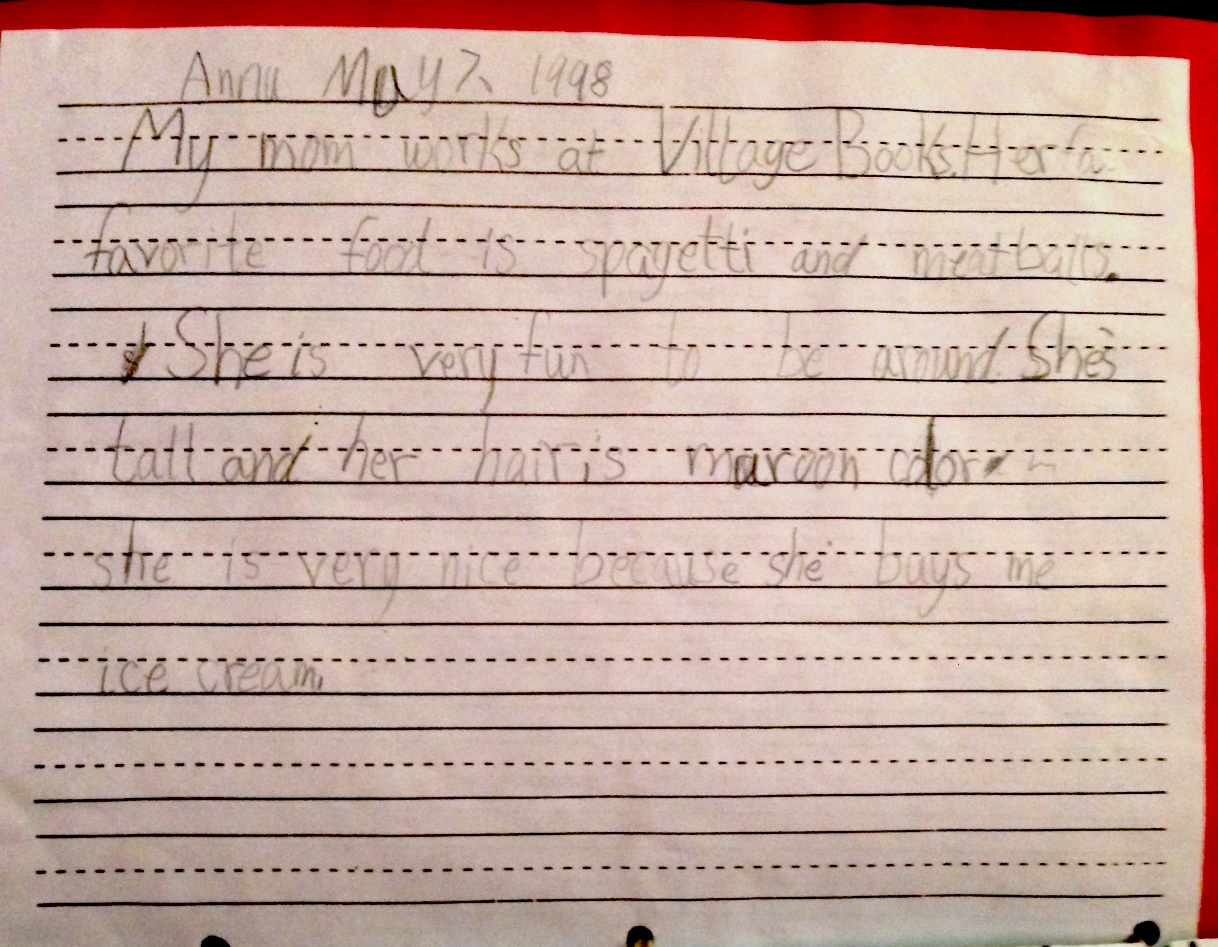
My mom works at Village Books. Her favorite food is spagetti and meatballs. She is very fun to be around. she’s tall and her hair is maroon color. She is very nice because she buys me ice cream.
My days suddenly silent, my nights stretched out empty, I spiraled into a deep depression. My identity as a mother slipped away. No diapers to change. No breakfast to make. No lunches to pack. What was I, if I wasn’t a mother? Everything I had been, I’d given up in our pursuit to adopt our girls, to be in this relationship, to become a family. One social worker along the way even commended me for giving up on being a writer and getting a real job. I’d sold my bookstore. I had become a Mother, and I loved being a Mother so much that I wanted to spend more time with the girls. That love had led me to here. To nothing, it seemed. If I couldn’t be a mother, then maybe I shouldn’t be at all. I thought about moving away, just leaving town. I flirted with razor blades and alcohol. My therapist reminded me regularly and forcefully of the damage done to those left behind.
I decided to stay. In town and on the planet. I upped my antidepressants. I got a lawyer. I worked three jobs and went back to school. I found two housemates, asked my grandmother for an advance on my inheritance, and bought a house. I made a home. I fought to remain relevant in my daughters’ lives. Not one part of this journey was easy. Co-parenting with someone who would rather I just disappear, with someone who had to be court-ordered to share custody sucked, but it sucked so much less than not parenting at all. My legal and therapy bills grew enormous. When I cried and railed against the unfairness of my situation, my therapist told me how fortunate my children were to have me in their lives. When I couldn’t breathe because the initial child support payments I had to make were more than half my meager monthly salary, she helped me strategize a solution. When I despaired that I would have no meaning in, no impact on my daughters’ lives, she reminded me that they would come back to me, they would be in my life, maybe not the next week or the next month, but in a few years, when they were out of school, in their late teens and early twenties. Mothering meant showing up and reaching out, even when I didn’t think it would matter, even when no one reached back. Even when the next week, let alone the next decade, seemed impossibly far away.
But I did it. I showed up. At games. At concerts. At parent teacher conferences. Doctor’s appointments. Most of the time, I felt awkward because the teachers, the doctors, the other parents didn’t know I even existed. I had to show up at the school with the Parenting Plan in hand to get my name on my kids’ emergency contact list. I had to request I be added to the PTA’s little booklet with the kids’ and parents’ names, phone numbers, and addresses. Every year. I had to introduce myself to coaches, principals, other parents. Sometimes, I missed events because I found out about them too late or was too embarrassed to call other parents to ask. The last time I called the pediatrician’s office to get information about my daughter’s medications they hung up on me, refusing to give me information even though my youngest was still a minor, even though I had the paperwork granting me joint medical custody. I had to take the parenting plan to the pharmacy to find out what medicine my child was taking. Often, I felt like a fraud, an imposter. So many times I wanted to give up, to crawl away in shame. The depression and suicidal thoughts stayed with me for years.
Getting Ice Cream at The Colophon Cafe
Still, I pressed through the fog and darkness. Even when I had to take a job 80 miles from home—I drove back three days a week, arriving in time to pick the kids up from school. I finagled time off. I found a way to be there. I got a MySpace Page. I got a Facebook page. I texted. I emailed. I called. I found a way. I made Easter baskets and bought Halloween treats, Valentines Day cards, swallowed my pride and left them on their front porch if I had to. And if my ex made other plans for Christmas Eve or Christmas Day, I had presents and stockings and dinner with the girls on December 23rd. Because what day we spent together didn’t matter. First day of school? I showed up. The day my eldest left for college, I packed my mother in the car with me and we went along too. I refused to be erased.
And you know what? That decade passed and my girls are in my life. They finished high school. My eldest finished college. The youngest just started this year. These are the days my therapist promised. These are the days I couldn’t even imagine.
These days as I work on my memoir, I’m writing about shopping for baby clothes, writing about the days when I’d throw baby Anna in the front pack and walk to a nearby children’s clothing consignment store. I loved to look at those tiny little jeans, the impossibly small shirts and sweatshirts, miniature jean jackets. As a lesbian mom I was determined to dress my daughters in gender-neutral colors and clothes, but I was also very aware that as a lesbian parent, whatever I chose to dress my kids in would be scrutinized closely. Evaluated for any hint of agenda. Judged as too masculine, too political, or god forbid, too dyke-y. Too much an extension of my own taste in clothing.
I don’t think I was prepared for the politics of clothing when I first became a mom. I certainly wasn’t aware of the enormous gulf between boys and girls clothes, even for kids who were not yet walking. Who knew toddler wear could be sexualized? And as much as I wanted to put baby Anna in those tiny blue jeans and a miniature grey sweatshirt, I resisted the urge, unwilling to open myself up to whatever criticism might come my way. Really, my dilemma only lasted until Anna could express a preference, which happened by the time she was two and demanded to wear only clothes that bore a picture from The Lion King, preferably Simba or Nala. What I wanted her to wear mattered not one whit after that. I felt fortunate if I could get her to swap the Nala dress for the Simba tshirt once a week for washing.
As I wrote about my experiences with Anna, I wondered if my mom worried what people would think about the clothes I wore as a kid? From the time I could walk, I preferred cowboy boots and buckskin jackets (thanks Grandpa) to Mary Janes and more lady like outerwear. I ached to wear my cowboy hat and checkered cowboy shirt with the pearl snaps. My mom still mostly dressed me in dresses if we left the house and until I was in the third grade I had to wear dresses to school. Granted, the year was, well, the year was sometime in the early 1970s, but feminism was taking hold by then, though the ERA would not be defeated for a few more years. I remember my parents lamenting the droves of hippies that had invaded our small town: men with long hair and women without bras. Gender lines were being crossed already, so I was not so much of a pioneer, though I had begun to stage my own little revolution.
On the days that I had Bluebirds and had to wear the insidious blue and red uniform dress, the saving grace was that I also wore a white blouse under the uniform so I could smuggle jeans to school in my lunch box and change once I got to school. I’m not sure how my mother missed the great bulge in my little tin lunchbox, the red and yellow plaid pattern straining at its edges. I loved the way I felt in my jeans, saddle shoes (not so much), and white shirt. I felt free. Boys couldn’t look up my skirt when I climbed on the monkey bars. I could properly propel myself out of the swings without worrying about skinned knees or my dress hiking up around my waist. I could play kickball and kick my hardest without worrying that my dress would fly up and reveal my little girl panties to the entire outfield.
By the time third grade rolled around, my mom and I struck a deal: I could wear pants three days a week. I was still in Bluebirds, still smuggling my jeans on Bluebirds day, so realistically, this meant only one day of dresses a week for me. This meant shopping for jeans when we went to Sears for Back-to-School shopping, and by jeans I mean shopping for boys’ clothes in the boys’ department. I would not be satisfied with some girly version of jeans; no side zippers, nor zippers up the back; no wussie zippers that might break should I slide into home plate during kickball. No. I insisted on Sears Toughskins, reinforced knees and all. And while we were in the boys’ department, why not some practical t-shirts as well in some good colors, like blue and green and red. I had no use for ruffles and pastels. I despised the scoop neck t-shirts and peter pan collars reserved for little girls. In fact, I would have been over the moon with super hero pajamas and some tightie whities as well, but Mom had to draw the line somewhere.
Happy? Comfortable?
I saved my most vociferous arguing for the shoe department, however. I had enough of the saddle shoes—which it turns out were my mother’s own leftover fantasy from her childhood, seeing as how her mother forbid her to wear saddle shoes—what I wanted now were Waffle Stompers. Anybody remember Waffle Stompers, named for the shape of their tread, with padding around the ankles and sliver triangle eyelets? They came in dark blue, maroon, or green, and I loved them. Back in the days before Merrells and Salomons became ubiquitous, before tennis shoes/sneakers were limited to PE class, before Nike was anything but a winged Greek goddess, Waffle Stompers offered a little budding lesbian like me a sensible shoe option of which my mother was hard pressed to disapprove. For reasons that still escape me, we (and by we, I mean all children of the time) had to have dress shoes and play shoes (just as we had school clothes and play clothes). Heaven forbid the two should ever be confused. No one could wear a pair of Chuck Taylors or those insipid Keds when in school clothes. But Waffle Stompers! Waffle Stompers offered a much needed middle ground—they weren’t tennis shoes, they weren’t dress shoes. They were sturdy and leather, and they definitely did not go with dresses. I had to get me some of those. And I would not relent. I finally got my Waffle Stompers. I wore my mother down.
But what, I wonder now, did Mom make of my tomboyish ways, my insistence that I dress like a boy? With my short carrot top hair and my Toughskins and Waffle Stompers, did I give anyone pause? Did anyone pull her aside and accuse her of having an agenda? (A sales clerk did object to my father buying me a toy rifle for Christmas one year, but that’s a different blog).
It’s interesting, the politics of clothing. Still, after roughly 43 years of dressing myself and choosing my own clothes, I struggle with what to wear, with how I want to look, how I want to be seen. What I am comfortable in. Except for a brief adolescent period, from roughly the ages of 13 to 16, I’ve always felt more comfortable in decidedly unfeminine clothes. Dressing up for me has mostly meant putting on pants that aren’t jeans, a shirt/pullover combination, or a polo shirt when it’s warm enough, and something on my feet besides sneakers or hiking shoes (though recently I’ve taken to wearing my red Chuck Taylor’s as dress up shoes).
Do the shoes make the woman?
I’m such a casual dresser that even my doctor made a note of it in my chart one time: Neatly dressed. Extremely casual. At Christmas gatherings when I was in college and in my early 20s, my grandmother used to say “Pam, you look like a boy!” I always took that as a compliment, as confirmation that I was slender and fit. Now when I get called “Sir,” and I do, regularly—just a couple of weeks ago, at the LA airport, dressed in my very womanly Izod golf shorts, not to mention my more obvious and, increasingly matronly, girl parts—I just look, like “Dude? Really?” More often than not, people are appropriately mortified. But I have to wonder, what are they seeing when they look at me?
(I do realize I’m laying myself wide open here) It has to be the clothes and my short hair—I think we’ve gotten to the point that women’s clothing is so drastically different than men’s clothing that most people don’t bother to look beyond clothes to determine someone’s gender. No visible cleavage? Guy. No floral patterns or ruffles? Guy. Short hair? Guy. Not pastels? Guy (though if you’ve been to a Ralph Lauren store lately, you know that the men are wearing a lot of pink, green, and yellow these days). Last summer, I was out and about town in a tshirt, a pair of cargo shorts, and flip flops. As I was locking my bicycle to a parking meter near the Saturday Market, a woman behind me kept saying, “Sir!” “Sir!” She got mad at me for not responding and when she found out I wasn’t a Sir! she was still mad at me. I thought that was rude. And especially now that I am a woman of a certain age, I think a certain amount of invisibility is inevitable.
Early in my professional career, I put a fair effort into dressing nicely, but in my very classically tailored clothes I was often addressed as “Sir.” I shopped exclusively in the women’s sections at Nordstrom’s and Macy’s (which was then The Bon Marche) and a gal could get shirts sans floral patterns and ruffles; I wore women’s Bass Weejuns with tassels, and (tragically) a woman’s London Fog raincoat. I even occasionally wore panty hose and a dress, and sometimes tights and professional shorts, and blazers (remember that bad 80s trend?). Eventually I tailored my career choices so I wouldn’t have to ever wear panty hose again, and these days I feel dressed up if I put on a pair of worn cords and a polo shirt for work. Most days I show up in saggy-assed Levis, a gray hoodie, and my black Converse. How I dress has no bearing on how I perform at work, except that less formal makes me happier and happier workers are better workers.
So, to bring it all back around to where I started . . . maybe what’s really important about clothing is that it makes us comfortable, because when we are comfortable, we are confident. If we are confident, we are happy. If we are happy, we are better learners, players, workers, partners, lovers, parents, children, and friends. Choosing our clothes, dressing our kids—these are political acts, not just across gender, but also across class and race (different blogs altogether). Being comfortable in my own skin, let alone in what I’m wearing? Judging one another according to what we wear? I don’t have any illusions this will change, ever. I just wish I could get over it, myself.
One of the giant, impossible, gnarliestquestions nearly all writers face is how to handle the people in their lives, particularly the people who might people their stories. Of course this is a theoretical question at first. And is handled as such in writing classes and groups and in discussions with writing gurus. Sometimes the fear is simply dismissed as a worry for amateurs. If we don’t write something, anything, nothing will ever be published, rendering our worries moot.
Published writers have expounded upon this fear in encouraging fashion, and I’ve long been an adherent to Anne Lamott’s pithy comments on the subject: “Write as if your parents are dead” and“You own everything that happened to you. Tell your stories. If people wanted you to write warmly about them, they should have behaved better.” Because if I didn’t believe this while I’m writing, I’d be paralyzed with anxiety, even more paralyzed than is normal for a writer.
At some point, if one is a serious writer, this concern blithely traipses across that line from theoretical to real. And this is what we serious writers want, what we yearn and ache for . . . that our work, our words, our views gain traction in the world and have lives of their own. Writing is not unlike having kids—we nurture, feed, hone, discipline, stay up at night, worry, fret, and finally let them loose to have lives of their own, and nothing prepares us for what comes next because we just don’t know, we no longer have control.
We celebrate. Publication parties, excited phone calls. Flowers. Like a graduation, an 18th birthday.Ours but no longer ours. Reflections on us forever it seems. And so.
I have always wanted to be a writer, but for many years did not write due to fear, fear that my words would be misunderstood, misinterpreted, used against me; fear that my words, my experiences would wound, maim, alienate, damage. I can trace that fear back to a specific incident, and what I learned then was this: I am not okay. Who I am, my deepest most intimate thoughts and experiences, the ones I dared to commit to paper are all wrong. Wrong, bad, evil even.
I hadn’t written a Unabomber manifesto or a hate-filled credo, simply a love story, a story between two teenage girls, the thralls of first love, the whispers, the profound moments of stolen passion, found time. The untimelydiscovery of this story scrawled in my loopy teenaged hand set me on a path that has led me directly to this day, yesterday, and the day before that. The past month, the last two years when I started taking my writing seriously again.
That story, the one that launched me into a world of trouble and onto the path that found me here, found the light of day again in a recently published anthology, and then again as it was reprinted by The Friendly Atheist Blog at patheos.com which is where I think my mom must have read it. She’s known for a good while now that I had an essay that would be published, and she knew the general context of the story, but she wasn’t prepared for the reality of my words. This time though, she’s not mortified by who I am or the story I am telling, but by her actions at the time, the beliefs she (and my father) held then, the ways in which these beliefs colored and shaped my life.
She emailed me a couple of weeks ago after I’d blogged about being raised Christian fundamentalist and the resulting damage to my psyche. She emailed to apologize and to beg forgiveness. I wrote back easily, telling her that forgiveness had long ago won out, that I no longer held that anger. We’ve been close in the past twenty some years, my mom and I. She’s been my biggest champion. I think I can write now about what happened then because I know we have a good relationship.
So I was sad when she emailed yesterday, telling me she wouldn’t be able to come to my reading and the book launch party for Beyond Belief on Sunday. She thought she might cry and be embarrassed and she still felt really awful about all of the Christian craziness of my childhood. She asked for my forgiveness, again. I reiterated what I’d said a few weeks ago: We are good. We have come to this place from those times. I forgive you. I love you.
My mother has her own stories. We all do. We own them. We can’t let fear in any of its guises (shame, guilt,vulnerability, martyrdom) silence us because then fear has won.
I just finished reading Andrew Solomon’s Far from the Tree. I managed to get through the 700 pages in a couple of weeks and right up to the last chapter, I found it engrossing and revelatory. As the parent of two adopted children, the sister of an adopted brother, and the daughter of a mother who herself was adopted, I know a bit about horizontal relationships in parenting. As a lesbian, too, I know a bit about falling far from the tree.
That said, I have some serious issues with what seems to be his bias toward creating a family biologically rather than via adoption, as well as the notion that it is better to breed than to adopt, even when biology is clearly flawed. On page 678, he writes that “the right to reproduce should be among the inalienable ones,” and later laments with one mother who didn’t consider adoption because it would be heartbreaking not to be pregnant or give birth (even though she would have a handicapped child).
As he continues on with his own quest for a perfect bio baby, I fail to understand how one person’s desire to be pregnant and birth a biological child, even though the chances of said child being profoundly handicapped, trumps creating a family through adoption. As a gay man, Solomon should know the value of creating a family of choice. I find the selfishness and narcissism rampant in his final chapter sufficient to render the preceding chapters nearly meaningless.
My mother was placed in a children’s home when she was about a year old by a single mother who couldn’t both work and support an infant. The people who became my grandparents adopted her when she was three years old, even though her birth mother came to visit her regularly.
My little brother (my only brother, my only sibling) arrived with only a week’s notice the year I was four, right around Thanksgiving. One day the phone rang and my mom asked me (rhetorically, I’m pretty sure) if I wanted a little brother. Seven days later, I’m at the hospital with my parents picking him up. I cannot imagine life without him.
Nor can I fathom the possibility of life without my daughters, children born into and then given into impossibly complex circumstances. I may have once been ambivalent about motherhood, but their arrivals in my life eradicated any indifference I may have ever had about being a parent.
I wasn’t one of those women who felt incomplete without children, or maybe I should say I wasn’t a young woman who felt that my life wouldn’t be complete should I not ever have children. I just didn’t think about it that much given that I was a lesbian. I figured that kids just weren’t in my future, and this realization did not cause me any angst.
Then I met and fell in love with a woman for whom having children was critically important, an imperative, even. Myself, I didn’t really understand how much I valued my role as a mother until I faced losing my children when my relationship with my co-parent went south. At the point where I could choose to remain a parent or walk away, I decided to stay. I guess in this way, I am like some of the parents in Solomon’s book.
My eldest daughter came to live with us three days after she was born. Her birth mother had decided to place her for adoption and had chosen my partner at the time as the person she wanted to raise her as yet unborn child. Given the times (1990, pre-Will and Grace, pre-Rosie, pre-Ellen, pre-gay marriage, even pre-Don’t Ask Don’t Tell), it made sense for my partner to adopt as a single parent. I was a willing, if somewhat ambivalent, participant in this process, until I held Anna. Once that baby was in my arms, any uncertainty melted away.
One of my greatest pleasures is wearing a sweatshirt my daughter Anna got for me one year for Mother’s weekend at her university—the sweatshirt has a large pink apple tree on it and says The Apple Doesn’t Fall Far From the Tree. I love the irony. I take certain pride in the fact that Anna is more like me than I ever could have imagined. But I didn’t adopt her so she would reflect myself back to me. I adopted her because I fell in love with her. I parented her because I loved her, from the moment I first held her.
Taylor, my youngest, found her way to us from Philadelphia. At the very moment I got the phone call as I was sitting at my desk at work, she became my precious and beloved child. When I first saw her tiny (and she was very, very tiny—a full term 4 lb. baby) little person, I had no doubts that I would love her with all of my heart and soul. She couldn’t be more different from me, and I love her fiercely. Taylor’s adoption got all kinds of complicated before it became final, but she was as much my child before the birth certificate arrived as she was after.
The paperwork is a formality—it doesn’t make my love or support for Taylor and Anna any more real. In that way, adoption is a bit like gay marriage—the paperwork grants us privileges under the law, but we are already a family without the judge’s decree.
I suppose Solomon is to be admired for not hiding his fears and feelings in the final chapter of his book, but I find his quest for the perfect child completely antithetical to the notion of parenting. As his book so profoundly shows us, there is no guarantee that our actual children will even remotely reflect our ideal child. And I would go so far as to say that the greater our expectations are that our children will arrive and fulfill our dreams for us, the greater our disappointment and the greater damage we as parents will inflict upon them.
Becoming a parent is a crapshoot any way it happens, but I do believe the children we need find their way to the families they need. May we all be able to accept these gifts with grace.
I’ve been trying to be upbeat, Dear Reader. Trying to write something meaningful and reflective, attempting to provide my audience with happier, more peaceful, less cynical insights, but then I go and read the news. The news does not bode well for humanity folks. Doesn’t bode well at all. How can I write rainbows and unicorns when shit like this is making headlines:
Woman’s corpse found in LA hotel’s water tank. Holy f$ck that is just disgusting. She’s been decomposing there for two weeks. TWO WEEKS. I am horrified on so many levels.
Testosterone found at Pistorious’s home. NO! Say it isn’t so! I’m shocked. Shocked! How many more women are going to die at the hands of enraged husbands and/or boyfriends?
Teens get strippers. Mom gets arrested. Again, I’m shocked (not). This sort of thing is inevitable when parents start getting their kids limos for their sixth grade dances. What is left for the kid’s 16th birthday party? Strippers and booze. Piñatas and cupcakes just ain’t gonna cut it. What are these boys going to do for their next momentous life passage? See above.
Jesse Jackson, Jr.: “Guilty Your Honor” No wonder he stepped down and checked into the psych ward. I’m thinking he’s the least of our collective worries. It’s just money. Nobody died.




 Pamela Helberg