Author: Pam
The First Time
![]() |
| Beyond Belief Contributors: Cami, Pam, Susan, Colleen, Elise |
I had practiced my reading the night before with TLW who told me that I needed to be more passionate in my delivery. So, I had that in my head as I stepped up to the microphone there in the basement at Elliott Bay Books (what is it with basements as reading areas?).
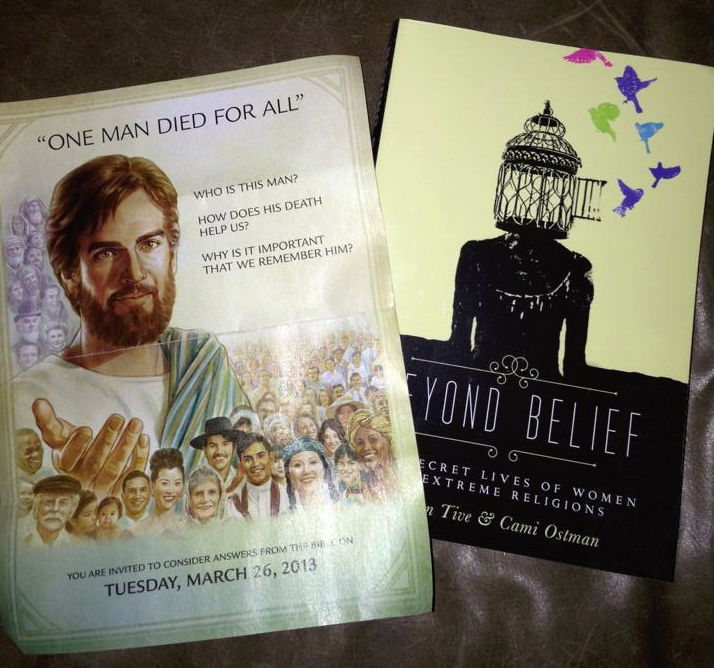
I intro’d my reading with the story of the Jehovah’s Witness flyer with its metrosexual Jesus that arrived on my doorstep the same day I got my copies of the BB anthology in the mail. That got a good laugh—a good sign. And I tried my darnedest to read with passion. (TLW reported later that I nailed it, passion-wise). Still, I was nervous, nerves that come from the fear not just of being exposed, but of being misunderstood by strangers and misinterpreted by those closest to me.
![]() |
| That’s ME! At Elliott Bay Books! |
Writing is Daring Greatly (thanks Brene Brown)
Mawwage . . .
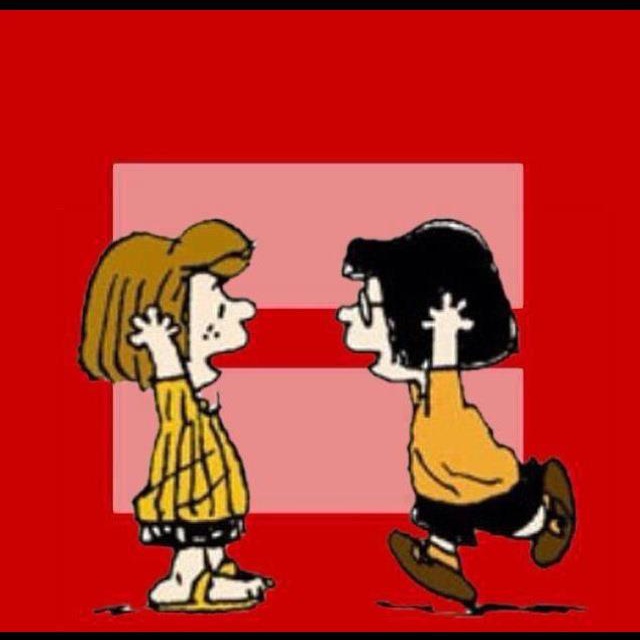
So, I changed my Facebook picture to the red equal sign because, even after I had this internal rant with myself (now external—I know, I couldn’t keep it to myself, it needed air), I think that we need equality. Period. We are all different, but we are all equal and deserving of the same basic human rights, and apparently, we are going to have to continue to legislate the obvious because no one seems to be giving this shit away. Imagine
John Lennon said it best: Imagine no religion. It’s easy if you try . . . no hell below us, above us only sky. Imagine. I try to imagine what my life might be like had I not been subjected to fundamentalist christianity between the ages of 5 and 21. Those 17 years more than any in my life shaped me indelibly. Those years of being labeled a sinner who would most likely face eternal damnation burning in hell still color my life. Even more than 25 years after I decided I could no longer subscribe to the tenets of christianity.
Last Wednesday evening, I sat with a group of women, all writers, all of us contributors to Beyond Belief: Women in Extreme Religion, an anthology of stories about women’s experiences getting into, staying in, and getting out of fundamentalist religions: Mormonism, Judaism, Islam, Catholicism, Scientology, the Unification Church, fundamentalist Christianity, and others.
Each of us read an excerpt from our story, and as we went around the room, a deep sadness overcame me (that and a not irrational fear that an angry god might smite us for talking smack about him). Sad about the potential wasted, the time wasted, the energy wasted—all the ways in which we’d been shamed, subjugated, stigmatized, separated in the name of god. Imagine growing up female and never feeling shame about being a girl, a woman. Never having to hide: our bodies behind burkas, our brains and intelligence behind our bodies. Imagine life as a woman without the imposition of religious constraints.
What could we have achieved, each of us, I wondered, had we been free to follow our natural impulses? If we had been encouraged to embrace our talents and truths rather than forced to shut ourselves off from the world, to shut ourselves down, to hide our true selves because our religions taught us our very essence—our loves, our bodies, our desires, our thirst for knowledge–offended some made up god. Eventually, we all managed to overcome the limits our various religious experiences imposed upon us, to come to an awakening, an awareness that we would never have a genuine life within the confines of these religions. But what had our lost time cost us, I wondered?
What might we have accomplished if our energies all those years had been channeled toward, say, science? Instead many of us worried constantly about going to hell, expending our resources both literal and emotional, on impossible reconfigurations of our minds and bodies. What if instead of having to be vigilant against every carnal thought and deed, I could have spent those years, oh, I don’t know, learning to play the drums or studying computer programming? What if instead of worrying about proselytizing and “saving” my neighbors, I had reached out across common interests and laid foundations for lifelong friendships instead of worrying my god would cast us all into the fiery pits of hell. Imagine.
As we each read our excerpts, sex emerged as a dominant theme. So much time and effort expended in our struggles to come to terms with our bodies, our sex, our sensuality. Our natural way of being in the world. Why, I wondered is religion so preoccupied with sex? Why so much devotion to not-sex? What better way to control people than by creating fear about the most basic of human instincts?
I was at a writing retreat last weekend, in a workshop on writing about sex, and one of the participants posited how crazy it is that our (judeo-christian) culture prefers to pretend that “good people” don’t have sex despite all evidence to the contrary. Religion’s powerful constraints spill out into culture and impact everyone, not only the believers, which is one of the most annoying and dangerous aspects of extreme religions: that misguided notion that there is only One Truth.
We only need to look at history (yesterday, two weeks ago, 500 years ago) to see clearly the evils perpetrated by extreme religions. Where could all of our energy go if we weren’t fighting for rights that religious leaders want to take away? DOMA. The Inquisition. Joan of Arc. Matthew Shepard. A woman’s right to choose. Westboro Baptist Church.
What else might that energy have cultivated had it not been hijacked by the holy?
Imagine.
Imagine
A Pivotal Moment: Memoir is Made of These
Twenty years ago I spent a long weekend at a workshop/retreat that fundamentally changed my life, or at least served as a pivot point in my journey. I had one incredibly emotional moment that weekend—a moment that has stayed with me all these years, through tremendous changes and ups and downs in my life.
One of my favorite parts of this retreat was that it was silent, a fact the participants did not know going in. We could talk only during the workshop sessions, and not with each other, but to the group as a whole. The food was intentionally less than optimal for those few days as well. And every morning we had to run a mile.
But, I digress. One evening, the retreat facilitator led us through some guided imagery and we were to be constructing our future home. What would it look like? Where would it be? Who would be there?
And here’s the part where I burst into tears: My future home was warm, with dark wood and candles, and inviting comfortable furniture, and it was full of many, many children, children that looked like my children.
At this point, the imagery had taken over and I was just a recipient of this vision. I wept for probably a good fifteen minutes, maybe more (it’s been twenty years—details are fuzzy), but I know for sure that tears and snot rolled down my face uncontrollably.
I did not understand then why I had that vision nor why I reacted so emotionally to it. The tears were neither sad nor joyous, just bursting with raw and uncontrollable feeling. Looking back now, I understand I was weeping because my vision was so radically, radically different from my reality. I wept for the pains and joys I had yet to experience on my path to my vision.
Writing my memoir these past 18 months has prompted all manner of self-reflection (the cynics among us might say navel-gazing—there’s a whole other blog), and I’m finding much of that reflecting to be awkward, if not downright painful. So, I was sort of happy when recent events coincided to prompt me to remember this image.
My youngest daughter’s biological brother (both of my kids are adopted) recently moved to our home state and last weekend came to have dinner with us—he and his wife and their four children. This was the first time I’d met her brother, though she had spent time with her biological family (including her birth parents) over the past few years.
As the day of their visit drew closer, I grew calmer—which is not really my MO. Usually I ramp up into a bit of a frenzy before such events. There were going to be ten of us, including four children, going out to dinner. I remained calm, grounded even. Even as the day grew closer and we had to redo the plans, I rolled with it, strangely confident that dinner would be what it needed to be.
And it was. I was home, surrounded by children that looked just like my daughters, surrounded by family new and old and new again.
A Pivotal Moment
Dash of Dysfunction. Pinch of Crazy
So Far From the Tree
I just finished reading Andrew Solomon’s Far from the Tree. I managed to get through the 700 pages in a couple of weeks and right up to the last chapter, I found it engrossing and revelatory. As the parent of two adopted children, the sister of an adopted brother, and the daughter of a mother who herself was adopted, I know a bit about horizontal relationships in parenting. As a lesbian, too, I know a bit about falling far from the tree.
That said, I have some serious issues with what seems to be his bias toward creating a family biologically rather than via adoption, as well as the notion that it is better to breed than to adopt, even when biology is clearly flawed. On page 678, he writes that “the right to reproduce should be among the inalienable ones,” and later laments with one mother who didn’t consider adoption because it would be heartbreaking not to be pregnant or give birth (even though she would have a handicapped child).
As he continues on with his own quest for a perfect bio baby, I fail to understand how one person’s desire to be pregnant and birth a biological child, even though the chances of said child being profoundly handicapped, trumps creating a family through adoption. As a gay man, Solomon should know the value of creating a family of choice. I find the selfishness and narcissism rampant in his final chapter sufficient to render the preceding chapters nearly meaningless.
My mother was placed in a children’s home when she was about a year old by a single mother who couldn’t both work and support an infant. The people who became my grandparents adopted her when she was three years old, even though her birth mother came to visit her regularly.
My little brother (my only brother, my only sibling) arrived with only a week’s notice the year I was four, right around Thanksgiving. One day the phone rang and my mom asked me (rhetorically, I’m pretty sure) if I wanted a little brother. Seven days later, I’m at the hospital with my parents picking him up. I cannot imagine life without him.
Nor can I fathom the possibility of life without my daughters, children born into and then given into impossibly complex circumstances. I may have once been ambivalent about motherhood, but their arrivals in my life eradicated any indifference I may have ever had about being a parent.
I wasn’t one of those women who felt incomplete without children, or maybe I should say I wasn’t a young woman who felt that my life wouldn’t be complete should I not ever have children. I just didn’t think about it that much given that I was a lesbian. I figured that kids just weren’t in my future, and this realization did not cause me any angst.
Then I met and fell in love with a woman for whom having children was critically important, an imperative, even. Myself, I didn’t really understand how much I valued my role as a mother until I faced losing my children when my relationship with my co-parent went south. At the point where I could choose to remain a parent or walk away, I decided to stay. I guess in this way, I am like some of the parents in Solomon’s book.
My eldest daughter came to live with us three days after she was born. Her birth mother had decided to place her for adoption and had chosen my partner at the time as the person she wanted to raise her as yet unborn child. Given the times (1990, pre-Will and Grace, pre-Rosie, pre-Ellen, pre-gay marriage, even pre-Don’t Ask Don’t Tell), it made sense for my partner to adopt as a single parent. I was a willing, if somewhat ambivalent, participant in this process, until I held Anna. Once that baby was in my arms, any uncertainty melted away.
One of my greatest pleasures is wearing a sweatshirt my daughter Anna got for me one year for Mother’s weekend at her university—the sweatshirt has a large pink apple tree on it and says The Apple Doesn’t Fall Far From the Tree. I love the irony. I take certain pride in the fact that Anna is more like me than I ever could have imagined. But I didn’t adopt her so she would reflect myself back to me. I adopted her because I fell in love with her. I parented her because I loved her, from the moment I first held her.
Taylor, my youngest, found her way to us from Philadelphia. At the very moment I got the phone call as I was sitting at my desk at work, she became my precious and beloved child. When I first saw her tiny (and she was very, very tiny—a full term 4 lb. baby) little person, I had no doubts that I would love her with all of my heart and soul. She couldn’t be more different from me, and I love her fiercely. Taylor’s adoption got all kinds of complicated before it became final, but she was as much my child before the birth certificate arrived as she was after.
The paperwork is a formality—it doesn’t make my love or support for Taylor and Anna any more real. In that way, adoption is a bit like gay marriage—the paperwork grants us privileges under the law, but we are already a family without the judge’s decree.
I suppose Solomon is to be admired for not hiding his fears and feelings in the final chapter of his book, but I find his quest for the perfect child completely antithetical to the notion of parenting. As his book so profoundly shows us, there is no guarantee that our actual children will even remotely reflect our ideal child. And I would go so far as to say that the greater our expectations are that our children will arrive and fulfill our dreams for us, the greater our disappointment and the greater damage we as parents will inflict upon them.
Becoming a parent is a crapshoot any way it happens, but I do believe the children we need find their way to the families they need. May we all be able to accept these gifts with grace.