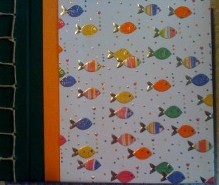
G is for Gym (will make more sense if you read E and F first)

About four years ago, I joined some work colleagues and started hitting the gym three to four mornings a week. I didn’t change my eating habits right away, and in fact, one of my mantras about working out was that I was working out so I could eat and drink beer, so that I wouldn’t have to change much.

I did not ever think I would be one to get up at 4:30 in the morning in order to be at the gym by 5:30 so I could be to work by 7:30, but there I was, generally, Tuesday through Friday, in my shorts, sweating before the sun came up. I loved that each morning was a different workout—Fridays we did yoga, Thursdays was spin class, Wednesdays power (weights), and Tuesdays cardio—lots of stepping and moving.

The changes were not dramatic—I didn’t lose a lot of weight, but the small shifts motivated me to continue, and, ironically, I began to want to eat differently. When I went out with friends after work—and I went out often—I became more conscious about my choices, drank fewer beers, ate less fried food, more salads. I started eating breakfast.

My clothes fit better, and for me, there’s nothing more reinforcing than clothes that fit. I dropped a pants size.

And then I moved back home—I changed jobs and took one closer to home, one that wouldn’t require me to live in another city during the week. I stopped going to the gym because I was now leaving for work at 5:30 a.m. and not getting home until after 5:30 p.m. For six months I just went to work and came home. And the pounds started piling back on.

I was miserable, and when a friend on Facebook offered to pay half of a membership to anyone who wanted to join her gym, I jumped at the chance. I didn’t care if I had to go straight from work to working out—something had to change. Again. My friend’s gym turned out to be a sort of cross-fit, extreme fitness kind of place, a far cry from the kinder, gentler yoga/spin/cardio gym I’d left behind. But I was desperate, and I gave it all I had.

I crawled across the floor using only my arms, dragging a weight with my feet. I perfected my 24” vertical jump. I tried and tried to do a pull up. I even tried to climb a rope. I ran and did burpees, lifted weights, threw tires, swung kettlebells, played tug of war, lunged, squatted, pushed up, crunched, kicked, ran hills, did stairs. And again, the pounds came off.

While I was at the gym, The Little Woman started running class, and pretty soon, I—who had sworn off running—started running with her. Eventually, we were running 5 Ks together. We went from being the people who laughed at the runners at running events on Saturday mornings, to being the runners at running events on Saturday mornings. I dropped the gym membership.

In the past two years, I seem to have reached an equilibrium between exercise and eating. And while many friends have opted for diets (paleo, skinny bitch, cabbage soup, grapefruit, blood type, hormone, Weight Watchers), I’ve just kept running. Running works for me—the more I run, the better I want to eat. I’m still not pulling up to a plate of vegetables at dinnertime, but neither am I eating unconsciously anymore.

I wouldn’t say I’m exactly ambivalent about food, and I certainly do enjoy eating whatever TLW whips up when she’s home to cook (she’s now working away from home during the week). The trick seems to be in Gaining awareness, Getting perspective, and Going the distance. G is not so much for Gym anymore for me, at least, as it is for Go. As in Ready. Set.

F is for Food (read E is for Eating first)

I like to think my history with food is fairly innocuous, but as I write about it, I’m discovering that’s not exactly the case. For example, I don’t care much for vegetables (aside from standard salad ingredients) and so exist mostly on carbohydrates. This disdain for green things can be traced to my childhood where I spent many nights alone at the dinner table with a plate of cold, congealing vegetables and as much milk as I needed to wash them down. Canned spinach, stewed tomatoes, canned green beans. I loathed them, but because “children were starving in India and China” my eating those vegetables became imperative. Waste not, want not. Or something. I threw up all over my dad one Christmas when forced to eat Brussel sprouts.

I don’t care how much cheese you put on broccoli or cauliflower, I’m not going to eat it. Go ahead and oven roast the hell out of the Brussel sprouts and the green peppers, and use all the EVOO you want—I won’t change my mind. I still hate spinach and while I will occasionally eat asparagus, I don’t seek it out. I realize that my dislike of all things green is probably irrational and that, ultimately, most likely not healthy, but I’m not one to eat something (any longer) because I’m “supposed to.”

Other than the nightly battle over the vegetables, there wasn’t much more personal drama around food when I was a kid. Overall, we ate pretty healthily—mom never served us anything out of a box, she canned fruit and veggies, forbid soda and sugared cereal, made her own bread and even churned her own butter for a while. We drank raw milk, ate locally raised beef, and never went for fast food.  But there were family issues around food—and without going too much into it, my parents had conflicts around food—both of them vying for control over what the other ate, how much, how often. As a result, I think I resolved not to care so much about food.

Then, during the summer between my junior and senior years of high school I went away to camp and came back about 20 pounds heavier. As a kid who’d never really paid much attention to my weight, I was astounded that my pants no longer fit. I didn’t know about eating disorders then, but I now know that I developed one. My mom’s Calorie Counter book became my best friend. I’d heard about girls who vomited after meals as a way to control their weight, but since I was not one for throwing up, I gravitated toward laxatives and became addicted to them and to eating raw bran (I know—nasty). I didn’t overeat or binge and purge exactly, but I figured the less time the food stayed in my system, the less chance it had to turn into fat.

The laxatives wreaked havoc on my digestive system, and I spent many years breaking my addiction. It wasn’t easy—in fact, even though I’ve not been addicted in many years, I’d say that it’s taken the better part of my adult life to get to a point where my digestive system functions normally all on its own.

 ***

When I found myself needing to lose weight as an adult for the first time, I knew I needed to return to a place of ambivalence about food. I couldn’t diet and I couldn’t rely on TLW to stop feeding me. I wasn’t going to return to using laxatives. I had to find a way to stop caring about food. No easy task. It’s like trying to stop caring about Christmas—I may no longer want to celebrate it or believe that it’s the birthday of the true lord and savior but that doesn’t keep it from coming around every year and taking up all kinds of psychic space.

One of the most difficult parts of cutting back on eating was convincing TLW that it had nothing to do with her. That not wanting to eat her amazing meals didn’t mean I no longer loved her or that I was rejecting her. As much as I have food issues, she does too, and historically for her, food equals love.

The best and simplest thing I could do was to start exercising. So I did. I joined a gym. Working out regularly not only sped up my metabolism but made me less interested in eating. After spending an hour at spin class, the last thing I wanted to do was eat something that would pile the calories back on.

Tune in tomorrow for G is for Gym. I hadn’t intended for this to be a multi-part piece. Funny how things work out.

E is for Eating (read this before you read F)

Posting two today–one to make up for missing Saturday, and one for today’s letter, F.

I’m fairly ambivalent about eating and food. When The Little Woman asks me in the morning what I want for dinner, or worse, when she asks me on Thursday what I want to eat over the weekend, I usually roll my eyes and shrug, the same way I do when my mother asks me in October what I’m planning to do for Christmas. I don’t know, and frankly I don’t care.

Do you live to Eat or Eat to live? I fall into the latter category, usually. That’s not to say that I don’t enjoy a fine meal or appreciate a lovingly prepared feast, but overall, food does not excite me the way it does some people in my life.

I’m married to a foodie. When we met, I weighed about 20 pounds less than I do now. Of course in the intervening 14 years I‘ve grown older and my metabolism has slowed considerably, so part of the change in weight, I’m sure, has to do with aging. But still. I now weigh about 20 pounds less than I did four years ago, and that has mostly to do with exercise and the fact that The Little Woman is not cooking for me daily any more. If my math is correct, that makes for a 40-pound weight gain in about 10 years. Not insignificant.

Don’t get me wrong. I’m not trying to blame TLW for my weight issues. I’m not. She did not hold me at gunpoint and force the fork into my hand. I simply got caught up in her enthusiasm for food, and eating, and the celebrations and socializing we did around food. And, when someone puts as much love and thought and delight into preparing a meal as she does, it is damn difficult to apply any sort of meaningful self-restraint or portion control.

And then TLW went to culinary school and spent a lot of time practicing. I was a very willing participant in her epicurean experiments. We had people over often. We had big parties and lots of food (and drink).  We ate and ate and ate. One weekend, Mother was visiting and she opened the refrigerator and exclaimed, “No wonder you girls are chubby! There are seven pints of heavy cream in here!”

No wonder indeed.

I was working away from home during the week in those days, and before I left on Monday mornings, TLW packed me grocery bags full of amazing food to get me through the week. I was the envy of everyone in the lunchroom where I worked. At lunchtime, I’d pull out perfectly grilled pork chops (with the grill marks) and garlic mashed potatoes made with heavy cream and lots of butter while my colleagues dined on frozen NutriSystem or Healthy Choice entrees.

And suddenly I weighed close to 200 pounds (at 5’ 6” tall) and even my fat pants were tight. How had I, someone who had never really had a weight issue, gotten to this place? Something had to change.

D is for the Goddamned Deer!

Did you ever set out to write something and then realize that to do so would be a bit Disengenuous, Dear Reader? This morning as I looked over my list of possible topics to be brought to you by the letter D, I thought, man I do not want to write about Depression or Drinking. I’m not suffering from either at the moment (knock on wood), and even if I were, I’m not sure that I want to be Defined by either of those words, though god knows I have been in the past.

So I pushed away from the computer this morning and decided to go for a run instead of writing, hoping that inspiration might strike while my body was otherwise occupied. As I began my second circuit around the lake and settled into a cadence, I realized that in all the times I’d run there I had not once seen Deer. And why would they be here, I realized with a jolt, when all the tasty treats are in the yards nearby?

If you’ve been reading my blog for any length of time, you’ll know that I’ve written previously about the godDamn Deer in the neighborhood. Monday Dawned bright and glorious, and I eventually Dragged myself out of the house after my early morning run thinking I should Do something productive in the yard since winter seems, finally, to be over.

One of the goddamn deer in our 'hood.
One of the goddamn deer in our ‘hood.

Things are blooming—or would be if the fucking Deer hadn’t eaten everything in my yard except the tiny smattering of Daffodils under the birch tree.  As I surveyed my flower beds, I became Depressed and Despondent—as far as my eyes could see the Deer had wreaked havoc: Tulips? Gone. Pretty purple flowers? Gone. Tiger lily? Chewed to the quick. Nascent hasta? Nubbins. The remaining hollyhocks? Mowed down.

Well, fuck this, I thought to myself and headed to the garage for my shovel. I couldn’t stand to look at the Destruction any longer. I couldn’t take being assaulted with this Degradation every time I wandered out the front Door, Dammit. Time to Do something. If I can’t enjoy the beauty of my bulbs, then the Damn Deer weren’t going to get anymore either, I Decided.

It hasn’t always been this way. For the first ten years I lived here (and during which time I planted said bulbs and other Deer Delicacies), my roses grew tall and strong and bloomed Deliciously. The hollyhocks waved all summer in magenta glory, and the tulips pushed through the soil and blossomed into an array of loveliness. But something changed.

The Deer left the nearby parks and woods with their boring diets of . . . whatever Deer used to eat before they tasted our suburban garden Delights. Now they roam in large packs, marauding up and down the city streets on a culinary circuit of Destruction. Not in my yard. No more.

I set about Digging up the bulbs. I cleared the beds of anything the Deer liked to chew on. No more tulips. No more pretty purple flowers. No more hasta. Bye-bye hollyhocks. I’d already gotten rid of the roses a couple of years ago in a similar fit of pique when I came out one day to find the ready-to-burst buds of the previous day completely Desecrated.

I replaced the rose bushes with California lilac, which, truth be told, is not really cutting it for me. I miss my roses, but I can’t go back to the days of constant vigilance—the spraying, the stress, the watching, the knowing that as soon as the rains come and wash off a coating of the (sadly) non-toxic deer repellent, the beasts will be back to strip my yard of its Delights.

I’m sure I will miss the greenery that pops up each spring, a reminder that winter is finally moving on, that summer awaits. But it is time for a new normal. Time to take control and beat back these feelings of helplessness and Despondency. I will buy more Daffodil bulbs this fall and plant them everywhere. I will get more peonies and some irises (I don’t think the Deer like irises). I will plant more lavender. There will be no more free Deer lunches. Not in my back (or front) yard.


C is for Children

In my post on adoption, I wrote that having kids is a crapshoot no matter which way they come into our lives, via adoption or via our own personal uteri. I consider myself supremely fortunate that my children found their way to me and that they are such amazing and lovely young women and a part of my life.

I wasn’t always sure that they would be in my life. Their other mother and I went through a particularly acrimonious split and subsequent custody battle when the girls were just two and six (nearly 20 years ago), sparking a years’ long wrangling over a workable parenting plan. Because we had each adopted both of the girls, we were both legal parents, but because we were lesbians who at the time could not get married, we were an enigma to the legal system. No one quite knew what to do with us. The lawyers, so happy to take our money, seemed befuddled and bemused.

I remember so many days spent weeping in my therapist’s office, certain that I would never see the kids again, afraid that I did not have the financial or emotional resources required to secure our future together. After all, technically, I was the parent who had left the family home (because I wasn’t an owner and because we weren’t legally married, and because I was young and didn’t know any better), and the lawyers and guardian ad litem put a lot of weight on maintaining a consistent environment for the girls.

I became despondent about the final parenting plan and at the thought of not having equal custody, having to be an every-other-weekend parent. I considered just leaving altogether, but my therapist (who deserves a medal for hanging in there with me, btw) encouraged me to take the long view. She somehow knew that if I hung in there, if I continued showing up against all odds at the kids’ school events, soccer games, concerts, doctor visits, that we could continue to be a family. She promised me that Anna and Taylor would come back to me as adults.

Keeping that long-term perspective as I missed out on so many childhood milestones and moments challenged me. I was supremely insecure in my role as a divorced lesbian mother (the invisible co-parent)—I had no role models. There were not any other mothers in our community in my shoes—half the time no one knew who I was or what my connection to the girls was. Teachers regarded me with suspicion—or assumed I was a stepparent. No one had a frame of reference for me in those days—I made it up as I went along.

Shame haunted me, too. I felt marked as a bad mother by my inability to win custody—felt like I had committed some horrible parenting faux pas, like I was wearing the bad parent equivalent of the scarlet letter. All I’d done was run out of money.  At the time I was teaching freshman composition at the local community college and reading student essays about divorce. So many 18-year-olds wrote about how their parents had squandered so much money on custody battles, how they’d ended up with the parent they didn’t want to be with, how they loved both of their parents and hated being pitted against them.

I’d like to say I took all of that to heart and became King Solomon-like in my detachment from the process, but I at least heard it and internalized it somewhat. I did decide to quit fighting, to preserve my own mental health if nothing else. I knew I couldn’t be a good parent at all if I were to allow myself to be destroyed by the process, either emotionally or financially. As it was, it took me a good decade to recover on both fronts. 

I wish I’d been more conscious in the moment, had been more aware of the potential for damage to the children. I said this to my therapist the last time I saw her, about five years ago now. She grew teary-eyed and looked me in the eyes and said, “Pam, you fought for what was best for those girls with everything you had. You did it the best way you could at the time. You could not have done anything differently or better to change the outcome.”

I can’t second-guess the pain my children experienced, but they are still in my life. They did, after all those years, after all of those cobbled together holidays and every-other-weekend visits, come back to me. For this I am grateful.

B is for Bookmaking

I remember buying Hand Bookbinding: A Manual of Instruction over 25 years ago (1988, the receipt is still in the book). I was fresh out of college and enamored of fine books—books that harkened back to earlier times, pre-mass market paperbacks, back to when the making of the book was as much an art as the writing of the book. While manual presented concepts beyond my comprehension, the precise line drawings and the very idea that I could make a book awakened a yearning in me.blue_yellow_box1

I dreamed of making books even if the tools and the concepts were complicated, beyond the realm of my experience: book presses and folding bones, book tape, book thread. I couldn’t even imagine where I would find these items. Still, I kept the book, cracking it open occasionally to remind myself that someday I’d figure it out.

blue_yellow_accordion.jpgLooking back, I believe I viewed making books as an alternative way in to writing, a side door. I wanted to be a writer, having recently graduated with a Master’s degree in creative writing, yet I didn’t quite trust (myself? Anyone?) enough to put my words on the page. Bookmaking became a surrogate, related to books and writing but not writing. I wanted to write, but writing scared me.

So, I made empty books. I created journals for others to write in, burying my own writing dreams deep while I busied myself earning a living and crafting a career that would pay better than (not) writing. I became, for a while, the technology director for a Catholic elementary school. One day, having befriended the school’s art teacher, I took one of my handmade books in to show her. She wasn’t impressed.  So what, she said. Where’s the art? All you’ve done is cover some cardboard with pretty paper.madbk11

I stared at the book in my hands and realized she was right—I wasn’t making art any more than I was writing. Where’s the color on your pages, the art teacher asked. Where’s the risk?baby_book1

That was the whole point, I told her. I didn’t want to make a mess. I liked the pristine white pages, the straight lines, the perfect edges. Paint it, she commanded. Put something of yourself into it.  So, when I made my nephew, a skateboarder, a foldout book full of pictures of him skating, I thought I had answered her challenge:

liam6There’s no mess there, she said. Be bold. Be brave. But I couldn’t, not yet. I gave him a book that was very cool in concept, but still boring and dry.

liam11

I did better when I made the same type of book for my niece, a dancer. This time, I got messy and creative. I had to start over and paint over my messes. And things rolled from there. I became more inventive, more willing to make a mess and take risks.

A funny thing happened in the process—I started writing. I signed up for a screen writing class, and then a nine-month novel writing class, and the following fall quarter, a nine-month memoir writing class.

My bookmaking has improvedmadeline_purple_1, as has my writing—creativity breeds creativity, I think. As I take a risk in one area, it feels safer to risk in the other. I’ve been more willing though to be experimental with the book making, more staid and conservative in the book writing. Whenever I feel stuck with my writing, I can turn to the book making—and it’s no longer just books.
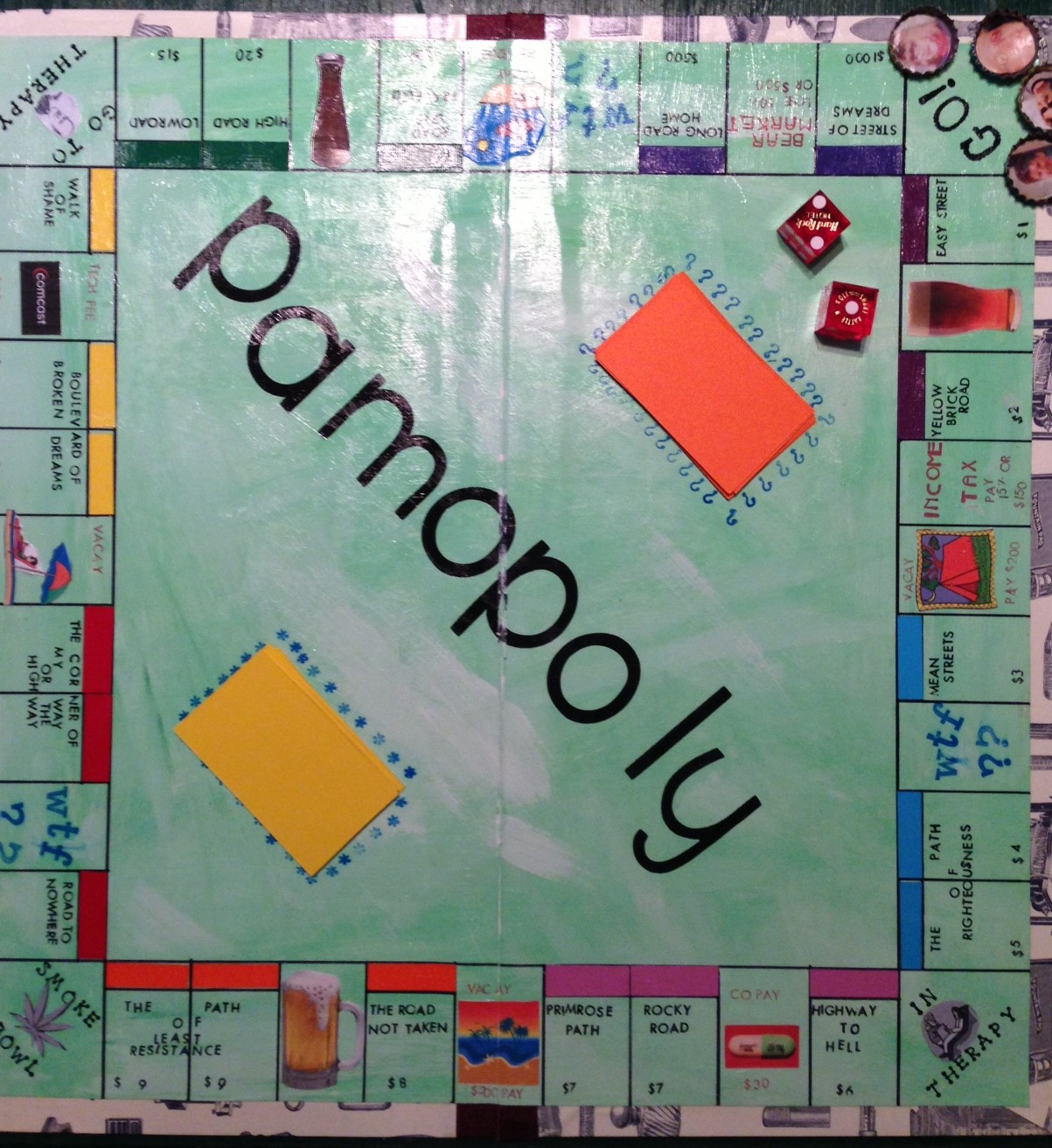
photo 1-1

Making books led me to learn how to make stamps, how to carve my own designs into a block, how to use ink and a roller to transfer the image onto whatever paper I wanted. I’ve made prayer flags for writers, books for friends and poets, for my kids, for my sweetie. I’ve made a game board for myself—Pamopoly—when I was feeling extremely stuck and creatively challenged in my writing. I’ve made art prints and pop up books whenever I am betwixt and between writing projects.pamopoly 2inrix

I’ve continued to write and to make books, though I’ve not yet combined the two. Perhaps that is next. After all, I have all of these haikus just hanging around.


DSC_0127

DSC_0125

tele


A is for Adoption

As I’ve written and rewritten this blog post, I’ve become hyper aware that mine may be a controversial stance and that I harbor very, very personal opinions on this topic. What is right for one family may not be right for another. I get that. I also need to disclose up front that I am the adoptive parent of two children who were born here in the United States. Both of my girls were adopted as infants through open adoptions. Both girls’ birth mothers chose my former partner and me to be the adoptive parents. Both of my children have reconnected with their biological families. In both cases, the birth fathers were out of the picture, though one of my children has a relationship currently with her biological father.

Also worth noting as relevant—my mother was adopted when she was three years old, and my parents adopted my little brother when he was an infant. Both of these adoptions were closed adoptions, meaning the records were sealed at the time of the adoptions and remain closed still.

Given my history with adoption, the fact that my families—both my family of origin and the family I later created with my former partner—would not exist without adoption, I have some strong feelings on the topic. To whit, whenever I hear about a couple’s struggle with infertility and how they are spending gazillions of dollars on in vitro and fertility treatments because they don’t want to consider adoption, my heart breaks a little. In my experience, people’s reasons for pursuing IVF vary, but generally fall into two camps: I want my own biological children and I’m afraid of losing my adopted child.

As a woman who never quite heard her own biological clock ticking, I’m the first to admit mine is not a very sympathetic response. As a mother who came to parenthood slantwise, my point of view is likely uncommon and perhaps unpopular. But, as a parent who, over the years, has worked very consciously to be a parent and to remain a parent in the face of some very daunting challenges, I think I have something valuable to add to the conversation.

First of all, having kids is a crapshoot. It doesn’t matter how they come into our lives. I think the single most important thing potential parents don’t realize is just how little control they will have once that child is conceived and/or born, bundled and placed in their arms. All bets are off. Who gets sick, who lives, who dies, who has disabilities, hidden or otherwise—there is no biological magic bullet that will protect you.

Second of all, children are not possessions with which we are to adorn our lives. Your dreams will not be their dreams; their achievements will not be yours. Their lives are their own. It doesn’t matter if they spring from your loins or from someone else’s—kids are individuals with every right to grow into themselves, whatever they may be, without unrealistic or narcissistic parental expectations, adopted or biological.

We seem to be smack in the midst of a sort of cult of childhood—our culture demands that we dote on our kids, lavish them with opportunities and options in ways our parents never dreamed of. I’m not sure where this urge comes from, but I suspect it springs from our own needs to be seen and doted upon. If our kids look like us, so much the better—it’s that much easier for us to infuse them with our own dreams and ambitions.

I’m not saying that adoptive parents don’t engage in this behavior, but I believe that some people may choose not to adopt because they can’t imagine investing themselves like that in a child that is not biologically theirs. And the world has plenty of children who need families, so it’s unfortunate, I think, that they are overlooked.

As for this notion that adoption is a process fraught with boogeymen who will at any moment demand the return of an adopted child, let me just say this—it’s not that common. In spite of the occasional heart wrenching media report (and very real heartbreak on the parts of all parents involved), the rise of open adoption in the past two and a half decades has gone a long way to deter adoption going off the rails.

I’ve also always been puzzled by adoptive parents who choose to go overseas to adopt. And one of the biggest reasons these folks give is that the chances of the birth parents coming for the kids is slimmer with international adoptions. Given that numbers of kids in this country who need homes, my bias is that we should start here, with our own kids first. And besides, if a birth parent changes his or her mind about placing their child for adoption, shouldn’t they have that right within a particular time frame? Don’t the birth parents deserve the dignity of an open adoption and ongoing communication with the adoptive family?

I have so much more to say on this topic, but it is going to be a long month of blog posts and I’m going to try to keep these things under 1000 words. The A to Z Challenge folks recommend 100-300 words, but I’m just not that good.

If you are considering adoption or want more info, check out these sites:

The Children’s Bureau

Administration for Children and Families

Open Adoption and Family Services

The End

And so ends a month of blogging (nearly) every day. Technically, according to the rules of the NaBloPoMo site we weren’t supposed to blog on the weekends, so considering that, I succeeded, I think in my commitment to blog every day this month.

Tomorrow begins a new challenge–blogging according to the alphabet, starting with a topic beginning with the letter A on April 1 and ending with a topic beginning with Z on the last day of the month (excluding Sundays). I’m still taking suggestions for topics . . . all will be considered.

Thanks for reading this month–looking forward to more anon.