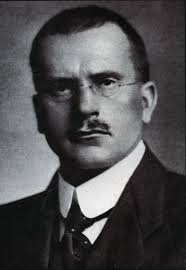
J is for Jung

jungGood Morning! I have a busy day ahead, so I thought that instead of writing something completely fresh, I would share with you the short paper I wrote on Carl Jung last quarter. Our assignment each week was to write a couple of paragraphs on the personality theorist of the week. We were to choose our favorite concept that theorist espoused and explicate it a bit and then we were to find an outside source that explains that concept and write a bit more about it.

My favorite Jung concept is transference. I’ve always wondered about how this concept works–and given the intimate nature of counseling or therapy, I’ve always suspected that transference is completely normal. How can a person not develop strong feelings towards someone with whom they share such intimate life details?

I found two articles in Psychology Today that I thought did a fantastic job of slicing through this tricky concept. I hope you’ll enjoy them as much as I did. Here’s my paper (Feist is the author of the text we read):

Favorite Jung Concept: Transference

Once concept that Feist touches on but doesn’t delve too far into with either Jung or Freud is the idea of transference. We first encounter the concept of transference with Freud, who believed that the “transference situation is vital to psychoanalysis” (Feist, p. 51). According to Freud, “transference refers to the strong sexual or aggressive feelings, positive or negative, that patients develop toward their analyst during the course of treatment.” Freud maintains that the therapist does nothing to earn the patient’s feelings; the patient was simply putting on the therapist the feelings the patient had toward his or her parents.  Like Freud, Jung believed that transference is a “powerful ally to the therapeutic process” (Feist, p. 51), but unlike Freud, he attributed transference, both positive and negative, as a natural outcome of the patients’ intimate revelations. It followed, Jung believed, that a patient would have strong feelings toward his or her therapist after revealing such personal information (Feist, 132). Jung encouraged his patients to see him as a savior or a god, according to Feist, as he guided them on their paths to wholeness and self-acceptance. Given that Jung had affairs with two of his patients, Sabina Spielrein and Toni Wolff, we can conclude that Jung might have seen himself as a bit more than merely a facilitator or guide on his patients’ journeys and did not do his own work to understand or overcome the pull of countertransference.

Outside Sources on Transference

While Feist doesn’t have much to say about transference with either Freud or Jung, quick research reveals a wealth of information. An article by Stephen A. Diamond in Psychology Today, http://bit.ly/1f0sfVh, takes a closer look at both Jung and Freud on this issue as well as at the concept of transference from a patient’s perspective. In a letter to Jung, Freud called psychoanalysis a love cure, and Diamond does a nice job of untangling how this “love cure” can work in therapy without crossing any moral or ethical boundaries. Therapy clients, Diamond asserts, come to therapy seeking to heal an unresolved “love wound,” looking for “acceptance or physical affection they never received from their [parents].” Therapists can heal this wound, not by entering in to an erotic relationship with clients, but by making “deliberate and proscribed use of love’s potent power to help patients heal . . . from being inappropriately loved.” Diamond acknowledges the difficulty inherent in providing the therapy patient with “a loving, supportive, caring, empathic, and non-judgmental” relationship that can truly help a client heal. Diamond also points out the importance of not denying the client’s strong feels when they do come up in a session, but to “honor and reflect” on the feelings without acting on them. For a client who has experienced trauma, large or small, around love, the therapist’s offering of a platonic love, according to Diamond, gives the patient an opportunity to respond “in kind . . . [t]o open up to love” with all of its risks and potential pitfalls. Handled properly, transference is, says Diamond, “the royal road into the very core of the love wound complex.”

TechTherapy for Writers and Other Anxious Folk

I’ve come up with a name and a tag line for my new business supporting writers and technology:  Tech Therapy for Writers and Other Anxious Folk. I’m building a website, too, which is more challenging than I thought it would be. The good news is that by the time the website is up and running, I’ll be excellent at building websites.

That’s the beauty about learning something and practicing it—the more we do it, the better we get, and the better we get, the more whatever it is becomes second nature. And I don’t mean that only the end result becomes easier to achieve. I have discovered that the process becomes more meaningful and profound as well—so much so that the process or practice becomes the focal point of the activity, sometimes eclipsing the product.

I’ve found this to be true with writing—by making a commitment to a haiku a day, I’ve gotten really good at writing them and not just at creating a 5-7-5 syllable poem, but at the craft: choosing the words, noticing the cadence, enjoying the sort of transcendent experience that the process evokes—that little daydream along the way, and more importantly, the connection with another person.

The same thing has happened with the daily blogs. At first, I thought coming up with something to write about everyday would be the biggest challenge, but really, the hardest part is trusting myself once I sit down to write—trusting that what I have to say will somehow connect with at least one other person. Learning to still the voices that tell me no one could possibly care what I think and trusting that place in my gut that reminds me we are all connected and that if I care about something, there are others who do as well.

So more than having a series of blogs at the end of this month, I’ll have an experience of having connected and the practice of connection—of the exchange with readers, the building of a community. And having that community makes the writing easier the next time. Synergy.

So, too, hopefully, it will be with websites and building a business that supports synergy and connection. I have to think that by focusing not just on the end result but on the process, the learning, and the craft we will all come away energized and engaged. And that’s what TechTherapy should be about.

p.s. if you’re interested in techtherapy, drop me a line at pamela.s.helberg@gmail.com

Happy Mothers’ Day: The Days My Therapist Promised

Fifteen years ago this week, I picked my eldest up from school. She arrived at my car sobbing, clutching what could only be a Mother’s Day art project, a gift wrapped with lots of construction paper, held together with even more scotch tape. When I asked her what was wrong, she explained between tears and hiccups that she only had time to make the one present. “But I have two mommies!” She whimpered. My heart broke into a million pieces. Gently, I took the gift from her hands and unwrapped it. It was a book. This was a problem easily solved. When I explained we could make a color copy, the relief on her face broke my heart all over again. We drove directly to Kinko’s.  “See,” I said, holding up an exact replica, “One for me. One for Mommy M.”

Mommy Pam's Hair and Necklace; Mommy M's Eyes and Earmuffs
Mommy Pam’s Hair and Necklace; Mommy M’s Eyes and Earmuffs

Seventeen years ago, I sat weeping in my therapist’s office, terrified that I had made the biggest mistake of my life, certain that my life as a mother was over.  I had just left my children, my partner and co-parent—my children’s other mother—had just moved out of our family home and into a tiny apartment, taking only my clothes, a CD player, and my 1964 Dodge pickup truck with its rusted out floorboards and no seatbelts. In a fit of youthful optimism I’d taken a job that would allow me to spend more time with our girls, keeping them out of daycare, a move that did not go over well with my co-parent. Long story short, she asked me to move out of the house, her house, launching us all into a long and painful custody battle. A war in which there would be no winners.

As I wept in that office, overwhelmed with despair, I could not visualize a way forward. I could not imagine life without my daughters, then six and two years old. We’d adopted both the girls as infants, first as single parents, then as a couple. We stood before the judge in the King County courthouse among family and friends and promised to be a forever family. Our names graced the birth certificates. Our little family seemed solid. I thought my decision to take job with more flexibility was the right one. My diminished salary would be made up in what we saved on daycare for our youngest and after school care for the oldest. We had worked so long and so hard to adopt the girls, had spent so many years dreaming this family into existence, it made no sense to me that we both worked full time and put the girls in daycare.

Full of bravado, and in spite of stern warnings from my partner, I had to follow my instincts as a mother. I had to do what I saw as the Right Thing. What did it get me?  No house. No relationship. No kids. I thought, naively it turns out, that being a legal mother of both girls would grant me the right to be a parent, at least half time. Not so. While heterosexual divorced couples with children automatically get kicked into a custody process, “divorced” lesbian mothers, at least in 1996, got nothing. There was no divorce because there had been no marriage. Our commitment ceremony, while a fun little ritual, had no legal ramifications. Really, all that seemed relevant at the time was the fact that I did not have my name on that house title. I had to move out. Having no legal access to the house meant I had no access to my kids. I had no idea when I left that my soon-to-be ex would bar me from seeing our kids, that once I was gone, she would attempt to erase me from their lives.

mothers day 5
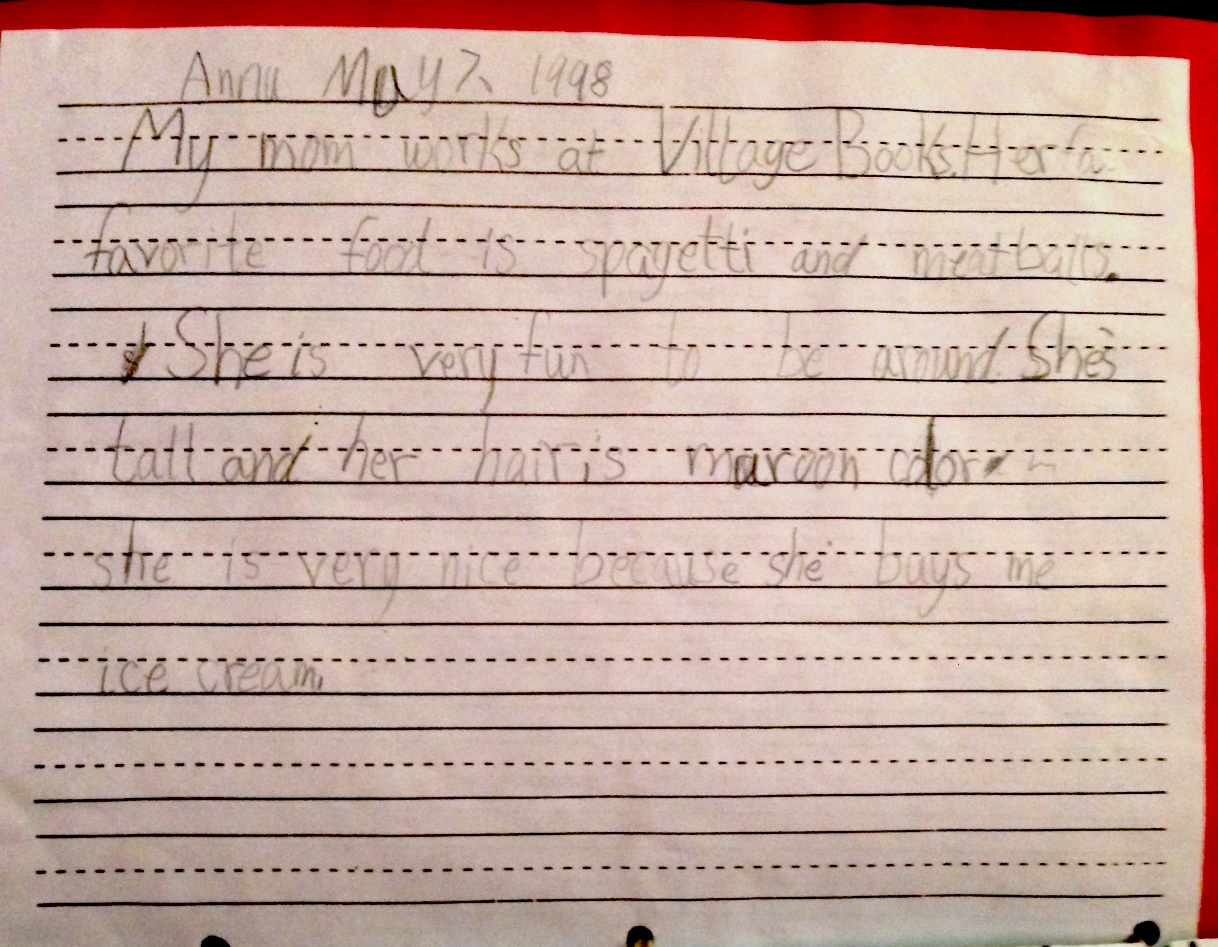
My mom works at Village Books. Her favorite food is spagetti and meatballs. She is very fun to be around. she’s tall and her hair is maroon color. She is very nice because she buys me ice cream.

My days suddenly silent, my nights stretched out empty, I spiraled into a deep depression. My identity as a mother slipped away. No diapers to change. No breakfast to make. No lunches to pack.  What was I, if I wasn’t a mother? Everything I had been, I’d given up in our pursuit to adopt our girls, to be in this relationship, to become a family. One social worker along the way even commended me for giving up on being a writer and getting a real job. I’d sold my bookstore. I had become a Mother, and I loved being a Mother so much that I wanted to spend more time with the girls. That love had led me to here. To nothing, it seemed. If I couldn’t be a mother, then maybe I shouldn’t be at all. I thought about moving away, just leaving town. I flirted with razor blades and alcohol. My therapist reminded me regularly and forcefully of the damage done to those left behind.

I decided to stay. In town and on the planet. I upped my antidepressants. I got a lawyer. I worked three jobs and went back to school. I found two housemates, asked my grandmother for an advance on my inheritance, and bought a house. I made a home. I fought to remain relevant in my daughters’ lives. Not one part of this journey was easy. Co-parenting with someone who would rather I just disappear, with someone who had to be court-ordered to share custody sucked, but it sucked so much less than not parenting at all. My legal and therapy bills grew enormous. When I cried and railed against the unfairness of my situation, my therapist told me how fortunate my children were to have me in their lives. When I couldn’t breathe because the initial child support payments I had to make were more than half my meager monthly salary, she helped me strategize a solution. When I despaired that I would have no meaning in, no impact on my daughters’ lives, she reminded me that they would come back to me, they would be in my life, maybe not the next week or the next month, but in a few years, when they were out of school, in their late teens and early twenties. Mothering meant showing up and reaching out, even when I didn’t think it would matter, even when no one reached back. Even when the next week, let alone the next decade, seemed impossibly far away.

But I did it. I showed up. At games. At concerts. At parent teacher conferences. Doctor’s appointments. Most of the time, I felt awkward because the teachers, the doctors, the other parents didn’t know I even existed. I had to show up at the school with the Parenting Plan in hand to get my name on my kids’ emergency contact list. I had to request I be added to the PTA’s little booklet with the kids’ and parents’ names, phone numbers, and addresses. Every year. I had to introduce myself to coaches, principals, other parents. Sometimes, I missed events because I found out about them too late or was too embarrassed to call other parents to ask. The last time I called the pediatrician’s office to get information about my daughter’s medications they hung up on me, refusing to give me information even though my youngest was still a minor, even though I had the paperwork granting me joint medical custody. I had to take the parenting plan to the pharmacy to find out what medicine my child was taking. Often, I felt like a fraud, an imposter. So many times I wanted to give up, to crawl away in shame. The depression and suicidal thoughts stayed with me for years.

Image
Getting Ice Cream at The Colophon Cafe

Still, I pressed through the fog and darkness. Even when I had to take a job 80 miles from home—I drove back three days a week, arriving in time to pick the kids up from school. I finagled time off. I found a way to be there. I got a MySpace Page. I got a Facebook page. I texted. I emailed. I called. I found a way. I made Easter baskets and bought Halloween treats, Valentines Day cards, swallowed my pride and left them on their front porch if I had to. And if my ex made other plans for Christmas Eve or Christmas Day, I had presents and stockings and dinner with the girls on December 23rd.  Because what day we spent together didn’t matter. First day of school? I showed up. The day my eldest left for college, I packed my mother in the car with me and we went along too. I refused to be erased.

And you know what? That decade passed and my girls are in my life. They finished high school. My eldest finished college. The youngest just started this year. These are the days my therapist promised. These are the days I couldn’t even imagine.

Happy Mothers’ Day.